
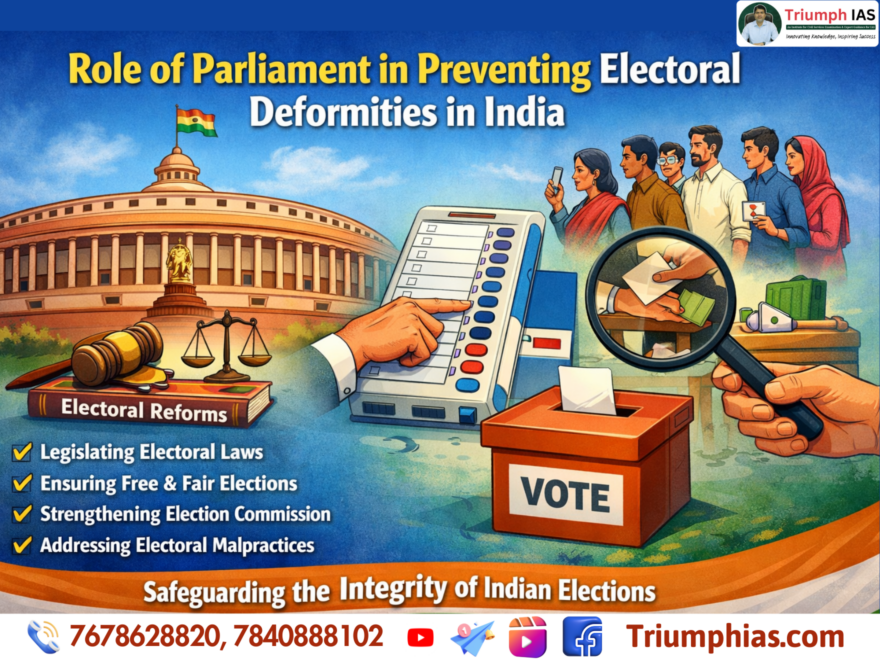
Role of Parliament in Preventing Electoral Deformities in India
(Relevant for Sociology Paper 2: Vision of Social Change in India and Politics and Society)
Role of ParliamentIndia, the world’s largest democracy, boasts an electoral system that involves millions of citizens casting votes to shape the future of the nation. While the election process is largely celebrated for its inclusivity and scale, electoral deformities such as Delimitation, One Nation One Election (ONOE), and Special Intensive Revision (SIR) of electoral rolls have started raising serious concerns. These measures, rather than strengthening electoral integrity, risk eroding the fairness and credibility of the democratic process. Understanding the Electoral Landscape in India:India operates under a parliamentary system, where elections are held periodically to elect representatives to the Lok Sabha (Lower House of Parliament) and State Assemblies. The Election Commission of India (ECI) is the constitutional body tasked with overseeing these elections. However, despite these structures, India faces growing concerns about the fairness of its electoral process. Issues like Delimitation, One Nation One Election (ONOE), and Special Intensive Revision (SIR) of electoral rolls threaten to undermine the core values of democracy, equality, and voter autonomy. Key Electoral Deformities and Concerns:
The Delimitation process involves redrawing constituency boundaries based on population. While this ensures that every constituency has roughly the same number of voters, it has the potential to distort the democratic balance. Why It’s a Concern:
Sociologists like Max Weber have emphasized how manipulation of state structures can lead to elite dominance. Gerrymandering could allow ruling elites to manipulate elections and control political power, further marginalizing opposition voices.
The proposal for simultaneous elections aims to streamline the process, reducing costs and administrative workload. However, ONOE could reduce local autonomy by focusing on national narratives while overshadowing local issues. Why It’s a Concern:
From a Marxist viewpoint, ONOE centralizes political power, reinforcing the control of the ruling national party. This diminishes the ability of regional or opposition parties to challenge the established political order, fostering electoral authoritarianism.
The Special Intensive Revision (SIR) of electoral rolls is designed to update voter lists, ensuring that new voters are added and duplicates are removed. However, there are concerns that this process can be manipulated, especially in states like Assam and Jammu & Kashmir, where minorities might be deliberately excluded. Why It’s a Concern:
Sociologist Émile Durkheim warned about the social disintegration that can occur when sections of society are excluded from the democratic process. If large sections of the population are denied their right to vote, it leads to alienation and undermines social cohesion. Global Context: Democracy Without Democrats India is not alone in facing concerns about electoral integrity. The concept of electoral authoritarianism—where elections remain technically intact but lose their substantive meaning—is a growing global phenomenon. The International IDEA’s Global State of Democracy report has flagged India for democratic backsliding, especially in areas like credible elections. What Should Parliament Do?Given these concerns, it’s clear that Parliament must step in to ensure the health of India’s electoral system. Here are the key actions Parliament should take to prevent electoral deformities and preserve the integrity of India’s democracy:
Conclusion: Safeguarding India’s Electoral IntegrityIndia’s electoral democracy is a cornerstone of its constitutional ethos, but recent reforms have cast doubts on the fairness and inclusivity of the system. Parliament has a pivotal role to play in ensuring that these reforms do not distort the democratic process. By focusing on fair representation, state autonomy, and electoral inclusivity, Parliament can prevent electoral deformities and ensure that the democratic process remains transparent, credible, and truly representative. As Max Weber argued, legitimate authority in democratic systems comes from fair and transparent processes that respect the autonomy of all citizens. Only through effective reforms and accountability mechanisms can India ensure that its democracy remains strong and inclusive for all. |
To Read more topics, visit: www.triumphias.com/blogs
Read more Blogs:
Bridging the AI Divide: A Sociological Perspective on Inclusive AI Adoption in the Asia-Pacific
Towards an Inclusive India: A Sociological Perspective on Disability Rights and Empowerment
One comment