

Rituals, Habits, and Social Norms: A Sociological Exploration
(Relevant for Sociology Paper 1: Sociological Thinkers)
|
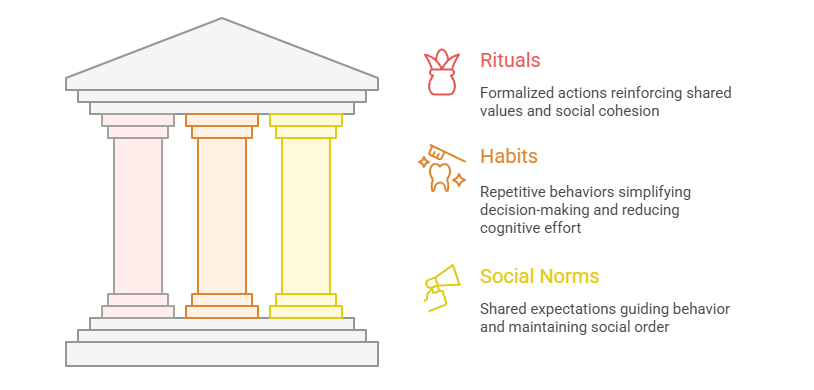
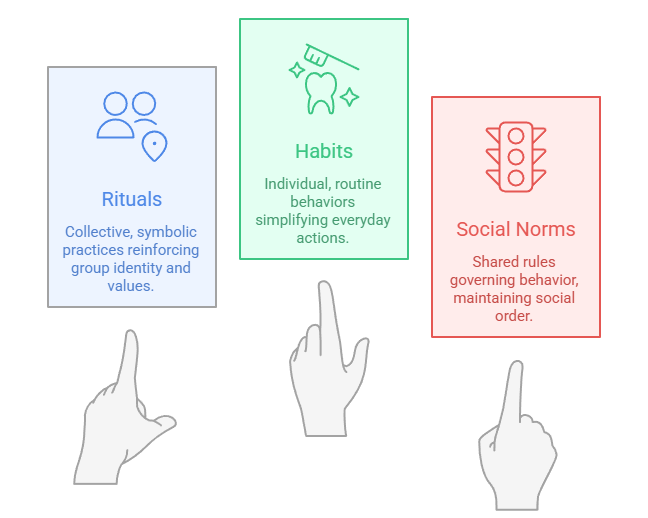
Human behavior is structured and patterned through various mechanisms that guide everyday actions. Among these, rituals, habits, and social norms are key concepts that sociologists analyze to understand how societies regulate conduct, transmit culture, and maintain social order. Though often used interchangeably in common discourse, these terms have distinct sociological meanings and functions. Defining Rituals, Habits, and Social Norms
Sociological Perspectives
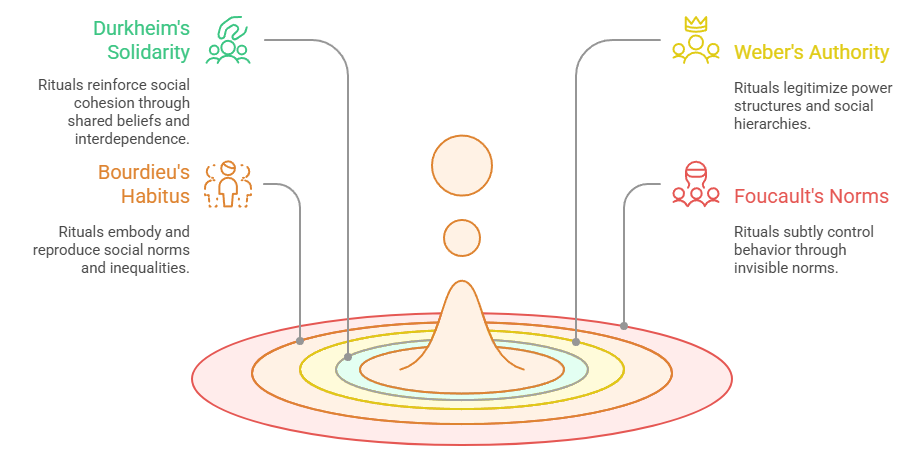
Émile Durkheim: Rituals and Social Solidarity Durkheim viewed rituals as foundational to social solidarity. He distinguished between mechanical solidarity (social cohesion in traditional societies based on similarity) and organic solidarity (cohesion in modern societies based on interdependence). Rituals in traditional societies reinforce mechanical solidarity by affirming shared beliefs and collective identity. Religious ceremonies, festivals, and rites of passage exemplify this process. Max Weber: Authority and Ritual Weber connected rituals to forms of authority. Traditional authority relies heavily on ritualized practices to legitimize power, such as caste ceremonies or royal rites. Charismatic and legal-rational authorities also use ritual to stabilize their legitimacy. Weber’s analysis reveals how ritual not only symbolizes but reproduces social hierarchies. Pierre Bourdieu: Habitus and Symbolic Power Bourdieu’s habitus concept bridges habits and social norms, arguing that social structures are embodied and reproduced unconsciously through everyday practices. Habitus guides perceptions and behaviors consistent with one’s social position. Habits, thus, are not just personal quirks but reflect underlying social inequalities. Bourdieu’s notion of symbolic power explains how dominant cultural norms become accepted as legitimate, influencing tastes, manners, and even speech patterns. Michel Foucault: Norms as Disciplinary Power Foucault shifted the focus to the power embedded in norms. He conceptualized modern power as disciplinary, operating through surveillance, normalization, and self-regulation. Norms function as “regimes of truth” that define normality and deviance, shaping identities and controlling populations subtly. Unlike formal laws, norms are often invisible but effective in regulating conduct. Differentiating the Concepts
Interconnections and Social FunctionsThough distinct, these three are interrelated:
Together, they contribute to the stability of social life by shaping behavior, sustaining culture, and regulating interactions. ConclusionUnderstanding rituals, habits, and social norms through a sociological lens reveals how human behavior is both structured and structuring. These concepts explain how societies maintain continuity, reproduce inequalities, and negotiate change. The perspectives of Durkheim, Weber, Bourdieu, and Foucault provide a comprehensive framework to analyze these phenomena. For sociologists and students alike, distinguishing between these concepts is vital for decoding the complexities of social order and individual agency. |
To Read more topics, visit: www.triumphias.com/blogs
One comment