Introduction: Neo Middle Class in India
The term Neo Middle Class refers to a socio-economic group that has recently risen above poverty but has not yet attained stable middle-class status. This class is characterized by aspirations for better education, employment, healthcare, and consumer goods, yet remains vulnerable to economic shocks. In the Indian context, this group has gained prominence post-liberalization and is central to the narrative of India’s demographic and economic transformation.
Socio-Economic Background
According to the National Council of Applied Economic Research (NCAER), the neo middle class includes individuals earning just above the poverty line but lacking the economic security of the established middle class. This class expanded significantly after India’s economic liberalization in the 1990s and has become a focal point in policy, electoral politics, and marketing strategies.
Key Characteristics
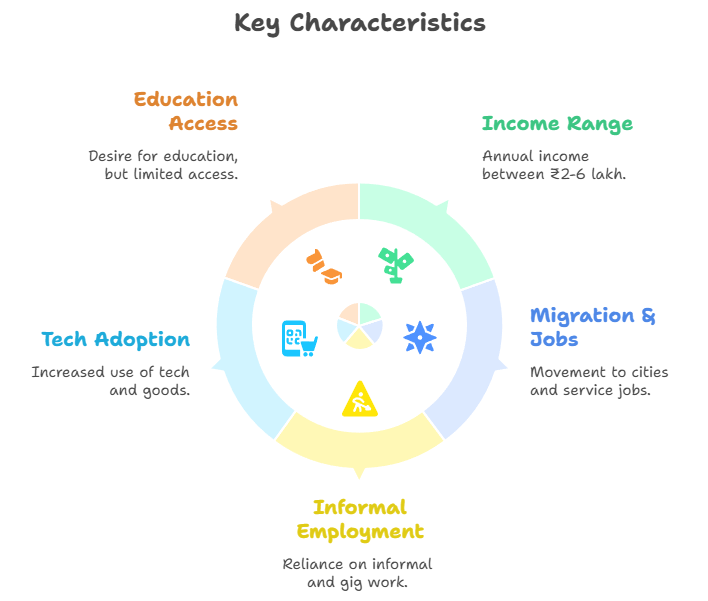
- Income range: ₹2 to ₹6 lakh annually
- Urban-rural migration and service sector jobs
- Dependency on informal employment and gig economy
- Rapid adoption of digital technology and consumer goods
- High educational aspirations but limited access
Sociological Analysis

- Class Mobility and False Consciousness: While Marx viewed the working class as exploited under capitalism, the neo middle class reflects a complex shift — neither proletariat nor bourgeoisie. Their consumer choices create a false consciousness, making them believe they’ve achieved class success, while still facing structural vulnerabilities.
- Life Chances and Status: Weber’s idea of life chances helps us understand how the neo middle class navigates social mobility. They have better access to goods and education than the poor, but not enough social capital or job security to consolidate their status.
- Habitus and Cultural Capital: Bourdieu’s concepts explain how this group adopts middle-class habitus— tastes, language, and consumption—without fully belonging to the elite due to lack of cultural capital. For instance, English-medium education is pursued but quality remains poor.
- Inequality in Modern India: Béteille’s focus on structural inequalities shows how caste, class, and education intersect in shaping the neo middle class’s journey. Many in this class belong to backward castes and face discrimination despite economic mobility.
Recent Trends and Data
- NSSO data shows that over 40 crore Indians are in the ‘vulnerable non-poor’ category—a proxy for the neo middle class.
- ILO (2023) reports suggest gig workers, many from this class, lack social protection.
- UPI & Digital India: Rapid digital inclusion has connected the neo middle class to global consumption trends.
Policy Implications and Government Schemes
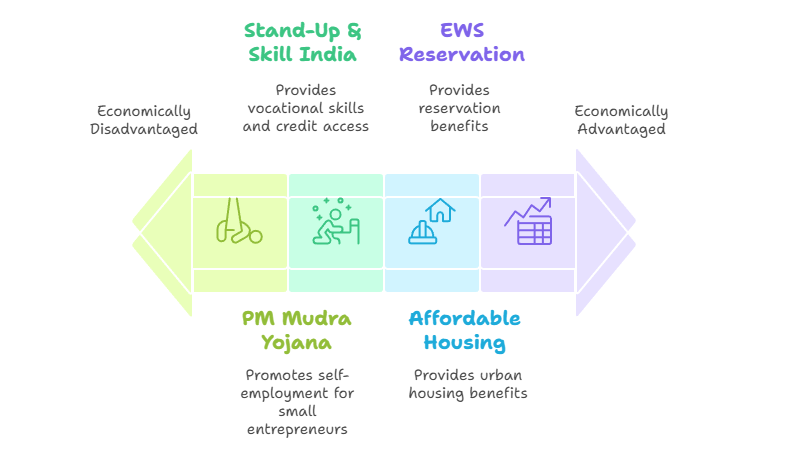
- PM Mudra Yojana – Encourages self-employment among aspiring small entrepreneurs.
- Stand-Up India & Skill India – Targets this group’s need for vocational skills and credit access.
- EWS Reservation (10%) – Aimed at economically weaker sections of upper castes, many of whom belong to this class.
- Affordable Housing Schemes – Neo middle class are key beneficiaries of urban housing drives.
Challenges Ahead
- Economic Vulnerability: Job loss or health crises can push this group back into poverty.
- Social Identity Crisis: Struggle to gain recognition from both lower and upper classes.
- Political Populism: This class is often swayed by aspirational politics and targeted welfare schemes.
Conclusion
The neo middle class in India is not just an economic category but a sociological phenomenon reflecting aspiration, precarity, and transition. Understanding their rise is crucial for policymakers and sociologists alike. Analyzing this class offers insights into modern India’s class dynamics, social change, and development debates.
PYQs
Paper 1
- Discuss the factors responsible for the emergence of new middle classes in developing societies. (2014)
- How does globalization impact the structure of social stratification in developing societies? (2018)
- Explain the concept of‘status anxiety’ in modern societies. How does it affect class consciousness? (2020)
- How does digital technology create new forms of class distinction in urban India? (2020)
- Analyze the relevance of Pierre Bourdieu’s theory of ‘habitus’ in understanding lifestyle and consumption in middle-class India. (2021)
- Explain the concept of ‘aspirational class’. How is it different from the traditional middle class? (2022)
Paper 2:
- Write a note on the emergence of the new middle class in India. (2014)
- Explain how economic liberalization has led to new patterns of inequality in Indian society. (2018)
- Examine the role of digital media in shaping aspirations and consumption patterns among the neo middle class in India. (2021)
- How do welfare schemes like MUDRA Yojana and Jan Dhan Yojana contribute to the growth of the neo middle class? (2023)
- How does migration contribute to the growth of the neo middle class in India? Support with examples. (2023)
|




One comment