Introduction
The reserve army of labour is a foundational concept in sociology and economics, particularly within Marxist theory. Coined by Karl Marx, this term refers to the pool of unemployed and underemployed workers who are available to be hired when needed. This concept is crucial for understanding labour market dynamics, unemployment trends, and the changing nature of work—especially in countries like India. For UPSC aspirants, the reserve army of labour has direct relevance to topics such as unemployment, informal sector growth, rural-urban migration, and labour reforms.
What is the Reserve Army of Labour?
The reserve army of labour (also called the “industrial reserve army” or “surplus labour force”) describes the group of workers who are either unemployed or underemployed and can be drawn into the workforce as demand rises. According to Karl Marx, the existence of this “army” allows capitalists to keep wages low, exert control over workers, and maintain the capitalist system.
Key Points
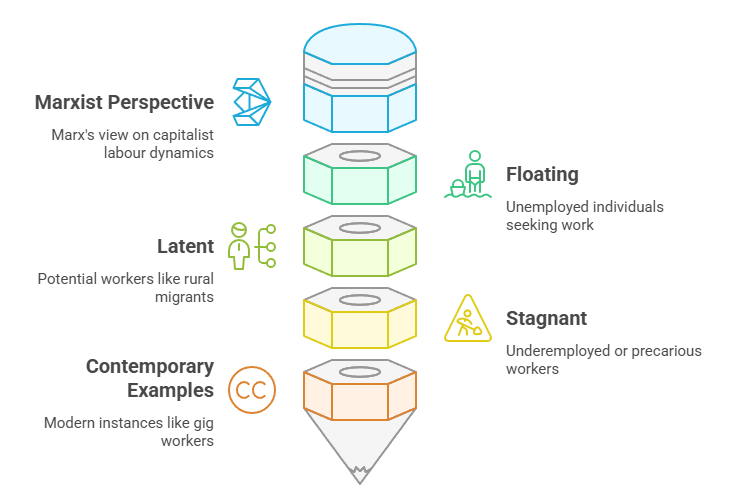
- Marxist Perspective: Marx argued that the capitalist system always maintains a surplus of labour to discipline the workforce and maximize profits.
- Types of Reserve Army: Marx identified different layers—floating (unemployed), latent (potential workers such as rural migrants), and stagnant (underemployed or precarious workers).
- Contemporary Examples: Gig economy workers, contract employees, and daily wage labourers in India represent the modern reserve army.
Indian Context
India’s labour market is characterized by large-scale unemployment, informal sector dominance, and frequent labour migration—making the reserve army of labour especially relevant.
Real-Life Illustration: During the COVID-19 lockdown, millions of migrant workers lost their jobs and returned to villages, highlighting the vulnerability and expendability of the reserve army of labour in India.
Sociological Analysis
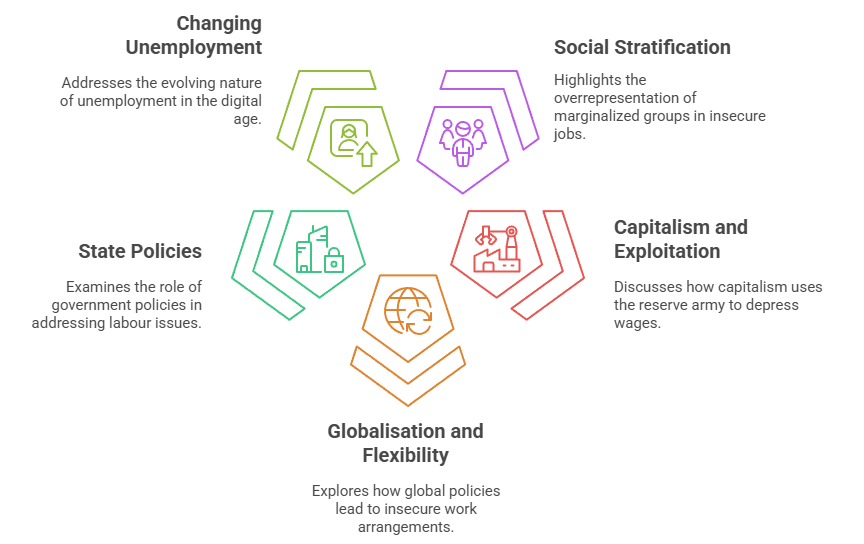
- Social Stratification and Inequality: The reserve army is not homogenous; it is marked by caste, gender, and class divisions. Women, Dalits, Adivasis, and minorities are overrepresented in the informal sector and face heightened job insecurity.
- Capitalism and Labour Exploitation: According to Marx, a large reserve army depresses wages and increases exploitation. Contemporary sociologists like Guy Standing discuss the rise of the “precariat”—a new class characterized by unstable jobs and lack of social rights.
- Globalisation and Labour Flexibility: Neoliberal policies and global value chains have led to increased casualization of work. Outsourcing, contractualization, and gig platforms (like Zomato, Uber) create a flexible yet insecure workforce.
- State Policies and Social Mobility: Policies like MGNREGA aim to absorb surplus labour and provide a safety net, but implementation gaps often persist.
- Changing Nature of Unemployment: Unemployment today is not just about lack of jobs, but also about poor job quality, underemployment, and informalisation—expanding the scope of the reserve army in the digital era.
Conclusion
The reserve army of labour remains central to understanding India’s socio-economic landscape and labour market policies. For Sociology, it is a critical concept that links theory with contemporary realities like informalisation, unemployment, migration, and labour reforms. As India navigates the challenges of jobless growth, digital disruption, and economic restructuring, the relevance of this Marxian concept continues to grow—offering rich material for both academic study and public policy debates.
PYQs
Paper 1:
- Examine the process of informalization of labour in developing societies. What are its implications for social structure? (2021)
- Discuss the significance of the informal sector in the Indian economy. How does it relate to the concept of ‘reserve army of labour’? (2020)
- Explain Marx’s concept of ‘reserve army of labour’. How is it relevant in contemporary society? (2018)
Paper 2:
- Discuss the impact of the COVID-19 pandemic on migrant labourers in India. What does this reveal about the nature of the Indian labour market? (2021)
- How has rural-urban migration contributed to the expansion of the reserve army of labour in Indian cities? (2019)
- Analyse the challenges faced by labour in the unorganized sector in the context of liberalization and globalization. (2019)
- Evaluate the effectiveness of MGNREGA in addressing rural unemployment and surplus labour in India. (2017)
- How does the feminization of labour affect the reserve army of labour in India? (2016)
- Discuss the phenomenon of jobless growth in India and its social implications. (2015)
|

One comment