Introduction
In the discourse of labor, the focus often rests on paid, productive work within formal economic sectors. However, reproductive labor, an indispensable foundation of social and economic functioning, often remains invisible, undervalued, and gendered. This form of labor includes domestic chores, caregiving, child-rearing, emotional support, and other activities that sustain the daily and generational reproduction of the workforce.
What is Reproductive Labor?
Reproductive labor refers to the unpaid or low-paid work that reproduces labor power for the capitalist economy. It includes:
- Childcare and eldercare
- Cooking, cleaning, and laundry
- Emotional care and socialization of children
- Managing household consumption and budgeting
- Sexual and emotional labor within households
This form of labor is typically performed by women, often taken for granted, and excluded from national income accounting systems such as GDP.
Historical Background and Evolution
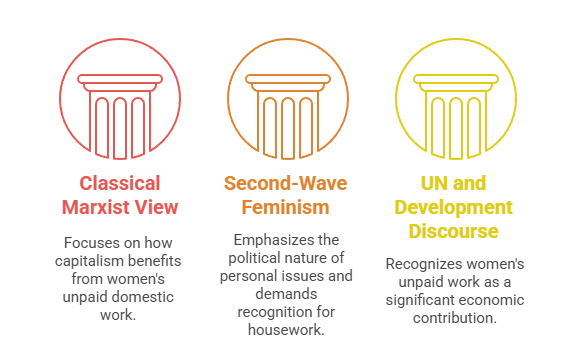
- Classical Marxist View:
Karl Marx did not extensively focus on reproductive labor, but later Marxist feminists like Silvia Federici, Angela Davis, and Mariarosa Dalla Costa expanded his ideas to explain how capitalism thrives on women’s unpaid domestic labor.
“They call it love, we call it unpaid labor.” – Silvia Federici
- Second-Wave Feminism (1960s–80s):
Feminists demanded that “the personal is political.” The Wages for Housework campaign initiated in the 1970s asserted that housework should be recognized as productive labor.
- UN and Development Discourse:
Organizations like UNDP and ILO began incorporating the idea of “care economy”, recognizing women’s unpaid work as a form of economic contribution.
Sociological Analysis
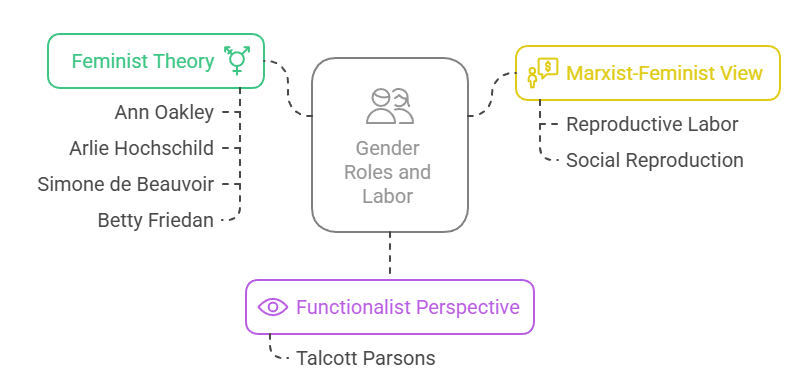
- Feminist theory
- Ann Oakley was one of the first sociologists to examine housework as real work. She showed how domestic labor is structured, repetitive, and isolating.
- Arlie Hochschild introduced the concept of “emotional labor”, especially in dual-income households where women performed a “second shift” after their paid jobs.
- Simone de Beauvoir and Betty Friedan highlighted how women’s identities are confined to their roles as mothers and wives in patriarchal systems.
- Functionalist Perspective
- Talcott Parsons justified gender division of labor where men took the instrumental role (breadwinners) and women the expressive role (homemakers), which feminist scholars critique as legitimizing unpaid domestic labor.
- Marxist-Feminist View
- Reproductive labor subsidizes capitalism by reproducing and maintaining the labor force without direct wage compensation.
- It lowers the cost of labor for capitalists and helps sustain social reproduction across generations.
Reproductive Labor in Indian Context
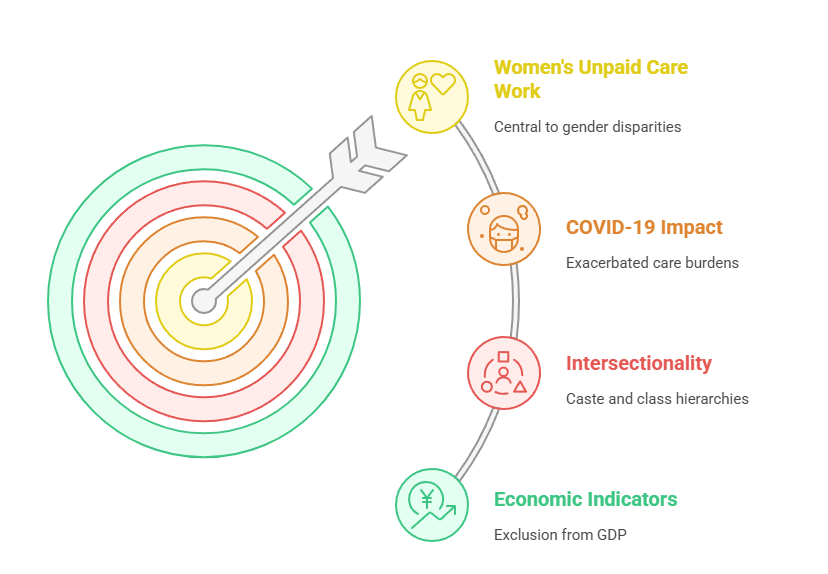
- Indian Census and National Accounts
India’s National Statistical Office (NSO) and Time Use Surveys (TUS) reveal that:
- Women spend 5–6 times more hours on unpaid domestic and caregiving work than men.
- This labor is not counted in the GDP or national economic indicators.
- Impact of COVID-19
During the pandemic:
- The burden of care on women increased drastically.
- School closures and eldercare became women’s unpaid responsibility.
- Women in the informal sector had to balance wage work with domestic work, resulting in burnout and withdrawal from the labor force.
- Intersectionality in India
- Caste and class intersect with gender. Middle- and upper-class women outsource reproductive labor to domestic workers, often Dalit or Adivasi women, perpetuating hierarchies within care work.
- Live-in domestic workers and ayahs are part of the informal economy, with no social security.
Global Examples:
- Nordic countries (Sweden, Norway) provide universal childcare and paid parental leave, recognizing reproductive labor.
- The ILO’s Decent Work Agenda includes unpaid care work as central to achieving gender equity.
Indian Government Initiatives:
| Scheme/Policy |
Focus Area |
| National Crèche Scheme |
Childcare for working women |
| Maternity Benefit Act |
Paid maternity leave |
| PM Matru Vandana Yojana |
Cash incentive for maternal care |
| Gender Budgeting |
Track public expenditure on women’s welfare |
Yet, most of these policies focus on maternal health rather than recognizing domestic labor as a formal economic contribution.
Key Debates
In Favor of Recognition
- Economic Inclusion: Recognizing unpaid domestic work in national accounts could reshape development metrics.
- Gender Justice: Pay equity and visibility of women’s labor will empower them socially and economically.
- Redistribution of Work: Encourages shared domestic responsibilities between men and women.
Criticisms & Concerns
- Quantification Challenges: How do you measure emotional or relational work?
- Reinforcing Gender Roles: Monetizing housework may further confine women to domestic spaces.
- State Responsibility Shift: May let the state off the hook in providing public childcare and care services.
Case Studies & Examples
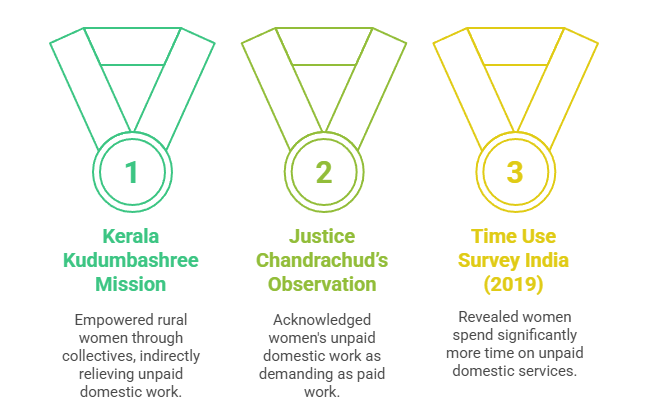
Case 1: Kerala Kudumbashree Mission
Empowered rural women through collectives and provided livelihood support, indirectly relieving them from some aspects of unpaid domestic work.
Case 2: Justice Chandrachud’s Observation
In a 2021 Supreme Court judgment, Justice D.Y. Chandrachud noted:
“The labour which is done by women in taking care of their families and household is no less and often more demanding than paid work.”
Case 3: Time Use Survey India (2019)
- Women spend 299 minutes/day on unpaid domestic services vs men’s 97 minutes/day
- Women spend 134 minutes/day on unpaid caregiving vs men’s 76 minutes/day
Way Forward
- Policy Inclusion:
Integrate reproductive labor in GDP estimation, census data, and labour surveys.
- Incentivize Shared Labor:
Promote paternity leave, workplace flexibility, and male sensitization programs.
- Invest in Social Infrastructure:
Public childcare centers, eldercare homes, and community kitchens can reduce the burden on individual households.
- Support Domestic Workers:
Enact and enforce legislation ensuring fair wages, rest time, and social security for care workers.
Conclusion
Reproductive labor, though historically hidden in the shadows of economic discourse, forms the backbone of society. It sustains not just families, but the entire workforce. Recognizing and valuing this labor is essential for achieving gender equity, economic justice, and inclusive development. For UPSC aspirants, understanding the sociological nuances of reproductive labor is critical for addressing contemporary issues of work, gender, and policy reforms in India.
PYQs
Paper I
Is unpaid domestic labor a form of exploitation? Examine from a Marxist and Feminist perspective. (2022)
Paper II
Discuss the gendered division of labor in the context of Indian society. (2023) |