Introduction: Religious Revivalism in Modern Society
In the age of rapid globalization, scientific advancement, and digital interconnectedness, one might expect religion to recede in influence. However, the opposite trend—religious revivalism—is increasingly visible across the globe. This refers to a renewed interest in religious beliefs, rituals, and institutions, often accompanied by a return to traditional or fundamentalist values.
Why Recently in News?
In India and globally, religious revivalism has become a significant force influencing identity, politics, social movements, and inter-group relations. Understanding this phenomenon is crucial under topics like Religion and Society, Social Change, Communalism, and Fundamentalism.
Sociological Analysis
- Émile Durkheim viewed religion as a fundamental institution that creates collective consciousness and moral regulation. In times of social uncertainty or rapid change—as seen in the era of globalization and neoliberal reforms—people often return to religion to regain a sense of belonging and moral direction. Religious revivalism, in this sense, serves a stabilizing function in modern society.
- Max Weber’s work on theodicy and the Protestant ethic provides insight into how religious revivalism can fuel both spiritual and economic motivations. In modern capitalist societies marked by inequality and disenchantment, people may return to religion for existential explanations and spiritual security. Revivalist movements also often promote discipline, moral conduct, and identity consolidation, as seen in various neo-Hindu, Islamic, and Evangelical Christian movements.
- Antonio Gramsci’s idea of cultural hegemony helps explain how religious elites may use revivalism to maintain ideological control over society. In many cases, revivalist narratives are used to mobilize political support, preserve traditional hierarchies, and resist liberal or secular influences—particularly in India, where religious nationalism has grown.
- Anthony Giddens argues that modernity brings uncertainty and existential risk. In such a world, religious revivalism emerges as a reaction to the insecurity brought about by technological change, rapid urbanization, and erosion of traditional communities. People seek refuge in religion as a source of emotional security and identity.
Religious Revivalism in India:
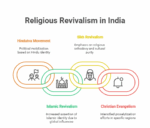
- Hindutva Movement: The rise of political Hinduism, or Hindutva, is a key example of religious revivalism where religious identity is central to political mobilization.
- Islamic Revivalism: Global and local factors, including the influence of Gulf-based ideologies and social media, have led to increased Islamic identity assertion in parts of India.
- Sikh Revivalism: Post-1984 and in response to marginalization, segments of the Sikh community have emphasized religious orthodoxy and cultural purity.
- Christian Evangelism: In parts of Northeast and tribal regions, Christian groups have intensified proselytization efforts, often leading to tensions with local faiths.
Why Is Religious Revivalism Gaining Ground Today?
- Globalization and Identity Crisis: As traditional communities dissolve under urbanization and globalization, individuals seek religious identity to regain a sense of belonging.
- Rise of Majoritarian Politics: In several democracies, religious identity is increasingly used for political consolidation and electoral gains.
- Social Media and Digital Proselytization: Platforms like YouTube and WhatsApp have become tools for spreading revivalist messages.
- Resistance to Westernization: Religious revivalism is often a cultural reaction to perceived Western values such as liberalism, consumerism, and secularism.
- Insecurity and Inequality: Economic deprivation, migration, and social exclusion often push marginalized communities toward religion for emotional and material support.

Implications of Religious Revivalism in Modern Society
Positive Effects:
- Fosters community solidarity and cultural preservation
- Revives traditional art, music, and values
- Provides emotional and moral support
Negative Effects:
- Intensifies communal conflict and sectarian violence
- Reinforces patriarchal and caste-based structures
- Undermines secularism and pluralism
- Leads to moral policing and regressive social norms
Case Studies
- Ayodhya Verdict (2019): Reflected religious sentiments shaping legal decisions.
- Hijab Row in Karnataka (2022): Showcased how religion intersects with education, gender, and law.
- Religious Conversion Laws: Various states have passed laws targeting religious conversion, reflecting the tension between secularism and religious revivalism.
- Cow Vigilantism: A religiously charged practice that shows how revivalism can take vigilante forms.
Conclusion
Religious revivalism is not merely a spiritual resurgence—it is deeply entwined with politics, identity, and social transformation. From a sociological lens, it reflects both the continuity of tradition and the crisis of modernity. Understanding the causes and consequences of religious revivalism is essential to critically analyze the changing dynamics of Indian society and the challenges it poses to secularism, social harmony, and inclusive development.
PYQs
Paper I
- Discuss the role of religion in the contemporary world. Do you agree with the view that the influence of religion on society is declining in the wake of modernity? (2016)
- How does Weber’s Protestant ethic thesis explain the relationship between religion and capitalism? Is it applicable to non-Western societies? (2017)
- How do fundamentalist movements emerge? Discuss with reference to the sociological perspective. (2018)
- Examine the relationship between religion and politics in the context of Max Weber’s sociology. (2019)
- Examine the relevance of Durkheim’s theory of religion in understanding the role of religion in contemporary society. (2020)
- Critically examine the concept of ‘Sacred’ and ‘Profane’ in Durkheim’s sociology of religion. How relevant is it today? (2021)
- Assess the contemporary relevance of religion in shaping social behavior and identity. (2023)
Paper II
- Explain the sociological significance of religious movements in post-independent India. (2014)
- Evaluate the impact of religious revivalism on secularism in India. (2015)
- Discuss the interface between religion and politics in India. To what extent does religion influence political behavior in contemporary India? (2017)
- Examine the role of religious minorities in the context of Indian democracy. (2018)
- Discuss the nature and causes of religious fundamentalism in India. (2020)
- Examine the impact of globalization on the religious practices of Indian society. (2021)
- How does the caste system intersect with religion to affect social dynamics in India? (2022)
- Discuss the emergence of religious nationalism in contemporary India. (2023)
|



The discussion on AI as both a creativity enabler and a potential threat to human originality really stood out. I’m curious how our education systems are evolving to help future generations balance innovation with authentic creative thinking.