
Rejuvenating Forest Ecosystems for a Sustainable India
(Relevant for GS paper-3, Environment and Ecology)
Introduction: Rejuvenating Forest EcosystemsForests play a vital role in maintaining ecological balance, supporting livelihoods, and combating climate change. In India, forests are not just a source of biodiversity but also integral to the cultural and economic well-being of millions. However, with rising developmental pressures and climate challenges, revitalizing forests has become essential for ensuring sustainable growth. This blog explores India’s efforts, challenges, and strategies to revitalize its forest ecosystems. Forest Resources in India: Current Status
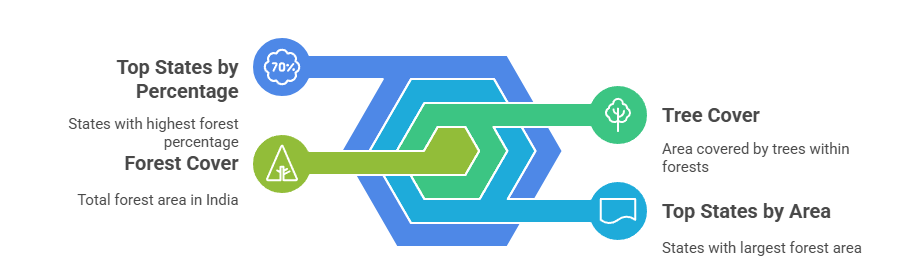
As per the India State of Forest Report (ISFR) 2023, India’s total forest and tree cover stands at 80.73 million hectares, which is 24.62% of the country’s geographical area.
Importance of Forests in India
Government Initiatives for Forest Revitalization
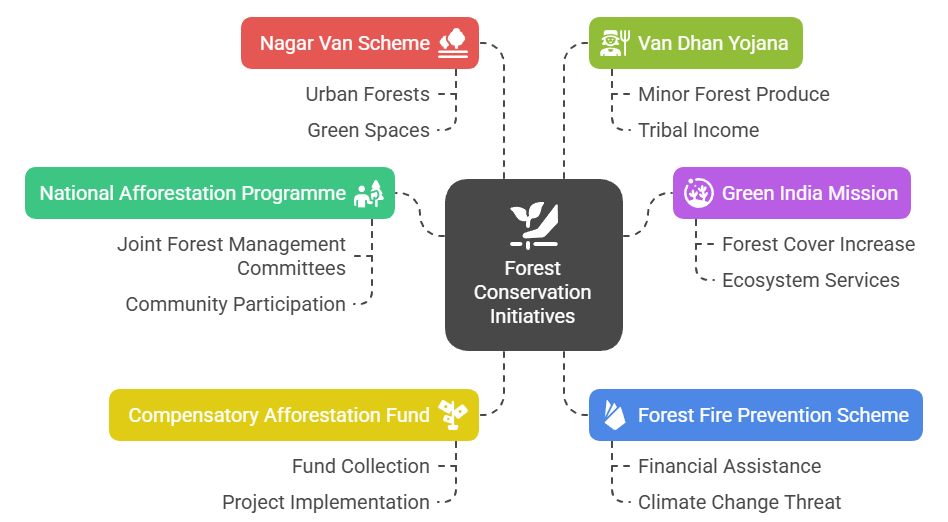
Launched in 2000, the NAP focuses on reforestation of degraded forests through Joint Forest Management Committees (JFMCs), encouraging local community participation.
Part of the National Action Plan on Climate Change (NAPCC), GIM aims to increase forest/tree cover by 5 million hectares and improve the quality of another 5 million hectares of degraded forests. The mission also targets ecosystem services enhancement and biodiversity conservation.
CAMPA, operationalized since 2016, collects funds from industries diverting forest land for non-forest purposes. As of 2024, more than ₹60,000 crore has been accumulated for afforestation and forest restoration projects.
Implemented by the Ministry of Environment, Forest and Climate Change (MoEFCC), this scheme provides financial assistance to states for fire prevention, an increasing threat due to climate change.
Launched in 2020, the scheme aims to develop 200 urban forests across India, enhancing green spaces in urban centers.
Focused on adding value to Minor Forest Produce (MFP) collected by tribal communities, the scheme strengthens their incomes while promoting sustainable forest use. Recent Developments and Achievements
Challenges in Forest Revitalization
Way Forward: Revitalizing Forests
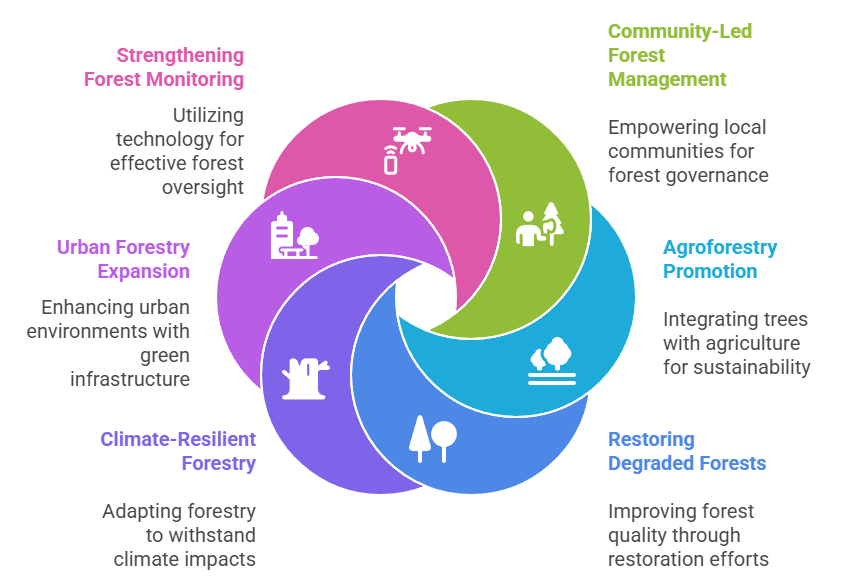
Empowering Gram Sabhas under the Forest Rights Act (2006) can improve local forest governance and protection. Participatory forest management ensures accountability and sustainable use.
Integrating trees with agricultural systems can increase green cover, enhance farmer incomes, and reduce pressure on natural forests. The Sub-Mission on Agroforestry supports this initiative.
Prioritizing forest quality improvement through indigenous species plantation, soil moisture conservation, and invasive species control is crucial for ecosystem restoration.
Adopting adaptive forestry techniques, including climate-resilient species and sustainable silviculture practices, is essential in the wake of rising climate impacts.
With increasing urbanization, promoting urban forestry, rooftop gardens, and green infrastructure can mitigate urban heat island effects and improve urban air quality.
Expanding real-time forest monitoring using drones, AI, and satellite technology can enhance transparency and effectiveness of afforestation programs. ConclusionRevitalizing India’s forests is pivotal to achieving sustainable development, biodiversity conservation, and climate resilience. With proactive policy measures, community participation, and technological interventions, India can restore and enhance its forest wealth. A balanced approach focusing on both ecological sustainability and socio-economic well-being is the need of the hour to secure a greener, healthier future for the nation. |
To Read more topics, visit: www.triumphias.com/blogs
One comment