
Reimagining Agriculture: Technology, Power, and Social Transformation in Rural India
(Relevant for Sociology Paper 1 and 2: Social change in Modern Society and Rural and Agrarian transformation in India)
Introduction: Agriculture at the Crossroads of Social and Technological ChangeIn India, agriculture is not merely an economic activity—it is a deeply social institution that shapes family structures, gender roles, and rural hierarchies. Yet, the sector today stands at a historical turning point. The release of NITI Aayog’s “Reimagining Agriculture: Roadmap for Frontier Technology-Led Transformation” (2025) signals a new era where algorithms, data, and biotechnology are poised to redefine what it means to be a farmer. The report’s emphasis on frontier technologies—AI, IoT, drones, and biotechnology—represents more than a technical shift; it is a social transformation of knowledge, identity, and power in rural India. From a sociological perspective, this roadmap invites us to question: How does technology reshape agrarian relations, digital inclusion, and rural modernity? Frontier Technologies and the Sociological Reimagining of FarmingThe report outlines a move from input-intensive to innovation-driven agriculture, envisioning an intelligent, data-driven ecosystem through the Digital Agriculture Mission 2.0. It is anchored in two key components:
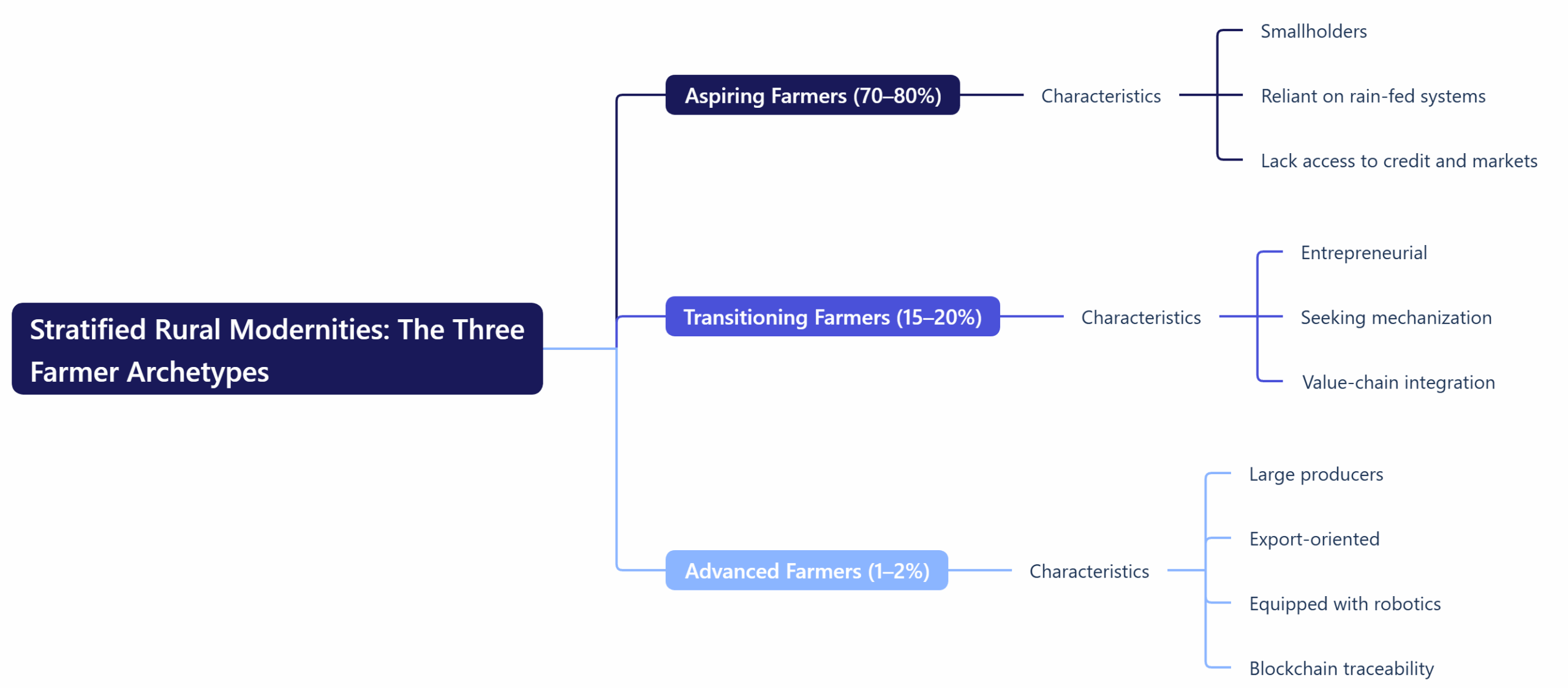
Sociologically, this signals a bureaucratic rationalization of agriculture—what Max Weber described as the shift toward efficiency and predictability through data and systems. Farming, once guided by local wisdom and collective experience, is now mediated by algorithms and predictive analytics. This “datafication” of rural life brings both empowerment and surveillance, raising crucial questions about who owns the data, who interprets it, and who benefits from it. Stratified Rural Modernities: The Three Farmer Archetypes
The NITI Aayog report categorizes farmers into three groups:
This classification mirrors India’s agrarian class structure, where technological capability corresponds to social and economic capital. The “advanced farmer” becomes the emblem of modernity and efficiency, while the “aspiring farmer” risks marginalization within the digital ecosystem. From a sociological lens, this reflects Manuel Castells’ “network society”, where power accrues to those with access to information networks. The digital divide—rooted in class, caste, and geography—risks deepening existing inequalities. While technology promises inclusion, it may also re-inscribe old hierarchies under new digital forms. The Three Pillars and the Sociology of Change
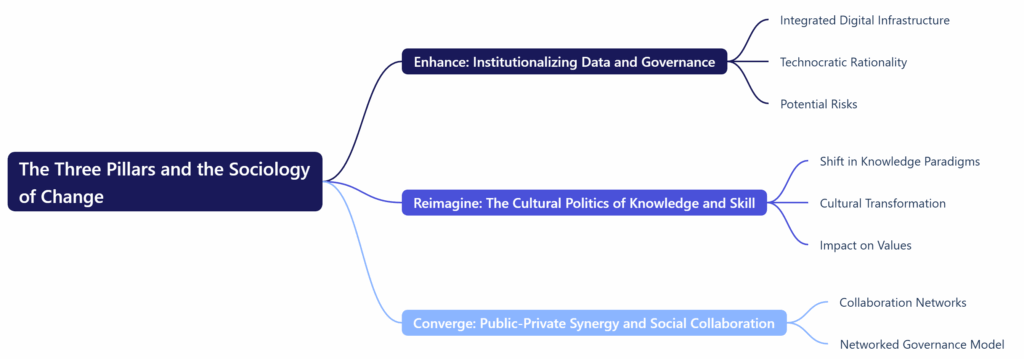
The roadmap’s **three pillars—Enhance, Reimagine, and Converge—**are not just technical strategies; they represent three sociological processes of transformation.
The Enhance pillar seeks to build an integrated digital infrastructure—Agri Kosh, soil maps, and crop databases—enabling AI-based advisories. This reflects a broader technocratic rationality, where governance becomes data-centric and decision-making shifts from human discretion to algorithmic authority. While such systems can promote transparency, they also risk alienating farmers from policy processes. Farmers’ knowledge—contextual, experiential, and often collective—may be undervalued in favor of “scientific” data. The sociologist James Scott warned of such “state simplifications”, where complex local realities are reduced to standardized datasets.
The Reimagine pillar focuses on reorienting research and building digital literacy through training programs for Krishi Sakhis and extension workers. This marks a shift from traditional agrarian knowledge—rooted in oral traditions and intergenerational learning—to technoscientific knowledge mediated by digital tools. From a symbolic interactionist view, this transforms the cultural meaning of the farmer: from subsistence cultivator to data-driven entrepreneur. It alters rural identities, aspirations, and even the moral values associated with farming. The discourse of “smart agriculture” thus becomes both an economic and cultural project of modernization.
The Converge pillar envisions collaboration between governments, start-ups, and academic institutions through Technology Centres of Excellence. Sociologically, this represents the rise of a “networked governance model”, where state authority is dispersed across hybrid institutions. Yet, this convergence also raises concerns of corporate influence and digital dependency. The privatization of agricultural data and technological tools may shift power away from farmers toward corporations controlling inputs, platforms, and analytics. Structural Barriers: Inequality in the Digital CountrysideDespite its ambitious vision, the roadmap faces deep-seated social barriers.
From a structural-functionalist view, the agricultural system’s stability depends on integrating these diverse strata into a cohesive framework. But without equitable access to digital resources, the new system may reinforce rather than resolve the existing contradictions of Indian agrarian society. The Promise and Peril of the Digital Agriculture Mission 2.0The Digital Agriculture Mission 2.0 embodies a vision of progress tied to the idea of Viksit Bharat 2047—a developed, self-reliant India. However, development, as dependency theorists remind us, is not neutral. It involves power relations between the state, corporations, and citizens. If implemented inclusively, digital agriculture could democratize access to markets, reduce transaction costs, and enable climate-resilient farming. But if driven primarily by capital and technology elites, it may lead to digital enclosure—where farmers’ autonomy is eroded, and rural life becomes dependent on platforms and proprietary technologies. The sociological challenge, therefore, lies in ensuring that modernization does not translate into technocratic dominance, but rather into participatory empowerment. Conclusion: Beyond Technology—Towards Social TransformationReimagining Indian agriculture through frontier technologies is not just a question of hardware and software; it is about restructuring social relations in the countryside. The true transformation will occur not when drones map fields or sensors measure soil, but when digital systems align with principles of equity, autonomy, and social justice. To make the vision of Viksit Bharat 2047 meaningful, the state must treat technology as a social good, not merely a tool of productivity. Training women farmers as digital leaders, creating participatory data governance frameworks, and recognizing farmers as co-creators of knowledge—not just data points—will be essential. In the end, technology may rewire how we farm, but sociology reminds us why we farm: to sustain communities, cultures, and the rhythms of rural life that define India itself. |
To Read more topics, visit: www.triumphias.com/blogs
Read more Blogs:
Remembering the Roots: How India is Reclaiming Tribal Histories Through Memory and Modernity
The point about how the digital divide continues to exacerbate rural inequality is crucial. While digital agriculture holds immense potential, without addressing access disparities, we risk deepening the gap between well-connected and underserved farmers. Ensuring equitable access to technology should be a priority in the drive for rural transformation.