
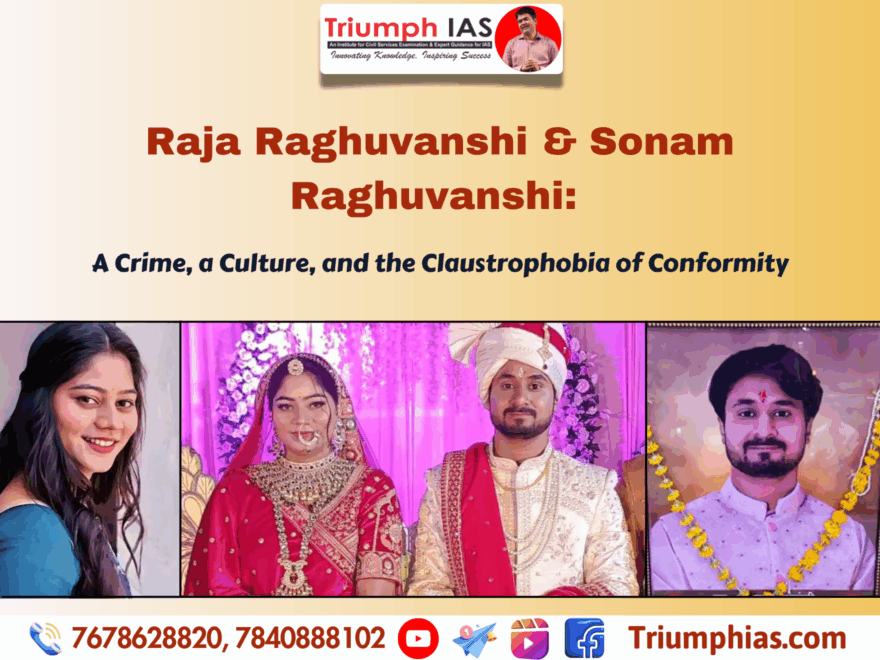
Raja Raghuvanshi and Sonam Raghuvanshi: A Crime, a Culture, and the Claustrophobia of Conformity
RAJA RAGHUVANSHI AND SONAM RAGHUVANSHI: A CRIME, A CULTURE, AND THE CLAUSTROPHOBIA OF CONFORMITY
A surge in spousal murders reflects – deeper societal issues where forced marriages and inability to express views about relationship choices can lead to violent outcomes.
In the narrow alleys of Kushwah Nagar, Indore, a young woman named Sonam Raghuvanshi once harbored modest dreams — of earning an MBA and helping grow her father’s plywood business. But in a deeply patriarchal world where a woman’s future is often mapped out within the rigid contours of caste and community, Sonam’s aspirations soon gave way to constraints. Her identity was reduced to a biodata entry in the Samaj Parichay Pustika, a matrimonial catalogue curated by her community to ensure “safe” intra-caste alliances.
Within six months of being listed, Sonam was married off — not to a man she knew or loved, but to one who was “astrologically compatible.” Today, she stands accused of murdering that man on their honeymoon, allegedly due to an “illicit affair” with a younger man employed by her family. The narrative, as sensationalized by media, has branded her not just a criminal but a moral deviant — “the woman who killed her husband,” “the woman with a lover,” and worse.
The legal proceedings are ongoing, but society has already passed judgment. Her own brother, caught in the media frenzy, expressed no doubt of her guilt. Television debates have turned into emotional courtroom dramas, pitting mothers against each other and exploiting every teardrop shed by school-going girls related to the accused parties. Sonam’s personhood has disappeared — she is now a cautionary tale.
But beneath the Newspaper headlines lies a disturbing sociological reality.
Marriage as Social Confinement
For many women like Sonam, marriage is not a choice but a cultural command. The ritual of arranged marriage — often celebrated as a symbol of Indian tradition — can also act as a mechanism of control. In Sonam’s case, a stranger was picked as a life partner based on caste purity, horoscope matches, and community expectations, not emotional compatibility.
The reference group theory in sociology explains how individuals mold their behavior based on the standards of groups they aspire to. Sonam’s life was dictated by her community’s reference group — her behavior judged not by personal goals but by community-prescribed norms. Her refusal to conform to these eventually made her a deviant in society’s eyes.
Gendered Double Standards
India’s media and society often respond to women’s transgressions with disproportionate fury. In the same breath that the nation glorifies “daughters” through symbolic military operations like “Operation Sindoor,” it condemns those like Sonam for stepping outside prescribed gender roles.
Dr. Naresh Purohit, affiliated with the National Mental Health Programme, rightly suggests that the growing incidence of spousal murders points to deeper societal fractures — particularly in contexts of forced marriages and emotional suppression. Love, choice, and autonomy — when denied — often ferment into acts of desperation.
The Sociology of Crime and Deviance
According to Merton’s Strain Theory, deviance occurs when individuals are unable to achieve culturally approved goals through legitimate means. If love and autonomy are denied through institutional channels like marriage, individuals may seek illegitimate paths. While this doesn’t justify violence, it does contextualize the social strain that may precede it.
Moreover, honour killings, societal backlash against inter-caste unions, and the policing of women’s desires reflect how control over female sexuality is central to community cohesion in caste-bound societies.
Parallel Lifelines & Broken Bridges
Ironically, the alleged murder occurred near Meghalaya’s iconic living root bridge, a site symbolic of natural strength and organic growth. One wonders what Sonam saw in the girls running snack stalls there — some perhaps from towns like hers, confidently speaking English and embracing tourism, autonomy, and economic freedom. Did they represent the alternate life she was never allowed?
Could she have left the marriage before it began? Could her family have accepted her love for someone of lower status? Perhaps. But as the article poignantly asks: how many of us would bet on that lifeline for a girl like Sonam?
Conclusion: A Case Beyond Crime
The Sonam Raghuvanshi case is not just a murder story — it’s a mirror reflecting the entrapment of women within caste, patriarchy, and honour-based morality. It calls for more than courtroom justice — it demands a societal reckoning with how we define love, marriage, and morality for our daughters.
Unless we acknowledge the structural violence embedded in forced conformity and closed lifelines, stories like Sonam’s will continue to surface — not as aberrations, but as deeply rooted outcomes of a broken social order.
To Read more topics, visit: www.triumphias.com/blogs
This post really brings out how cultural conformity can quietly become a prison, especially for women. It’s tragic how systemic silence and forced choices can escalate into something as extreme as crime.