Introduction
“No one is born hating another person because of the color of his skin.” — Nelson Mandela
Racial discrimination refers to unjust or prejudicial treatment of individuals based on their race, skin color, ethnicity, or ancestry. It is a socially constructed phenomenon that assigns hierarchical value to human physical traits, often resulting in inequality, exclusion, and violence.
Though most commonly discussed in Western societies, racism has manifested globally, including in India, albeit through different structures like caste, colorism, and ethnic exclusion.
Sociological Analysis

- Structural Functionalism – Talcott Parsons viewed society as a system of interrelated parts working together. Racial discrimination, in this framework, is seen as dysfunctional because it disrupts social harmony and integration. It hampers the optimal performance of institutions like education and economy by excluding certain racial groups, leading to social disequilibrium.
- Conflict Theory – Marxian theorists interpret racial discrimination as a tool of class domination. Du Bois argued that race was used to divide the working class and uphold capitalist interests. Racism, in this view, is not just interpersonal prejudice but a structural mechanism that maintains economic inequality and power asymmetry.
- Symbolic Interactionism – This theory focuses on micro-level interactions and how meanings of race and identity are socially constructed. Goffman’s idea of stigma applies to racial minorities who face labeling and stereotyping. Through everyday interactions—like racial slurs or profiling—racial meanings are reinforced, sustaining discrimination even without formal structures.
- Post-Colonial Theory – Post-colonial theorists argue that colonialism produced racial hierarchies privileging white/European standards. Frantz Fanon & Edward said emphasized how colonized subjects internalized inferiority through racialized discourse. Said’s concept of “Orientalism” reveals how the West constructed the East as backward and inferior, justifying domination. Racial discrimination here is both ideological and psychological.
- Ethno-Racial Typologies – In colonial India, H.H. Risley classified Indian castes and tribes based on racial features like nasal index, promoting a pseudo-scientific racial hierarchy. He argued that caste was rooted in race, linking Indo-Aryans with superior racial stock. This theory has been debunked, but it institutionalized racial and caste discrimination under colonial rule and shaped early anthropological discourse in India.
- Critical Race Theory (CRT) – CRT posits that racism is not just individual bias but embedded in law, policies, and institutions. It emphasizes intersectionality—how race intersects with gender, class, and caste to produce cumulative disadvantage. This theory helps understand institutional discrimination in policing, healthcare, or housing.
Forms of Racial Discrimination Across the Globe
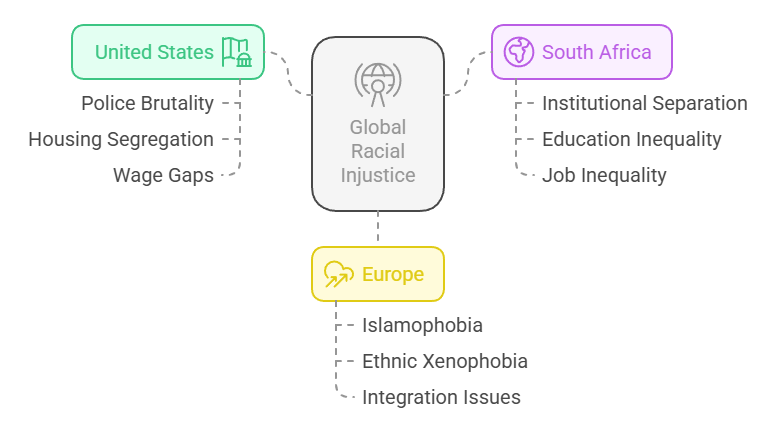
- United States: Structural Racism
- Police brutality, housing segregation, and wage gaps reflect institutional racism.
- The Black Lives Matter (BLM) movement has spotlighted racial injustice.
- South Africa: Apartheid Legacy
- Institutional separation of races till 1994.
- Post-apartheid, racial inequality persists in access to education and jobs.
- Europe: Islamophobia & Ethnic Xenophobia
- Rise in discrimination against immigrants and Muslims.
- Issues with integration, ghettoization, and identity politics.
Is Racial Discrimination Present in India?

Though India doesn’t have a formal “race” system like the West, caste, skin color (colorism), regionalism, and ethnic identity serve similar exclusionary functions.
Northeast Indian Discrimination
- People from the Northeast face racist slurs, housing discrimination, and workplace bias, especially in metropolitan cities.
African Students in India
- Subjected to violent attacks, accused of criminal behavior, often stereotyped in media.
Colorism in Indian Society
- Preference for “fair” skin, visible in marriage ads, beauty standards, and employment biases.
Ethnic Profiling in Policing
- Minority groups, especially Muslims and tribals, face surveillance and institutional bias.
Legal Measures Against Racial Discrimination
Global Frameworks
- UN Convention on the Elimination of Racial Discrimination (1965)
- Universal Declaration of Human Rights
Indian Constitutional Safeguards
- Article 15(1): Prohibits discrimination based on race, religion, caste, sex, or place of birth.
- Article 14: Equality before the law.
- SC/ST Atrocities Act: Aims to eliminate caste-based exclusion, akin to racial discrimination.
Contemporary Relevance: Globalization and Race
Globalization has:
- Created transnational racial hierarchies (e.g., white labor preferred in service sectors).
- Increased visibility of racism through digital platforms (e.g., #BlackLivesMatter).
However, it has also:
- Enabled solidarity movements.
- Allowed for transnational anti-racism activism.
Conclusion
Racial discrimination is not just a Western phenomenon, but a universal structure of inequality with deep historical, economic, and psychological roots. In India, caste, colorism, and ethnic exclusion play analogous roles. Addressing it requires educational reforms, legal enforcement, social sensitization, and most importantly, redefining human value beyond skin color or ancestry.
PYQs
Paper 1:
- What are the structural sources of social inequality? Discuss with reference to caste and race.(2016)
- Explain how race and ethnicity intersect with class and gender in stratified societies.(2019)
- How do symbolic interactionists explain race and ethnic relations?(2021)
Paper 2:
- Discuss the challenges faced by the people of Northeast India in mainland cities(2015)
- Discuss how caste and regional identities shape political behavior in India.(2019)
|



One comment