
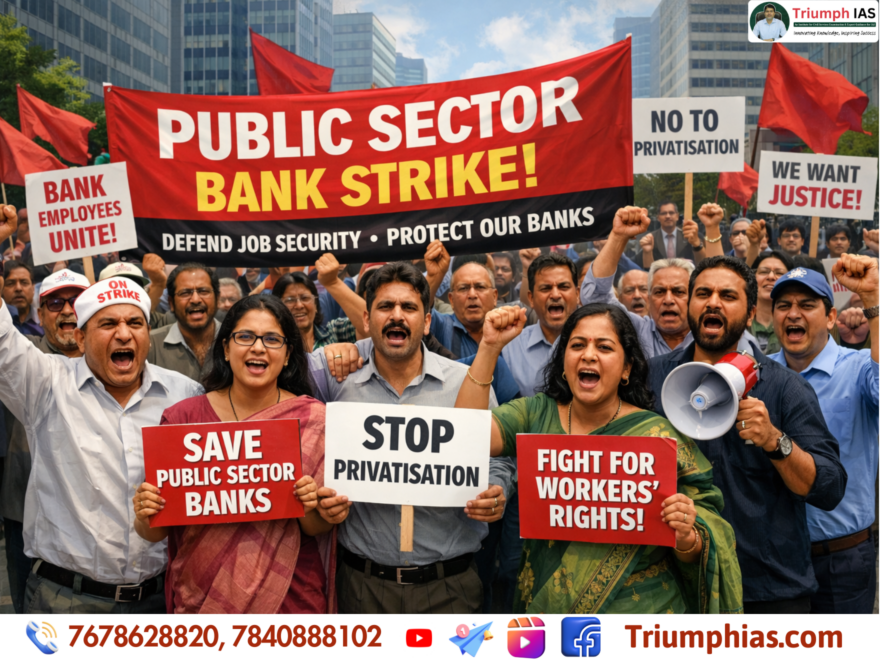
Public Sector Bank Strike and Workers Rights
(Relevant for sociology Paper II)
Introduction: When Bank Counters Fall Silent, Deeper Questions EmergeAcross India, public sector banks have witnessed a nationwide strike by bank employees, bringing routine banking operations to a near standstill. Cash counters slowed, cheque clearances were delayed, and in-branch services were disrupted across major institutions such as the State Bank of India (SBI) and other public sector banks. While digital banking channels such as ATMs and online transfers continued to function, the strike underscored the continuing relevance of human labour in an increasingly digitised financial system. At the heart of the protest lies a demand that many consider modest yet symbolically powerful: a five-day work week. Bank unions argue that this reform is long overdue and essential to align public sector banking with modern work-life expectations, international labour norms, and the realities of a high-pressure service sector. Beyond immediate inconvenience, the strike raises fundamental questions about workers’ rights, labour reforms, productivity, governance, and the changing nature of work in India’s public sector. This blog explores the strike not merely as an industrial dispute but as a lens through which to examine broader socio-economic transformations. Understanding the Public Sector Banking WorkforceThe Backbone of India’s Financial InclusionPublic sector banks (PSBs) remain the backbone of India’s financial system. They play a crucial role in:
Despite the growth of private banks and fintech platforms, PSBs continue to handle a significant share of deposits, loans, and public transactions. Bank employees, therefore, operate at the intersection of economic governance and public service delivery. Workload Pressures and Changing ResponsibilitiesOver the past decade, bank employees have faced intensifying workloads due to:
While technology has increased efficiency, it has also expanded expectations, often without proportional improvements in staffing or work conditions. The demand for a five-day work week must be seen against this backdrop of rising occupational stress and role expansion. The Strike: What Is Being Demanded?Core Demand: A Five-Day Work WeekThe central demand of the strike is the adoption of a five-day work week for public sector banks, bringing them in line with:
Unions argue that the current six-day work structure is out of sync with contemporary labour standards, particularly given the mental and emotional demands of customer-facing financial work. Associated ConcernsWhile the five-day week is the headline issue, the strike also reflects deeper concerns, including:
Thus, the strike represents accumulated dissatisfaction, not a single isolated grievance. Services Disrupted: The Immediate ImpactOperational SlowdownDuring the strike:
However, the continuation of:
highlighted India’s progress towards a hybrid banking model, where digital systems coexist with physical infrastructure. Public Response and Economic RipplesBank strikes, especially when occurring around holidays, affect:
These disruptions remind policymakers that banking is a foundational service, where labour disputes have immediate macroeconomic consequences. Why This Strike Matters Beyond Banking1. Labour Rights in a Changing EconomyThe strike reflects broader tensions in India’s labour landscape, where workers seek:
As India modernises its economy, debates are shifting from mere employment generation to quality of employment — a hallmark of mature labour markets. 2. Public Sector Reforms and Employee MoralePublic sector reform discussions often emphasise:
However, employee morale, job satisfaction, and work conditions are equally important. Ignoring these dimensions can weaken institutional capacity and service delivery. The bank strike highlights the need for balanced reforms that integrate efficiency with dignity of labour. 3. Work-Life Balance as a Policy IssueThe demand for a five-day work week signals a broader societal shift. Work-life balance is no longer viewed as a luxury but as a legitimate policy concern, linked to:
In service-intensive sectors like banking, these factors directly influence performance and public trust. Digitalisation and the Myth of Reduced WorkHas Technology Reduced Workload?While digitalisation has automated several processes, it has also:
Employees now manage both digital systems and physical interactions, often without adequate training or compensation for increased complexity. The strike challenges the assumption that technology automatically reduces human effort. Digital Divide and Human DependencyDespite digital growth, a significant segment of India’s population still depends on:
This makes bank employees indispensable intermediaries between technology and society. Trade Unions and Collective BargainingThe Role of Bank UnionsBank unions in India have historically played a strong role in:
The current strike reaffirms the relevance of collective bargaining in democratic labour relations, even in the age of platform work and gig economies. Declining Union Power? Not QuiteWhile unionisation has weakened in many sectors, banking remains one of the few domains where unions retain organisational strength. This strike demonstrates that institutional labour still has a voice, particularly in public services. Comparative Perspective: Global Banking PracticesIn many countries:
India’s demand aligns with global labour norms, suggesting that reform is not radical but adaptive. Gender Dimensions of the StrikeImpact on Women EmployeesBanking employs a growing number of women, particularly in clerical and officer cadres. Long working hours and weekend duties disproportionately affect women due to:
A five-day work week could:
Thus, the strike has an important gender justice dimension. State, Economy, and Labour: A Sociological LensFrom a sociological perspective, the bank strike illustrates:
It reflects how economic institutions are embedded in social relationships, not isolated technical systems. Policy Dilemmas and the Way ForwardKey Policy Questions
Possible Pathways
Such measures can transform conflict into collaboration. Conclusion: More Than a Strike, a SignalThe public sector bank strike is not merely about working days. It is a signal of changing aspirations within India’s workforce, where dignity, balance, and recognition matter as much as wages. As India positions itself as a modern economy, it must reconcile:
How policymakers respond to this moment will shape not only the future of banking but also the trajectory of labour rights in India’s public sector. |
To Read more topics, visit: www.triumphias.com/blogs
Read more Blogs:
A World at a Crossroads: India and Global Developments Shaping January 2026
India’s 2026 Budget Priorities and Impact: A Comprehensive Analysis
One comment