Introduction
The debate between privatization and public provisioning of education is at the heart of educational reforms in India. With the rise of private schools, ed-tech companies, and the increasing role of market forces, questions are being raised about equity, quality, and accessibility of education. As education remains a key instrument for social mobility, understanding the sociological implications of these trends is crucial for UPSC aspirants and policymakers alike.
What is Privatization of Education?
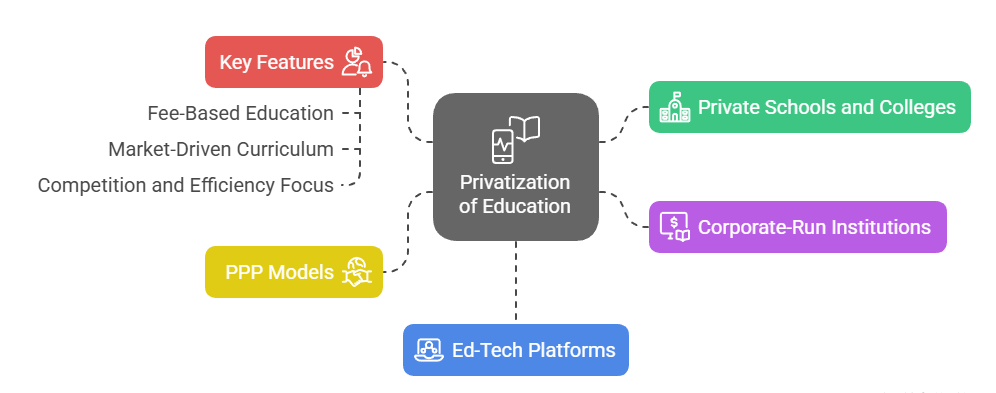
Privatization of education refers to the shift of educational services from government to private actors. It includes:
- Private schools and colleges
- Corporate-run educational institutions
- PPP (Public-Private Partnership) models
- Ed-tech and online learning platforms
Key Features:
- Fee-based education
- Market-driven curriculum
- Competition and efficiency focus
What is Public Provisioning of Education?
Public provisioning of education means education funded, managed, and delivered by the government, aiming for:
- Universal access
- Equity and inclusion
- Standardized curriculum and regulation
- Social justice
- Examples: Government schools, Kendriya Vidyalayas, Navodaya Vidyalayas, state-run colleges.
Sociological Analysis

- Equity and Social Stratification: Public Education Aims to provide a level playing field. The Right to Education (RTE) Act, 2009, mandates free and compulsory education for 6-14 years age group. It attempts to break barriers of caste, class, and gender. Private Education tends to favor the privileged. High fees, language barriers, and “creaming” of students reinforce social stratification and widen the gap between rich and poor. Pierre Bourdieu argued that schools reproduce existing social hierarchies through cultural capital—private institutions often cater to those already privileged.
- Quality and Accountability: Private Schools Often perceived as delivering better quality due to modern infrastructure and English-medium instruction. However, quality varies; many budget private schools lack trained teachers and resources. Public Schools Face challenges like teacher absenteeism, poor infrastructure, and bureaucratic delays. Yet, government schools reach the largest population, especially in rural and marginalized communities.
- Social Mobility and Meritocracy: Public Provisioning enables upward mobility for marginalized groups through scholarships, reservations, and midday meals. Privatization can undermine meritocracy if access is determined by ability to pay, not talent. Emile Durkheim emphasized education as an integrative force, promoting solidarity and citizenship—something only mass, public education can provide at scale.
- Functionalist vs. Conflict Theory Perspectives: Functionalist Perspective (Durkheim) Sees education as a means to transmit societal values, foster integration, and prepare individuals for societal roles. Conflict Theory (Marx, Bowles & Gintis) Views education as perpetuating class inequalities; privatization serves capitalist interests and perpetuates elite dominance.
- Gender and Minority Inclusion: Public Schools Reservation policies and affirmative action have improved access for girls, Dalits, Adivasis, and minorities. Private Sector Often lacks affirmative action; admission may discriminate subtly against marginalized communities.
Recent Policy Trends
- National Education Policy (NEP) 2020: Emphasizes flexibility, multidisciplinary learning, and public investment, but also encourages PPP and greater private sector participation.
- Ed-Tech: COVID-19 pandemic accelerated digital learning, but deepened the digital divide—many children lack access to devices and the internet.
Data Points
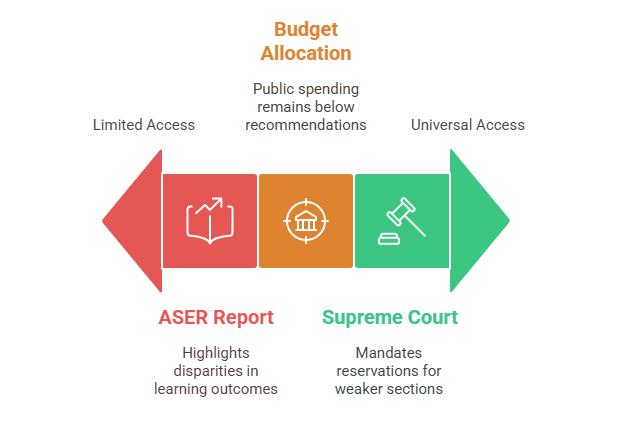
- ASER 2024 Report: Shows stark disparities in learning outcomes between private and public schools.
- Budget Allocation: Public spending on education in India remains below 6% of GDP, recommended by Kothari Commission.
- Supreme Court on RTE: Mandated 25% reservation for economically weaker sections in private schools, but implementation remains patchy.
Conclusion
The balance between privatization and public provisioning of education is delicate. While privatization can bring innovation and efficiency, over-reliance risks deepening social inequalities. Public education remains vital for nation-building, social justice, and the realization of constitutional goals. For a truly inclusive and meritocratic society, robust public investment and effective regulation of private providers are essential.
PYQs
Paper 1
- How does education contribute to social mobility in India? Discuss with suitable examples. (2022)
- Examine the impact of privatization and commercialization of education on equality of educational opportunity in India. (2021)
- How do schools act as agents of social stratification and social mobility? Illustrate your answer with reference to Indian society. (2020)
- ‘Education is the most important agent of social change in the modern world.’ Discuss. (2018)
- Discuss the role of education in the process of modernization. (2017)
- Examine the role of education in reproduction of inequality in society, with special reference to Bourdieu’s concept of cultural capital. (2016)
- Comment on the relationship between education and social mobility. How far has the Indian education system succeeded in promoting social mobility among the weaker sections? (2015)
- Explain how education acts both as an instrument of social mobility and social control. (2014)
Paper 2
- Examine the impact of the privatization of higher education on the accessibility and quality of education in India. (2022)
- Discuss the role of education in the empowerment of marginalized communities in India. (2021)
- Evaluate the effectiveness of affirmative action policies (reservation) in education for promoting social equality in India. (2020)
- Examine the challenges faced by the Indian education system in ensuring inclusive and equitable quality education for all. (2019)
- Discuss the issues of inequality and exclusion in the Indian education system. (2018)
- What are the sociological implications of the expansion of private schools and colleges in India? (2017)
- How has the National Policy on Education addressed issues of access, equity, and quality in Indian education? (2016)
- Discuss the role of education in social transformation in India. (2015)
- Analyse the changing nature of educational inequalities in contemporary India. (2014)
|


One comment