Introduction
In recent decades, India has witnessed the rapid privatization of higher education, with private universities, deemed-to-be institutions, and foreign collaborations expanding significantly. While this growth bridges capacity gaps, it also deepens class-based disparities and raises critical concerns around social justice, access, and equality of opportunity. Privatization refers to the increasing role of private players in providing and managing education. This shift has transformed higher education from a public good to a market commodity, altering its relationship with class, caste, gender, and social mobility. In this blog, we delve into the sociological implications of this transformation.
Sociological Analysis
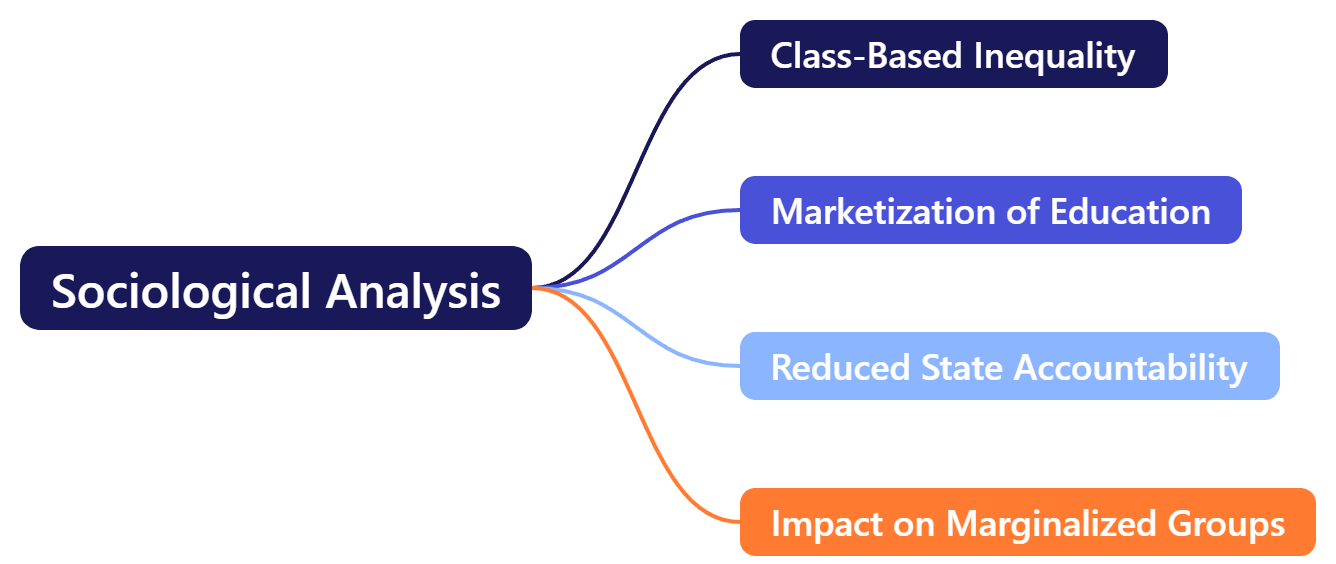
- Class-Based Inequality: Private universities charge high fees, often making higher education a luxury for the middle and upper classes. The working class and rural poor face exclusion due to financial constraints. Bourdieu’s concept of Cultural Capital is relevant here: affluent families provide resources (language, skills, and exposure) that give their children an edge in elite institutions. Credentialism becomes a class-reproducing mechanism—where degrees from reputed private institutes determine future job prospects.
- Marketization of Education: The entry of foreign universities and the emergence of “edu-business” models signify a shift towards neoliberal governance of education. Education is commodified, and merit is redefined by ability to pay rather than academic capability. This aligns with Bauman’s idea of Liquid Modernity, where institutions no longer provide stable social structures and identities, including in education.
- Reduced State Accountability: The state’s withdrawal from funding public universities and promoting PPP models has led to a dual system:
- Underfunded public institutions catering to marginalized sections.
- Privileged private spaces for the elite.
- Impact on Dalits and Other Marginalized Groups: The reservation system in private institutions is either weak or non-existent, defeating the affirmative action framework aimed at ensuring social justice. As sociologist Gail Omvedt argues, privatization bypasses the social responsibility of education to uplift Dalits, Adivasis, and OBCs.
Real-Life Examples
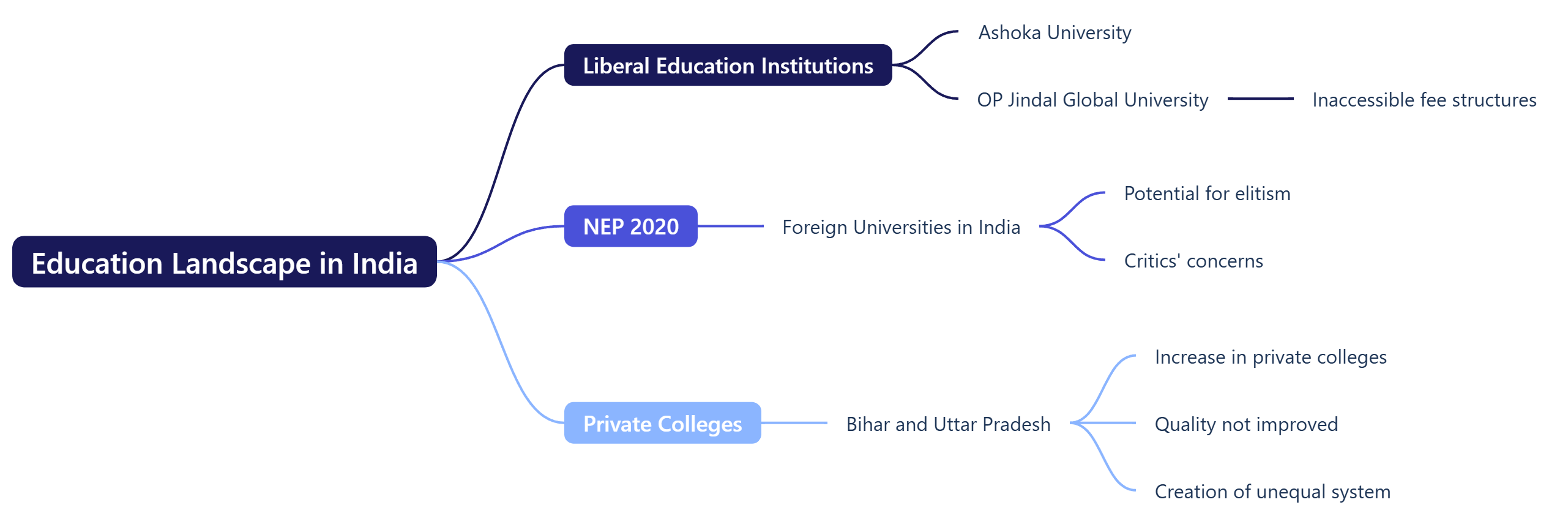
- Ashoka University and OP Jindal Global University offer liberal education, but their fee structures remain inaccessible to most.
- NEP 2020 allows foreign universities in India, but critics argue this may promote elitism.
- In Bihar and Uttar Pradesh, the explosion of private colleges hasn’t improved quality but only created a parallel unequal system.
Policy Implications

- Public-private divide creates educational ghettos—public institutions for the poor, private for the rich.
- Skill gaps and employability worsen, as many private colleges operate with poor quality assurance.
- Education as a right transforms into education as a privilege, weakening democratic ideals.
Conclusion
The privatization of higher education reflects broader structural inequalities embedded in Indian society. While it may enhance access quantitatively, it compromises equity and quality. A balanced sociological framework is essential to ensure that education continues to be a means of social mobility, not a reinforcer of class privilege.
PYQs
Paper 1
- Discuss education as an instrument of social change and social control in modern society. (2014)
- How does the modern education system contribute to both integration and fragmentation in society? (2015)
- Evaluate the role of education in perpetuating social stratification in modern society. (2016)
- Critically examine how education reproduces class inequality according to Marxist and Neo-Marxist perspectives. (2017)
- How do functionalist and conflict perspectives differ in their view of the role of education in society? (2018)
- Explain the role of education in the transmission of dominant ideology, with special reference to Althusser’s theory. (2019)
- Examine the relationship between education and social mobility in the context of Bourdieu’s theory of cultural capital. (2020)
- Discuss the impact of globalization and privatization on the functions of education in contemporary society. (2021)
- Discuss the challenges to equity and access in higher education in light of increasing privatization. (2022)
- How do new communication technologies and e-learning affect education as a social institution? (2023)
Paper 2
- Discuss the impact of privatization of education on access to higher education for marginalized communities in India. (2014)
- Do private educational institutions in India act as agents of meritocracy or perpetuate social exclusion? Discuss. (2015)
- Examine the consequences of commercialization of education on rural-urban educational disparities. (2016)
- How far has the Indian education system succeeded in facilitating social mobility among the SCs and STs? (2017)
- Discuss how state withdrawal and privatization trends have impacted affirmative action in higher education. (2018)
- What role has the expansion of private universities played in shaping new forms of social inequality in India? (2019)
- Explain how neoliberal reforms in the education sector have influenced intergenerational mobility in India. (2020)
- Critically analyze the implications of the New Education Policy (NEP 2020) in addressing class and caste disparities. (2021)
- How does caste-based reservation in higher education interface with growing marketization of the sector? (2022)
- Evaluate the challenges faced by first-generation learners in accessing quality education in a privatized system. (2023)
|



One comment