

Positivism and its Critique: With Reference to Contemporary Society
(Relevant for Sociology Paper 1: Sociology as Science)
》》 Vikash Ranjan @ Triumph IAS Ph: 78408 88102
|
Positivism occupies a central position in the history of sociological thought. It represents the earliest systematic attempt to establish sociology as a scientific discipline by borrowing methods, assumptions, and epistemological foundations from the natural sciences. Emerging in the context of rapid social transformation brought about by the Industrial Revolution, urbanization, and political upheavals in Europe, positivism promised certainty, order, and predictability in an otherwise chaotic social world. Its enduring influence can still be seen in contemporary governance, policy-making, development planning, and empirical social research. At the same time, positivism has been subjected to sustained and wide-ranging criticism for its inability to adequately capture meaning, subjectivity, power relations, and lived experiences. An examination of positivism and its critique, therefore, provides crucial insights into both the strengths and limitations of sociology as a discipline in contemporary society. Positivism, as a philosophical orientation, is based on the belief that authentic knowledge is derived from sensory experience and empirical observation. It holds that society operates according to discoverable laws, much like the natural world, and that these laws can be identified through systematic observation, measurement, and comparison. The intellectual roots of positivism lie in Enlightenment rationalism and empiricism, which emphasized reason, scientific inquiry, and progress as antidotes to superstition and tradition. In sociology, positivism found its most articulate formulation in the works of Auguste Comte, who not only coined the term “sociology” but also laid down its scientific mission. Comte argued that human knowledge progresses through three stages, known as the Law of Three Stages: the theological stage, where phenomena are explained through supernatural forces; the metaphysical stage, where abstract entities and philosophical speculation dominate; and finally, the positive stage, where explanations are based on scientific observation and empirical laws. According to Comte, society had entered the positive stage, making it possible to study social phenomena scientifically. He believed that sociology, as the most complex and comprehensive science, would integrate insights from other sciences and guide social reform. For Comte, positivism was not merely a method but a moral and intellectual project aimed at restoring social order while ensuring progress. The positivist tradition was further strengthened and systematized by Émile Durkheim, who is often regarded as the first true sociologist . Durkheim’s contribution lay in translating positivist philosophy into rigorous sociological methodology. He argued that society is a reality sui generis, existing independently of individual consciousness. Social facts, according to Durkheim, are ways of acting, thinking, and feeling that are external to the individual and endowed with a power of coercion. These social facts must be treated as “things,” meaning that they should be studied objectively, without recourse to personal opinions or subjective interpretations. Durkheim’s empirical study Suicide stands as a classic example of positivist sociology in action. By analyzing suicide rates across different societies and social groups, he demonstrated that even a deeply personal act could be explained by social variables such as integration and regulation. Higher suicide rates among Protestants compared to Catholics, or among unmarried individuals compared to married ones, were not matters of individual psychology but reflections of broader social conditions. Through statistical analysis and comparative method, Durkheim reinforced the positivist claim that social phenomena exhibit regularities and can be explained through causal laws. The core assumptions of positivism can be summarized as empiricism, objectivity, quantification, determinism, and law-seeking. Positivists argue that valid knowledge must be based on observable and measurable facts rather than speculation or introspection. The researcher is expected to maintain value neutrality, keeping personal beliefs separate from scientific inquiry. Quantitative methods, especially statistics and surveys, are preferred because they allow for generalization and prediction. Social phenomena are assumed to have identifiable causes, and once these causes are known, social outcomes can be predicted and controlled. CONTEMPORARY RELEVANCE
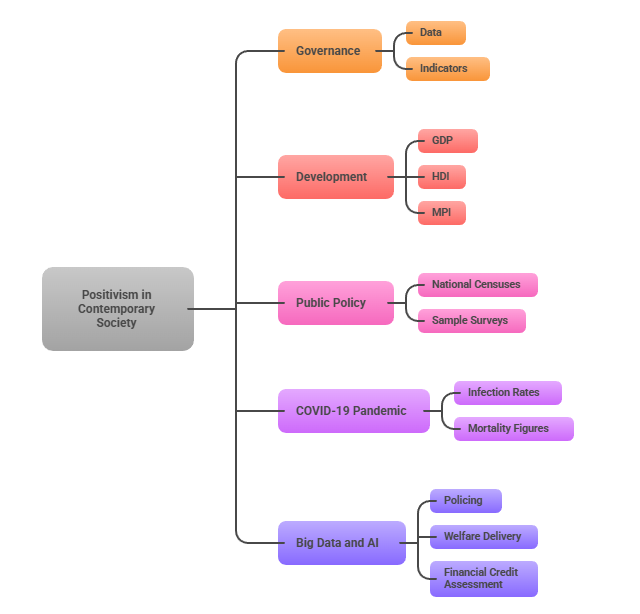
In contemporary society, positivism continues to exert considerable influence, particularly in the domains of governance, development, and public policy. Modern states rely heavily on data, indicators, and statistical models to understand and manage social life. National censuses, sample surveys, economic indicators, and social indices form the backbone of policy formulation and evaluation. Measures such as Gross Domestic Product (GDP), Human Development Index (HDI), and Multidimensional Poverty Index (MPI) reflect a positivist faith in numerical representation of social reality. Social progress is increasingly understood through rankings, scores, and performance metrics. The role of positivism became especially visible during the COVID-19 pandemic. Governments across the world relied on infection rates, mortality figures, reproduction numbers, and vaccination data to design containment strategies and allocate resources. Public health decisions were guided by epidemiological models and statistical projections, reflecting the positivist assumption that social and biological phenomena can be measured, predicted, and managed scientifically. Similarly, the growing use of big data, artificial intelligence, and algorithmic governance in areas such as policing, welfare delivery, and financial credit assessment demonstrates the continued relevance of positivist thinking in contemporary societies. CRITICAL ANALYSISHowever, alongside its achievements, positivism has attracted significant criticism. One of the earliest and most influential critiques came from the interpretive or anti-positivist tradition, most prominently associated with Max Weber. Weber did not reject science or empirical research, but he challenged the positivist assumption that social reality could be understood in the same way as natural phenomena. He argued that human beings are meaning-making agents, and their actions are guided by subjective meanings, values, and intentions. Therefore, sociology must aim not only at causal explanation but also at interpretive understanding, or Verstehen. According to Weber, social action is meaningful action, and understanding society requires grasping the meanings that individuals attach to their actions. While statistics can reveal patterns, they cannot explain why people act in certain ways unless these actions are interpreted within their cultural and historical contexts. For example, phenomena such as religious fundamentalism, nationalism, or social movements cannot be fully understood through numerical data alone. They require an analysis of beliefs, emotions, symbols, and ideologies that shape human behavior. Weber also critiqued the idea of complete value neutrality, arguing that while researchers should strive for objectivity, their choice of research problems is inevitably influenced by values. Another major critique of positivism comes from the Marxist and critical theory traditions. From this perspective, positivism is criticized for its failure to address issues of power, domination, and inequality. Marxists argue that positivism treats social facts as neutral and given, thereby obscuring the historical and structural processes that produce them. By focusing on observable outcomes rather than underlying relations of production, positivist sociology risks legitimizing the status quo. Social inequalities appear as mere facts rather than as consequences of exploitation and class struggle. Critical theorists of the Frankfurt School, such as Theodor Adorno, extended this critique by arguing that positivism promotes instrumental rationality. In modern capitalist societies, knowledge is increasingly valued for its technical utility rather than its capacity to promote human emancipation. Positivist methods, according to Adorno, reduce reason to calculation and efficiency, sidelining ethical reflection and critical consciousness. In contemporary corporate environments, data-driven performance metrics and productivity algorithms may enhance efficiency, but they often mask worker alienation, surveillance, and precarity. Feminist sociology has also offered a powerful critique of positivism by challenging its claim to objectivity and universality. Feminist scholars argue that what is presented as neutral and scientific knowledge often reflects male-dominated perspectives and priorities. Traditional positivist research has historically ignored or marginalized women’s experiences, particularly in areas such as domestic labor, care work, and gender-based violence. Quantitative data may underrepresent these phenomena due to social stigma, underreporting, or definitional biases. As a result, positivist approaches can reproduce gender inequalities rather than expose them. Postmodern critiques take the challenge to positivism even further by questioning the very possibility of universal truths and grand narratives. Postmodern thinkers argue that reality is socially constructed, fragmented, and mediated through language and discourse. Knowledge, from this perspective, is inseparable from power. What counts as “truth” is shaped by institutional authority, cultural norms, and political interests. In contemporary digital societies, the proliferation of competing narratives on social media platforms demonstrates that empirical facts alone do not determine social consensus. Misinformation, identity-based beliefs, and emotional appeals often override statistical evidence, challenging the positivist faith in rational agreement through data. Beyond theoretical critiques, positivism also faces methodological limitations. Human societies are reflexive, meaning that individuals and groups can change their behavior in response to knowledge about themselves. This reflexivity makes prediction difficult and undermines the search for universal social laws. Moreover, social phenomena are deeply embedded in specific historical and cultural contexts, limiting the applicability of generalizations across time and space. Quantitative methods, while powerful, often fail to capture emotions, meanings, and moral dilemmas that are central to social life. In response to these critiques, contemporary sociology has largely moved away from rigid positivism toward methodological pluralism. Rather than viewing positivism and its critics as mutually exclusive, sociologists increasingly recognize the value of combining different approaches. Quantitative methods provide breadth, comparability, and policy relevance, while qualitative methods offer depth, context, and interpretive insight. For instance, understanding the issue of farmer suicides requires not only statistical analysis of trends and correlations but also qualitative studies of indebtedness, social isolation, and cultural expectations. In contemporary society, the challenge is not to abandon positivism but to situate it within a broader epistemological framework. Positivism remains indispensable for large-scale social measurement, policy evaluation, and comparative analysis. At the same time, its limitations highlight the need for interpretive, critical, and reflexive approaches that address meaning, power, and inequality. Sociology’s strength lies precisely in its ability to engage in dialogue between different perspectives rather than adhering dogmatically to any single paradigm. CONCLUSION:In conclusion, positivism represents a crucial stage in the development of sociology, providing the discipline with scientific legitimacy and methodological rigor. Its influence continues to shape contemporary society through data-driven governance, evidence-based policy-making, and empirical research. However, the critiques of positivism reveal its inability to fully capture the complexity of social life, particularly in relation to meaning, subjectivity, and power. A mature sociological understanding recognizes positivism as a necessary but insufficient approach. By integrating its insights with interpretive and critical perspectives, sociology can offer a more comprehensive and nuanced understanding of contemporary society. |
To Read more topics, visit: www.triumphias.com/blogs
Read more Blogs:
Potable Water as a Social Right: A Sociological Analysis of India’s Contemporary Water Crisis
Good Governance and the Sociology of Power: Rethinking the State, Citizens, and Trust in India
One comment