Platformization of Labour

Platformization of Labour

Platformization of Labour

(Relevant for Sociology Paper I: Works and Economic Life and Sociology Paper II: Industrialization and Urbanization in India)

Introduction

In recent years, the platform economy has transformed the way people work across the globe. Services like Uber, Ola, Zomato, Swiggy, Amazon Mechanical Turk, Urban Company, and Upwork are now shaping employment patterns, wages, and work relations. This shift is often referred to as the platformization of labour. This is not just an economic phenomenon but a deeply social transformation that touches questions of class, precarity, gender, technology, and globalization.

Understanding this concept is crucial because it links directly with themes such as industrialization, social change, labour, informal sector, class relations, gender and work, and globalization.

What is Platformization of Labour?

Platformization of labour refers to the organization of work and employment through digital platforms. Here, technology acts as an intermediary between service providers (workers) and consumers. Instead of working in a traditional factory or office, workers connect with clients through apps and websites.

Examples:

  • Ride-hailing platforms: Ola, Uber
  • Food delivery apps: Swiggy, Zomato
  • Freelance work: Upwork, Fiverr
  • Domestic and care work: Urban Company
  • Crowdwork: Amazon Mechanical Turk

This new work arrangement is flexible, decentralized, and task-oriented. However, it comes with sociological implications that go beyond economics.

Characteristics of Platform Labour

Characteristics of Platform Labour

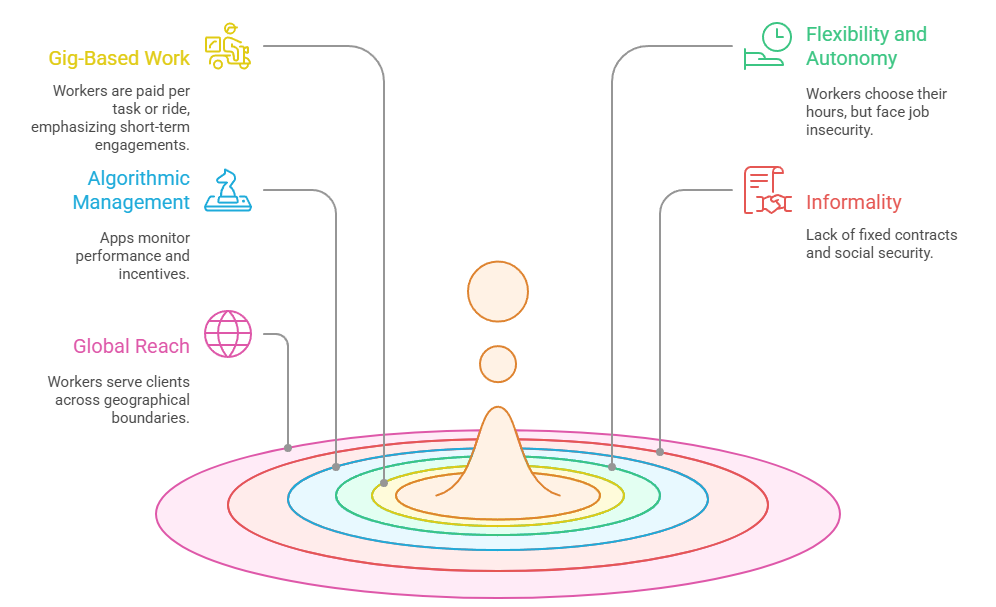
  1. Gig-based and task-oriented: Workers are paid per ride, delivery, or task.
  2. Flexibility and autonomy: They choose working hours, but often at the cost of job security.
  3. Algorithmic management: Apps monitor performance, ratings, and even incentives.
  4. Informality: No fixed contracts, limited labour rights, and absence of social security.
  5. Global reach: Workers in India can serve clients abroad, breaking geographical boundaries.

Sociological Analysis

Sociological Analysis

  1. Labour and Alienation

Marx argued that under capitalism, workers face alienation from the product, process, and their own potential. Platform labour intensifies this alienation:

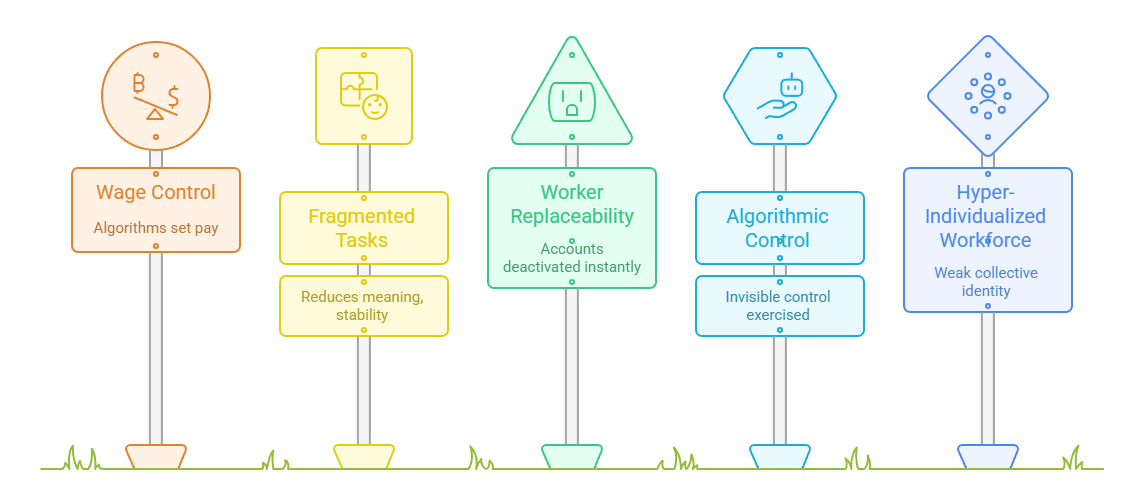
  • Workers have little control over wages (set by algorithm).
  • Their labour is fragmented into small tasks, reducing meaning and stability.
  • They often feel replaceable, as apps can deactivate accounts instantly.
  1. Bureaucracy and Rationalization

Weber spoke about rationalization and bureaucratic control. In platform labour, algorithms replace supervisors, exercising invisible control through ratings, penalties, and incentives. This reflects a new form of digital bureaucracy.

  1. Division of Labour

Durkheim emphasized solidarity in division of labour. But platformization creates a hyper-individualized workforce with weak collective identity. Unlike factory workers, gig workers rarely meet or unionize, which weakens their bargaining power.

  1. Precariat Class

Guy Standing describes a new social class called the precariat—people with insecure, unstable jobs and no welfare support. Platform workers fit this category perfectly.

  1. Liquid Modernity

Zygmunt Bauman’s concept of liquid modernity explains how modern life is flexible but unstable. Platform labour mirrors this liquidity—workers float between multiple jobs but lack stability.

Platform Labour in India

India has become one of the fastest-growing gig economies. According to NITI Aayog (2022), India had 7.7 million gig workers, expected to rise to 23.5 million by 2030. Most are in urban centers, engaged in food delivery, ride-hailing, and personal services.

Key Issues:

  • Income instability: Earnings fluctuate daily.
  • No social security: No health insurance, pension, or paid leave.
  • Gender dimensions: Women gig workers face safety concerns and cultural restrictions.
  • Caste-based segmentation: Certain jobs like domestic work or sanitation on platforms still reflect caste hierarchies.
  • Unionization challenges: App-based workers’ unions are emerging (e.g., Indian Federation of App-based Transport Workers), but face resistance from companies.

Globalization and Platform Labour

Platformization is part of the global shift towards digital capitalism. A worker in Bangalore may write content for a client in New York or design logos for someone in London. This creates:

  • Global labour competition: Workers compete across borders, often pushing down wages.
  • Race to the bottom: Employers outsource tasks to countries with cheaper labour.
  • Digital colonialism: Platforms headquartered in the Global North extract value from workers in the Global South without adequate regulation.

Policy and Legal Concerns

The Indian government has taken steps to recognize gig and platform workers under the Code on Social Security, 2020. However, actual benefits remain limited. Many workers continue to lack coverage under healthcare schemes, provident funds, or accident insurance.

Civil society groups and trade unions demand:

  • Minimum wage regulations for platform work.
  • Social security coverage irrespective of employment type.
  • Platform accountability for worker well-being.

Way Forward

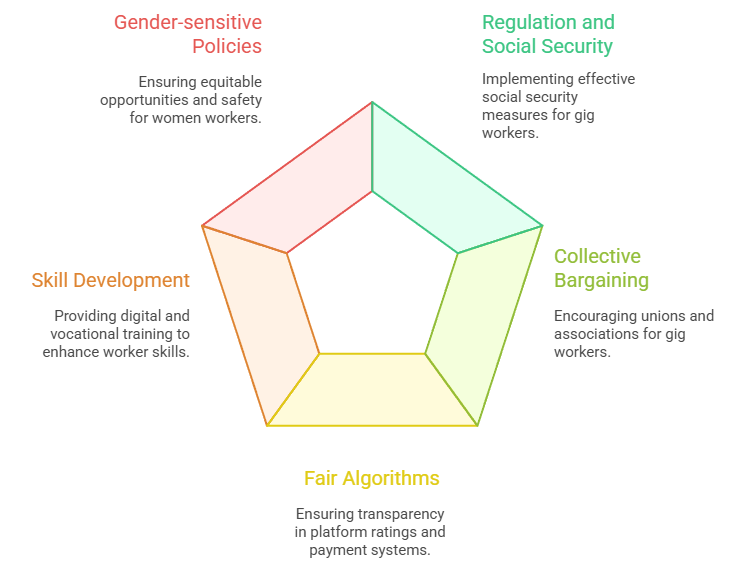
  1. Regulation and Social Security: Implement the Social Security Code effectively for gig workers.
  2. Collective Bargaining: Encourage unions and associations of gig workers.
  3. Fair Algorithms: Platforms must ensure transparency in ratings and payment systems.
  4. Skill Development: Provide digital and vocational training to workers.
  5. Gender-sensitive policies: Ensure women workers have safe, accessible, and equitable opportunities.

Conclusion

The platformization of labour is not just a technological development but a sociological transformation. It is reshaping class relations, employment structures, and everyday lives. While it offers flexibility and global opportunities, it also deepens precarity, inequality, and insecurity.

It also reflects broader questions: How do we ensure dignity of labour in a digital economy? How do we balance innovation with social justice?

The answers to these will shape the future of work in India and the world.

PYQs

Paper-1

  • Examine the social impact of globalization on labour and society. (2013)
  • The increasing importance of the tertiary sector has weakened the formal organization of work in recent times. Examine the statement. (2015)
  • “Globalization has pushed the labour into informal organization of work.” Substantiate your answer with suitable examples. (2016)
  • What do you understand by ‘informalisation of labour’? Write your answer with special reference to India. (2017)
  • Trace the changing nature of organisation of work in capitalist society over the years. (2017)
  • Discuss the nature of social organisation of work in capitalist society with reference to the ‘Limits of the working day’. (2018)
  • What do you understand by ‘labour commitment’? Discuss it with reference to studies of manufacturing industry. (2018)
  • What is ‘informal labour’? Discuss the need for and challenges in regulating informal labour in the post-industrial society. (2019)
  • What is ‘reserve army of labour’? Present the position of feminist scholars on this. (2019)
  • Capitalism has brought increasing informalisation of work in society. Substantiate your answer. (2020)
  • What characterizes degradation of work in capitalist society according to Marx? (2022)

Paper-2

  • Explain how the idea of ‘Work from Home’ forced us to redefine the formal and informal organization of work. (2021)
  • Discuss the new labour codes and their impact on formal and informal labour in India. (2020)

To Read more topicsvisit: www.triumphias.com/blogs

Read more Blogs:

Middle-Class Women

Download Sociology Optional Paper 2 2025 | Triumph IAS

One comment

Leave a Reply

Your email address will not be published. Required fields are marked *