Introduction
The Platform Economy refers to the economic and social systems created through digital platforms like Uber, Zomato, Amazon, Swiggy, Urban Company, Ola, and others. These platforms act as intermediaries between service providers and consumers, structuring labor in new, data-driven, and algorithmic ways. India, with its vast internet user base and cheap mobile data, has seen explosive growth in platform-based work—reshaping employment patterns, labor rights, and social relations.
Key Features of Platform Economy in India
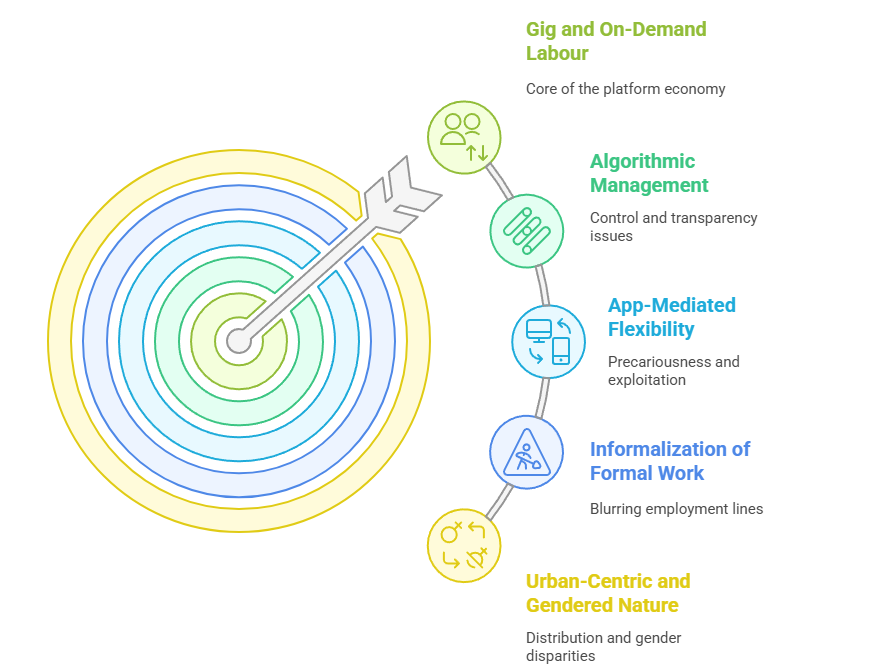
- Gig and On-Demand Labour: The platform economy thrives on freelance, temporary, and task-based jobs, often referred to as gig work. Workers are not employees but “partners” or “independent contractors,” often lacking social security.
- Algorithmic Management: Work allocation, performance monitoring, and payment in platform-based jobs are driven by algorithms, which raises issues of transparency and control.
- App-Mediated Flexibility: While platforms promise flexibility and autonomy, in reality, workers often face precarious incomes, long hours, and surveillance, turning freedom into digital exploitation.
- Informalization of Formal Work: Even educated youth now take up platform-based roles, blurring the line between formal and informal employment, leading to what scholars call “formalized informality.”
- Urban-Centric and Gendered Nature: Most platform jobs are urban-centric, and many are male-dominated (e.g., ride-hailing). Women workers often engage in beauty, healthcare, or food delivery, facing both gendered risks and digital marginalization.
Recent Developments
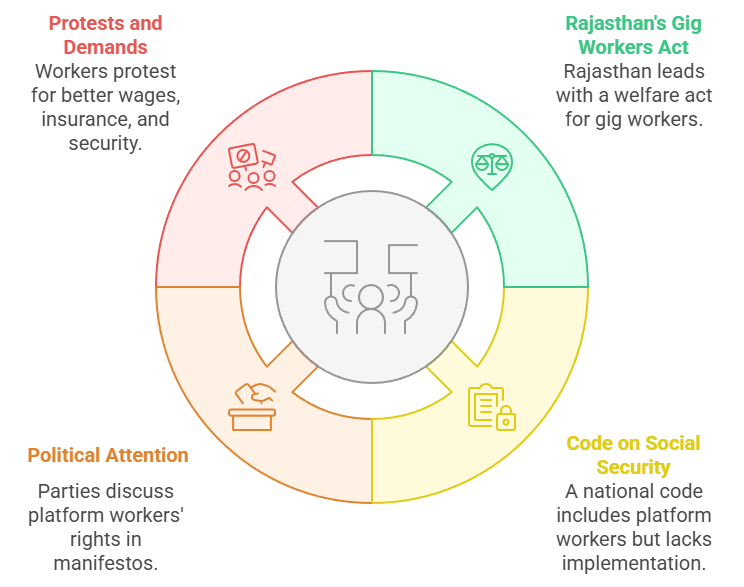
- In 2023, Rajasthan became the first Indian state to enact a Gig Workers Welfare Act, creating a welfare board and social security fund.
- The Code on Social Security, 2020 includes platform workers as a category, but implementation remains weak.
- The 2024 Lok Sabha Manifestos of various parties discussed platform workers’ rights, reflecting rising political attention.
- Recent protests by Zomato, Swiggy, Ola-Uber drivers have sparked debates on minimum wage guarantees, accident insurance, and job security.
Sociological Analysis
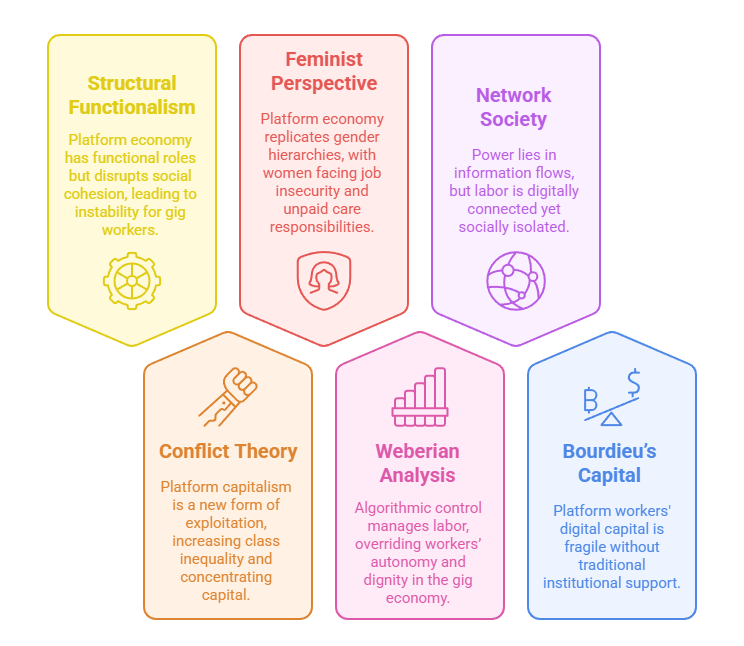
- Structural Functionalism: Platform economy serves functional roles like income generation, digital inclusion, and access to services. However, it disrupts social cohesion by creating alienated and fragmented workforces. Durkheim’s concept of anomie is evident in the instability and uncertainty faced by gig workers.
- Conflict Theory: From a Marxist lens, platform capitalism is a new form of exploitation, where tech corporations extract surplus value from gig workers without offering basic employment rights. As A.R. Desai argued about Indian capitalism, the platform economy increases class inequality, with capital concentrated in the hands of global tech giants while workers remain disempowered.
- Feminist Perspective: Feminist theorists highlight how the platform economy often replicates existing gender hierarchies. Women workers face both unpaid care responsibilities and digital job insecurity. Sylvia Walby’s patriarchal structures are evident in how app-based work commodifies women’s bodies (e.g., beauty services) without offering protection or support.
- Weberian Analysis: Max Weber’s theory of bureaucracy and rationalization applies to platforms that use algorithmic control to manage labor. The concept of the “iron cage” of rationality fits the gig economy, where efficiency and profit override workers’ autonomy and dignity.
- Postmodern and Network Society Perspective: Manuel Castells’ concept of the network society aptly describes platform economy, where power lies in information flows, and labor is digitally connected but socially isolated. Workers are part of a global digital network but remain fragmented and lacking collective bargaining power.
- Bourdieu’s Concept of Capital: Platform workers may lack economic and cultural capital, but their digital capital (ability to navigate apps, ratings, reviews) becomes key. However, without traditional institutional support, this capital is fragile and unstable.
Challenges of the Platform Economy
- Lack of Regulation: Absence of comprehensive labor laws to govern app-based work.
- Income Instability: No fixed salaries or minimum wage guarantee.
- No Social Security: No access to health insurance, maternity benefits, or pension.
- Algorithmic Exploitation: Lack of transparency and human accountability.
- Digital Divide: Workers with low digital literacy face marginalization.
- Gender and Caste Bias: Platform algorithms may reflect societal prejudices.
Case Examples
- Urban Company workers protest (2022): Women service professionals demanded better commissions and social security.
- Ola-Uber Drivers’ Strikes (2021–2024): Demanding minimum earnings, fuel allowances, and transparency.
- Jharkhand Gig Workers Union: Emergence of collective bargaining through WhatsApp and social media platforms.
Conclusion:
The platform economy represents a paradigm shift in the structure of labor in India. While it offers flexibility and opportunity, it also brings precarity and control. For UPSC aspirants, this topic is crucial to understanding how digital capitalism, class dynamics, and social inequalities are being reconfigured in real-time.
PYQs
Paper I
- Explain the impact of new technologies on work, employment and labor relations. (2017)
Paper II
- Examine the role of informal sector in the context of globalization. (2016)
- Discuss the role of ICT in changing the nature of work and employment in India. (2018)
- Discuss how traditional caste and gender inequalities persist in new forms in urban India. (2022)
|