Introduction: Security Rights for LGBTQIA+ Couples
The recent Madras High Court observation that “not every parent is like Justice Leila Seth, who supported her gay son” has reignited critical debates on LGBTQIA+ rights, parental acceptance, and legal protection in India. The court also raised concerns over the use of the word ‘queer’, emphasizing that there is nothing ‘strange’ or ‘odd’ about gender identity or sexual orientation. This development is highly relevant for Sociology, as it intersects with topics such as gender, sexuality, family, law and society, and social change.
Key Highlights from the Judgment
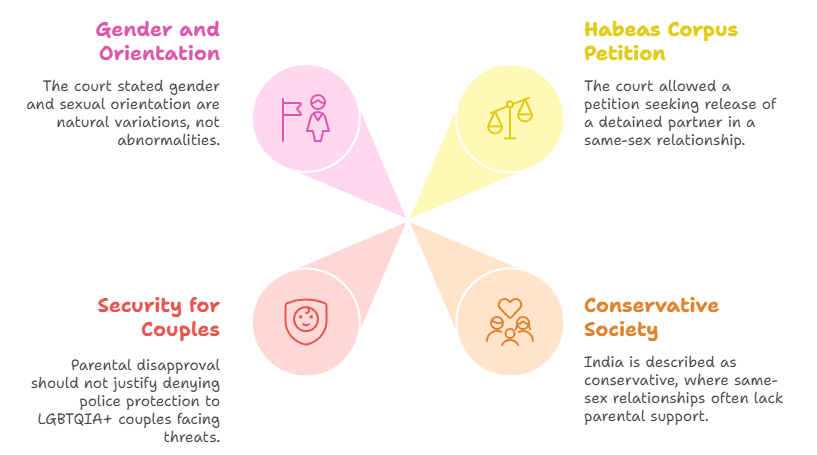
- The Division Bench of Justices G.R. Swaminathan and V. Lakshminarayanan allowed a habeas corpus petition filed by a 25-year-old woman seeking release of her partner allegedly detained by the latter’s parents.
- The court emphasized that India is still a conservative society, and most parents do not support same-sex relationships, unlike Justice Leila Seth, a prominent supporter of LGBTQIA+ rights
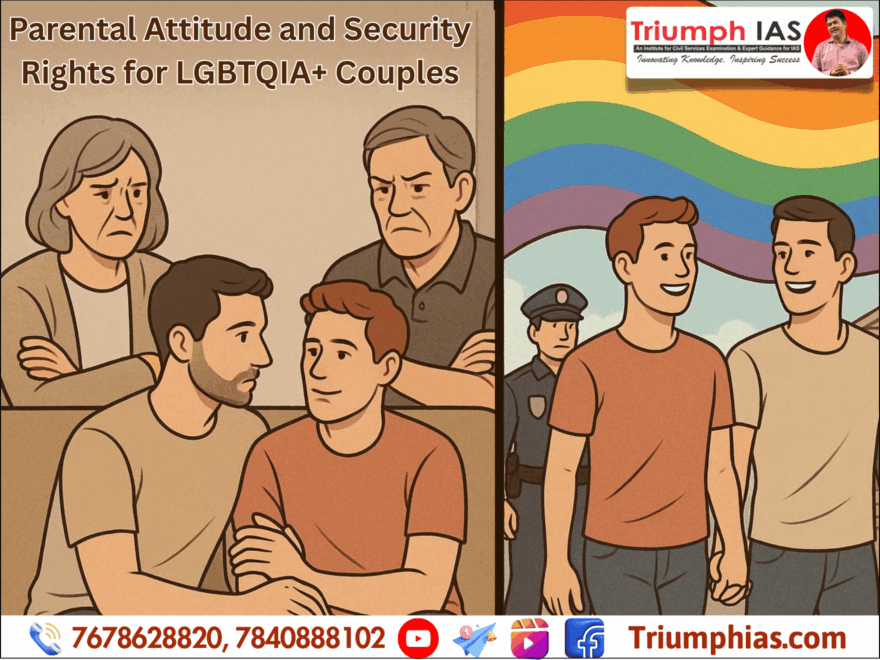
- It was asserted that lack of parental acceptance cannot be a reason for the police to deny security to LGBTQIA+ couples facing familial or societal threats.
- The judges expressed reservations about labeling identities as ‘queer’, stressing that gender and sexual orientation are natural variations and not abnormalities.
Sociological Analysis
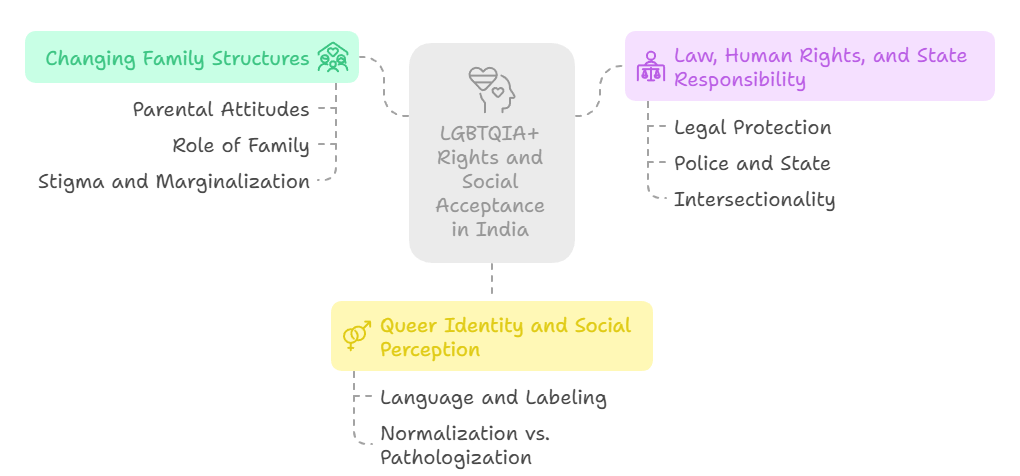
- Changing Family Structures and Social Acceptance
- Parental Attitudes: The case reveals the deep-rooted heteronormativity in Indian families, where parental expectations are often at odds with individual sexual orientation or gender identity.
- Role of Family: According to Talcott Parsons’ theory of family, the institution serves both expressive and instrumental functions. However, in the Indian context, the family often acts as an agent of social control, reinforcing traditional gender roles and marital norms.
- Stigma and Marginalization: Erving Goffman’s concept of ‘stigma’ is relevant here; LGBTQIA+ individuals face social labeling and discrimination within their own families, which can result in violence, forced conversion therapies, or confinement.
- Law, Human Rights, and State Responsibility
- Legal Protection: The Supreme Court decriminalized homosexuality (Section 377 IPC) in 2018, but legal recognition is not always matched by societal acceptance. This gap often leads to violence and denial of basic rights.
- Police and State: The court’s direction that police must provide protection to LGBTQIA+ couples is in line with the constitutional mandate of equality, dignity, and the right to life (Article 21).
- Intersectionality: As Kimberlé Crenshaw’s theory suggests, individuals may face multiple, intersecting forms of oppression—here, the intersections of gender, sexuality, family status, and legal rights.
- Queer Identity and Social Perception
- Language and Labeling: The judges’ observation on the use of ‘queer’ opens up debate about the role of language in shaping social attitudes. Judith Butler emphasizes that language can either reinforce or challenge heteronormativity.
- Normalization vs. Pathologization: The idea that there is ‘nothing strange or odd’ about gender identity or sexual orientation challenges the medical and moral discourses that have long pathologized LGBTQIA+ lives.
Conclusion
The Madras High Court’s progressive stand not only upholds constitutional values but also provides an opportunity to reflect on the intersections of law, society, and family in shaping LGBTQIA+ rights in India. This case is a rich example of how social norms, legal structures, and individual agency interact in the ongoing struggle for equality and justice.
PYQs
Paper 1:
- Discuss the changing nature of family and marriage in India with special reference to challenges faced by LGBTQIA+ individuals. (2023)
- How do stigma and labelling affect the social identity and integration of marginalized groups such as LGBTQIA+ in Indian society? (2022)
- Examine the role of law and judiciary in bringing about social change, with reference to the decriminalization of homosexuality in India. (2021)
- Discuss Erving Goffman’s concept of stigma. How is it relevant to the study of sexual minorities in India? (2020)
- What are the sociological implications of legal reforms related to gender and sexuality in India? Illustrate with recent examples. (2019)
- How has the women’s movement in India broadened to include the rights of sexual minorities? (2018)
- Explain the relationship between law and social change, using Section 377 as an example. (2017)
- Discuss the significance of gender identity and sexual orientation in shaping social stratification in contemporary India. (2017)
- Examine the role of family as an agent of social control in India. How does this affect LGBTQIA+ individuals? (2016)
- Discuss the concept of intersectionality and its relevance in understanding the lived experiences of Indian women and LGBTQIA+ individuals. (2015)
- How does the state regulate sexuality through law and policy in India? (2014)
Paper 2:
- Critically analyse the status of LGBTQIA+ rights in India after the Supreme Court’s verdict on Section 377. (2023)
- Discuss the role of judiciary and civil society in protecting the rights of sexual minorities in India. (2022)
- How do caste, class, and gender intersect in shaping the lives of LGBTQIA+ people in rural and urban India? (2021)
- Evaluate the effectiveness of legal reforms in ensuring equality for marginalized groups, especially sexual minorities, in India. (2021)
- Explain the challenges faced by same-sex couples in India with reference to family, law, and social attitudes. (2020)
- Discuss the impact of social movements in India in securing rights for LGBTQIA+ individuals. (2019)
- Examine the role of media and public discourse in shaping perceptions about gender and sexuality in Indian society. (2019)
- Write a note on the contemporary debates on same-sex marriage in India. (2018)
- Discuss the significance of the Madras High Court and other judicial interventions in safeguarding the constitutional rights of LGBTQIA+ persons. (2017)
- What are the sociological implications of social stigma attached to non-normative sexualities in India? (2016)
- Assess the impact of urbanization and modernization on the acceptance of alternative sexualities and family forms in India. (2016)
- Explain the factors contributing to the marginalization of sexual minorities in Indian society. Suggest measures for their inclusion. (2015)
- Examine the process of social exclusion and its impact on LGBTQIA+ communities in India. (2015)
- How has the law evolved in India with respect to gender and sexual minorities? (2014)
|


2 comments