Introduction:
Organised crime refers to criminal activities conducted by structured groups or criminal syndicates over a sustained period, often transcending national boundaries. It is one of the most pressing internal security threats faced by modern states, including India. Organised crime undermines governance, exploits vulnerable populations, and often has deep-rooted links with politics, business, and law enforcement agencies.
Types of Organised Crime in India

- Drug Trafficking: India’s geographical location makes it vulnerable to drug smuggling, particularly along the “Golden Crescent” and “Golden Triangle”.
- Human Trafficking and Child Trafficking: Major cities like Delhi and Mumbai are hotspots for trafficking for forced labour and sex work.
- Arms Smuggling and Terrorism: Linkages between organised crime and terrorism (nexus between underworld and terror outfits).
- Money Laundering and Hawala: Black money and unaccounted wealth, often routed through shell companies and informal networks.
- Cyber Crime: Rise of cyber syndicates and digital rackets, especially post-COVID-19.
- Organised Extortion and Land Mafia: Syndicates involved in land grabbing, real estate scams, and “protection rackets”.
Recent Trends & Current Affairs
- NCRB Data (2024) shows a surge in cyber-enabled organised crimes.
- Enforcement Directorate (ED) has increased crackdowns on money laundering under the Prevention of Money Laundering Act (PMLA).
- The Sand Mafia in Uttar Pradesh and Bihar, and the Coal Mafia in Jharkhand, are classic examples.
- International Collaboration: India’s partnership with INTERPOL to tackle cross-border crime.
Sociological Analysis
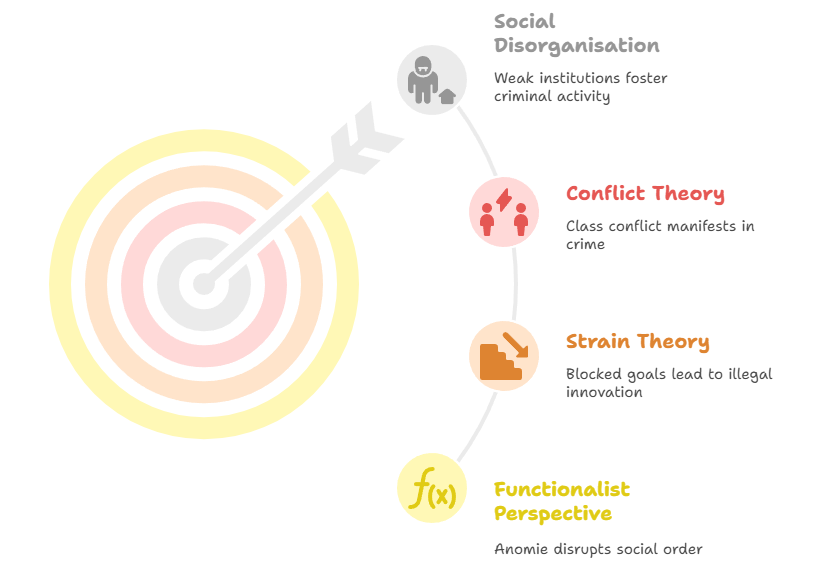
- Functionalist Perspective: Emile Durkheim argued that crime is “normal” to society, serving functions like boundary maintenance and social change. In the case of organised crime, however, anomie (normlessness) can lead to the breakdown of social order, especially in rapidly urbanising contexts.
- Strain Theory (Robert K. Merton): Organised crime arises when legitimate avenues to achieve culturally approved goals (wealth, status) are blocked, leading individuals to innovate—often through illegal means. For example, youth unemployment and socio-economic disparities fuel recruitment into criminal syndicates.
- Conflict Theory (Karl Marx): Organised crime is a manifestation of class conflict. The powerful may criminalise the poor, but also collude with criminal groups for profit and political control. Corruption and the “criminal-politician nexus” exemplify this in India.
- Social Disorganisation Theory (Shaw & McKay): High levels of migration, poverty, and lack of community control in urban slums foster organised criminal activity. Weak institutional enforcement enables mafia groups to provide “alternative governance”.
Organised Crime and State Response
Legislation:
- Maharashtra Control of Organised Crime Act (MCOCA)
- Prevention of Money Laundering Act (PMLA)
- Unlawful Activities (Prevention) Act (UAPA)
Institutional Mechanisms: Central Bureau of Investigation (CBI), National Investigation Agency (NIA), Financial Intelligence Unit (FIU)
Community Policing and Rehabilitation: De-addiction, skill training for at-risk youth.
Sociological Implications

- Erosion of Social Trust: Fear, extortion, and violence undermine community solidarity.
- Impact on Marginalised Groups: Women, children, migrants are disproportionately affected.
- State Legitimacy: Perception of state complicity or inefficacy can fuel vigilantism.
Conclusion
Combating organised crime requires a multi-pronged approach: legal reforms, effective policing, cross-border cooperation, and addressing underlying social inequalities. Sociological analysis is essential for understanding root causes and designing inclusive policies that target not just the symptoms, but the structures that enable organised crime.
PYQs
Paper I:
- What is ‘organised crime’? Examine the relevance of sociological theories in understanding the emergence and persistence of organised crime in modern societies.(2023)
- Examine the relationship between marginalisation, poverty, and crime with reference to urban slums in India.(2022)
- Critically analyse the concept of ‘white-collar crime’ as developed by Sutherland. What are the challenges in controlling such crimes in contemporary societies?(2020)
- How do anomie and social disorganisation contribute to the growth of crime in urban areas? Illustrate with examples from India.(2021)
- How is the functionalist perspective useful in understanding deviance and crime? Discuss with reference to Durkheim and Merton.(2019)
- Discuss the concept of ‘deviance’ and explain its relationship with social control mechanisms in Indian society.(2018)
- Discuss the major tenets of the Differential Association Theory of Sutherland. How far does it explain white-collar and organised crimes in society?(2017)
- Distinguish between street crime and organised crime. Examine the social factors facilitating the growth of organised crime in India.(2016)
Paper II:
- Examine the role of the state in controlling organised crime in India. Discuss with reference to recent legislations.(2023)
- Analyse the link between urbanisation and the emergence of new forms of crime such as cybercrime, organised rackets, and trafficking in Indian cities.(2022)
- How has the introduction of new technology affected the nature and extent of organised crime in India?(2022)
- Discuss the sociological factors contributing to the rise of criminal syndicates and mafia groups in urban India.(2021)
- Write a note on the sand mafia, coal mafia, and their socio-economic impact in India.(2020)
- Discuss the impact of organised crime and mafia groups on social institutions and everyday life in Indian society.(2019)
- How does human trafficking as an organised crime affect vulnerable groups in India? Suggest sociological measures for its prevention.(2018)
- Examine the role of corruption and the criminalisation of politics in the perpetuation of organised crime in India.(2017)
- Analyse the interrelationship between terrorism and organised crime in India, with recent examples.(2016)
- Discuss the role of law enforcement agencies and community initiatives in the prevention of organised crime.(2015)
|


One comment