
New Patterns of Inequality in Indian Society
(Relevant for Sociology Paper I: Stratification and Mobility and Sociology Paper II: Social Problems)
IntroductionInequality has been an enduring feature of Indian society, historically shaped by caste, class, gender, and religion. However, with the advent of liberalization, privatization, and globalization (LPG), new dimensions and patterns of inequality have emerged. These are no longer confined to traditional hierarchies but are now digitally embedded, regionally divergent, and economically complex. This blog explores the new patterns of inequality in India, such as digital divide, income inequality, urban-rural gap, educational disparity, social exclusion, gender inequality, and intergenerational mobility. Traditional vs. New Inequality:Traditional forms of inequality in India were largely structural and rooted in caste-based hierarchy, feudal land ownership, and patriarchal norms. However, in post-liberalization India, inequality is shaped by market forces, technological access, and policy design. It now cuts across urban-rural, digital-analog, formal-informal, and regional-development divides. New Patterns of Inequality in Indian Society
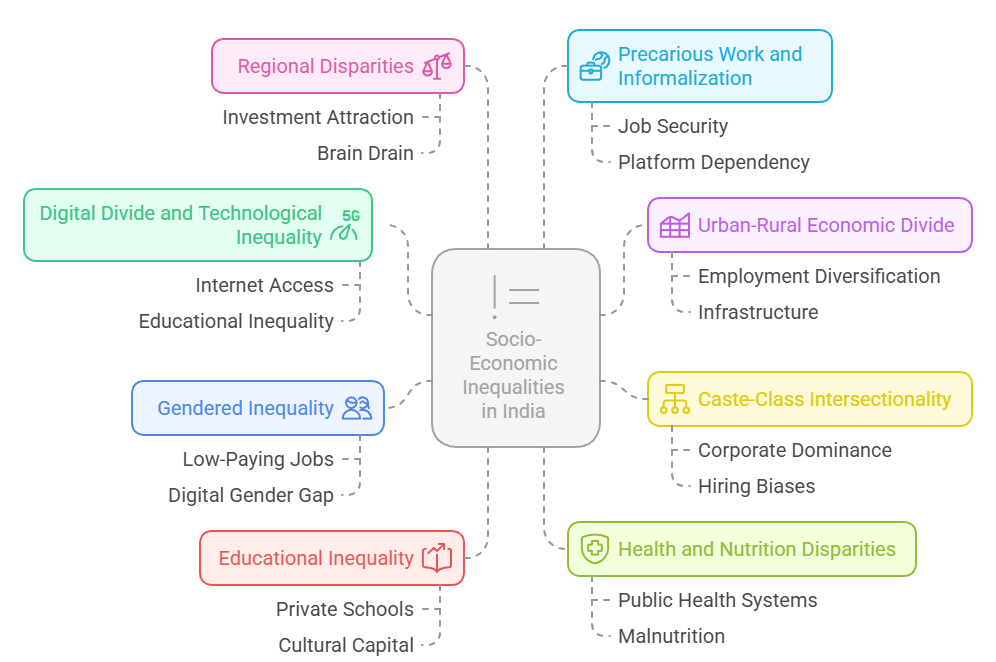
With the rise of digital governance, online education, fintech, and AI, access to technology has become a major determinant of opportunity. According to the NFHS-5, only 33% of women in rural India use the internet compared to 72% of urban men.
This form of inequality is invisible but potent, contributing to information asymmetry and class entrenchment.
India’s economic growth has been concentrated in urban corridors, particularly Tier-I and Tier-II cities. Rural regions suffer from:
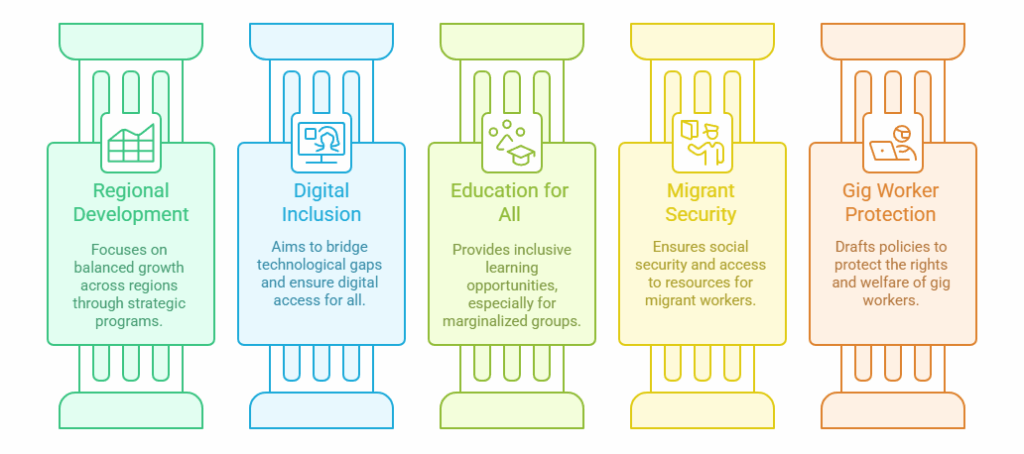
Schemes like PMGSY and Digital India aim to bridge the gap, but resource allocation remains uneven, aggravating regional inequality.
While constitutional safeguards have helped in affirmative action, the upper castes continue to dominate the corporate and entrepreneurial sectors. At the same time:
Sociologist André Béteille notes that economic liberalization has made class more important, but caste still shapes access to class.
Post-pandemic, female labor force participation fell below 20% (PLFS 2023), reflecting structural inequality in employment opportunities.
Feminist scholars like Nandini Sundar and Leela Dube argue that these inequalities are systemic, reinforced by both cultural norms and economic design.
Education has become a market commodity post-liberalization. Private schools and coaching centers dominate, leaving:
Bourdieu’s concept of cultural capital explains how the upper classes pass on educational privilege, reproducing class inequality.
While urban elites access premium healthcare, millions in rural India rely on overburdened public health systems.
These healths divide impacts life expectancy, productivity, and intergenerational mobility.
States like Maharashtra, Gujarat, Tamil Nadu, and Karnataka attract more investment and jobs, while Bihar, Jharkhand, Odisha, and parts of North-East remain underdeveloped. This leads to:
The Sociological concept of regionalism becomes critical in understanding development-linked identity politics.
The gig economy, while offering flexibility, creates a new class of digitally connected but economically insecure workers.
As Guy Standing argues, this rise of the precariat reflects a new class structure with no upward mobility or rights. Sociological Theories
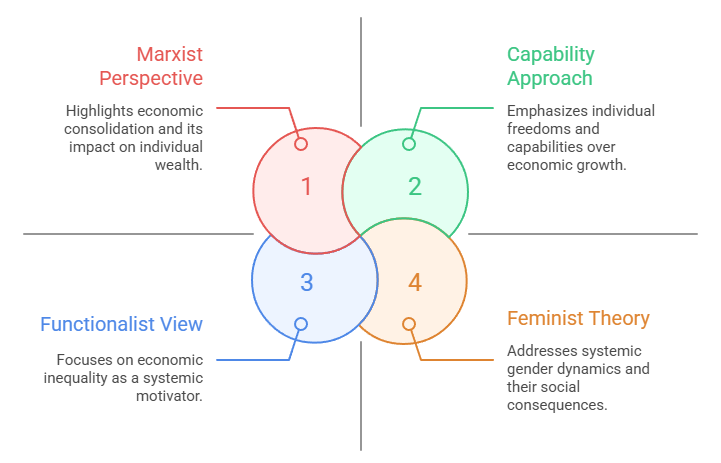
Marxists argue that economic liberalization has led to capitalist consolidation, where wealth is concentrated in the hands of a few. Inequality is no longer just a byproduct but a systemic necessity of the neoliberal order. The rich-poor gap widens as the surplus value extracted from labor benefits only the elite.
Functionalists see inequality as necessary to motivate achievement and efficiency. However, new forms of inequality, such as the digital divide, are not merit-based and hence threaten social stability and value consensus, creating dysfunctions.
Feminist sociology reveals how new technologies, labor structures, and policies have failed to address gendered power dynamics. Women are expected to conform to caregiver roles while also participating in the economy—leading to double burden syndrome and systemic exclusion.
Sen emphasizes enhancing capabilities and freedoms, not just income. He critiques current policy focus on GDP growth, which hides capability deficits among marginalized communities. Inequality, for Sen, is about freedom to lead a life of one’s choosing. Government Initiatives to Tackle New Inequality
Despite these steps, implementation bottlenecks, underfunding, and lack of awareness limit impact. ConclusionIndia’s inequality landscape is evolving, shifting from visible caste or class hierarchies to digital, spatial, and structural divides. These new patterns of inequality are complex and multi-layered, cutting across technology, gender, education, region, and labor. A sociological analysis helps unpack these layers, challenging superficial narratives of growth and inclusion. It is critical to go beyond economics and explore how social structures, policies, and cultural norms interact to produce new exclusionary patterns. To build a truly inclusive society, India must prioritize universal access to technology, quality education, healthcare, and livelihood security, alongside sustained efforts to eliminate social prejudice. PYQsPaper 1
Paper 2
|
To Read more topics, visit: www.triumphias.com/blogs
Read more Blogs:
On the Occasion of Teachers Day | Ethics for UPSC Civil Services Examination | Triumph IAS