
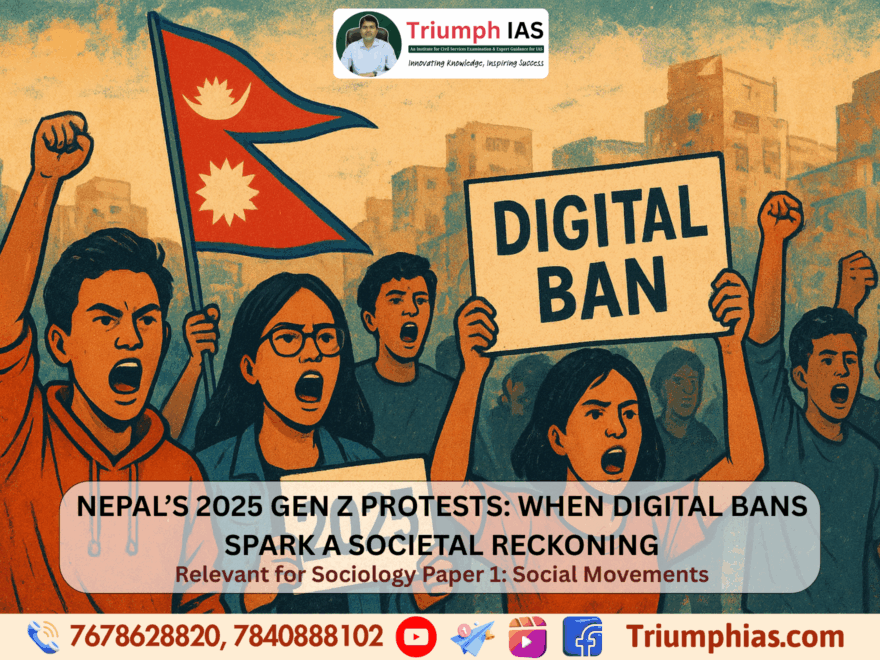
Nepal 2025 Gen Z Protests: When Digital Bans Spark a Societal Reckoning
(Relevant for Sociology Paper 1: Social Movements)
Introduction: Nepal 2025 Gen Z protestsRecently, Nepal erupted into nationwide protests—not just about a government social media ban, but a deeper demand for justice, transparency, and representation. This uprising, led by Generation Z, reveals not only a clash over digital space but also a profound moment of social transformation. To truly understand this event, we need to explore not just what happened, but why it happened—and what it means for Nepal’s society. What Sparked the Protests?The immediate cause was the Nepalese government’s sudden ban on 26 social media platforms like Facebook, YouTube, X (formerly Twitter), and Instagram. The government claimed this was to enforce new digital taxes and regulations, but for most young people, it felt like a blatant attempt to silence dissent and restrict their freedom of expression. Why does this matter? Because for Nepal’s youth—especially Gen Z, who have never known a world without the internet—these platforms are not just places to share memes or chat with friends. They are essential spaces for information, community, political expression, and even economic survival. When those digital spaces were abruptly cut off, it wasn’t just an inconvenience. It was a symbolic and practical attack on the voice and agency of a whole generation. Generation Z: More Than Digital Natives
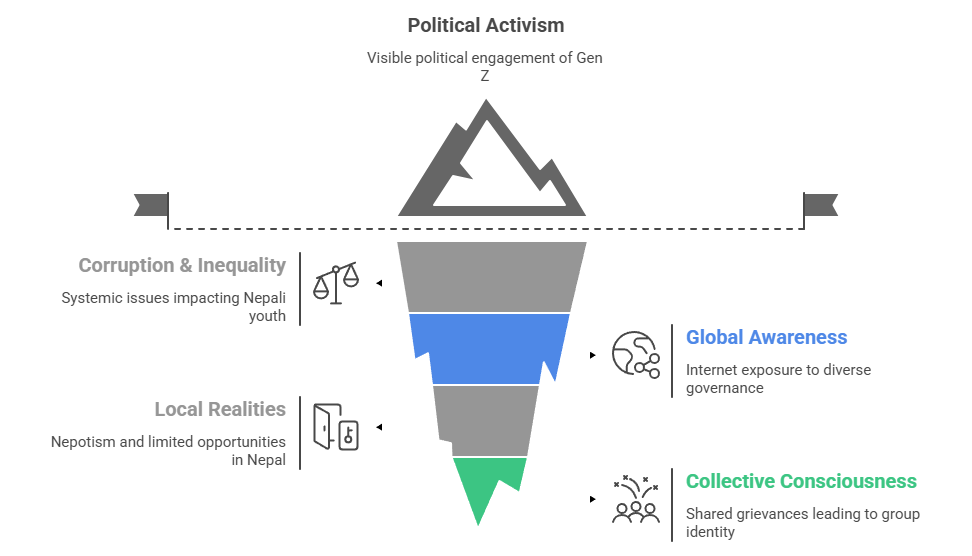
This leads us to a core sociological insight: Generation Z in Nepal isn’t just a group of tech-savvy kids; they are emerging political actors with a collective identity shaped by the unique challenges of their time. Growing up in a country grappling with corruption, economic inequality, and fragile democracy, these young people experience a double burden. On one hand, they are connected globally through the internet, aware of different ideas of freedom and governance. On the other, they face local realities of nepotism, poor governance, and limited opportunities. This tension gave rise to a powerful collective consciousness among Nepali youth. Sociologist Charles Tilly’s theory on social movements explains this well: when people share grievances and discover others who feel the same, they begin to see themselves as a group capable of demanding change. For Nepali Gen Z, the social media ban was a shared grievance that crystallized into a collective demand for transparency, accountability, and democracy. Social Media: The New Public SquareHistorically, public squares and town halls were where citizens gathered to debate and influence politics. Today, for many young people around the world—and particularly in Nepal—social media platforms function as the modern public square. Philosopher Jürgen Habermas called this the “public sphere,” a space for dialogue between citizens and the state. When the government blocked social media, it was essentially shutting down this crucial arena for public discourse. The ban ignited protests not just because access was denied, but because it threatened the very fabric of political participation and free speech. It was an attempt by the state to reassert control over information flows and curtail the growing power of youth voices amplified online. Unequal Power: Corruption and Nepotism
But there’s a bigger backdrop to these protests: the entrenched system of corruption and nepotism that shapes Nepalese politics and society. In everyday life, many Nepalis see the stark contrast between their struggles and the lavish displays of wealth and privilege by political elites—often flaunted on social media. This visible inequality generates resentment and distrust toward the ruling class. Sociologist Pierre Bourdieu’s concepts of social capital and symbolic power help us understand this dynamic. The elite’s economic and cultural capital allows them to dominate political institutions, perpetuating cycles of privilege. The “Nepo Kid” culture, where family connections override merit, fuels a sense of exclusion among the youth. The Gen Z protests were as much a revolt against this system of inequality as they were about digital censorship. New Forms of Activism: Decentralized and DigitalThe protests also highlight a shift in how social movements operate in the digital age. Unlike traditional protests led by political parties or unions, these were organized through online networks like Discord, Instagram, and community NGOs such as Hami Nepal. Sociologist Manuel Castells describes such movements as “networked social movements,” decentralized but coordinated through digital platforms. This structure allows rapid mobilization, greater inclusivity, and resilience, but it also presents challenges, such as vulnerability to misinformation and state surveillance. Nepal’s Gen Z activists exemplify this hybrid model of activism, blending online communication with street protests to demand change. The State’s Response: Repression and NegotiationThe government’s response—violent crackdowns, use of live ammunition, and curfews—reflects a common pattern in authoritarian or semi-authoritarian states facing popular uprisings. Sociological research on contentious politics shows that repression can sometimes deter protests but often escalates conflicts by increasing grievances. In Nepal, repression initially deepened anger but eventually forced political concessions, such as the resignation of Prime Minister K.P. Sharma Oli and the appointment of Sushila Karki, Nepal’s first female interim Prime Minister. This cycle of repression and negotiation underscores the fragile balance between state power and citizen demands in a democracy under stress. Gender and Political ChangeThe appointment of Sushila Karki is a landmark moment in a male-dominated political system. From a feminist sociological perspective, this signals potential openings for gender inclusion and challenges to patriarchal power structures. Her leadership, emerging in the aftermath of youth-led protests, also reflects how social movements can open space for marginalized voices in politics. Theorists and Their Views
Several sociological thinkers help illuminate the dynamics behind Nepal’s Gen Z protests:
Together, these thinkers frame the protests as a complex interplay of identity, power, communication, and resistance. Looking Forward: Democracy in the Digital AgeThe Nepal protests show how deeply democracy is intertwined with digital technology and youth participation. Robert Putnam’s work on social capital teaches us that democratic health depends on trust and active civic engagement. When young people are excluded or silenced, democracy weakens. For Nepal, the 2025 protests are a wake-up call: meaningful reform requires listening to youth, ensuring transparency, and safeguarding digital freedoms. Conclusion: A Generation Demanding ChangeNepal’s Gen Z protests were far more than a reaction to a social media ban. They represent a generational demand to reshape the country’s political and social landscape—to dismantle corruption, claim digital spaces, and build a more just and democratic society. This movement exemplifies the power of youth activism in the digital era and reminds us that social media is not just a communication tool, but a critical space for political and social life. As Nepal moves forward, the voices of its young generation will continue to shape the future—both online and in the streets. |


To Read more topics, visit: www.triumphias.com/blogs
Read more Blogs:
Bringing India Northeast into the Sociological Mainstream: A Civilizational Imperative