Introduction: Neoliberal policies
Since the 1991 economic liberalization, neoliberal policies in India have significantly transformed the labour market. Characterized by market deregulation, privatization, and downsizing of the public sector, these reforms have altered the structure of employment, contributing to rising informalisation, contractualization, and precarity in the world of work. From a sociological perspective, this shift raises questions about social security, labour rights, and inequality, especially for marginalized communities.
Key Features of Neoliberal Labour Policies in India
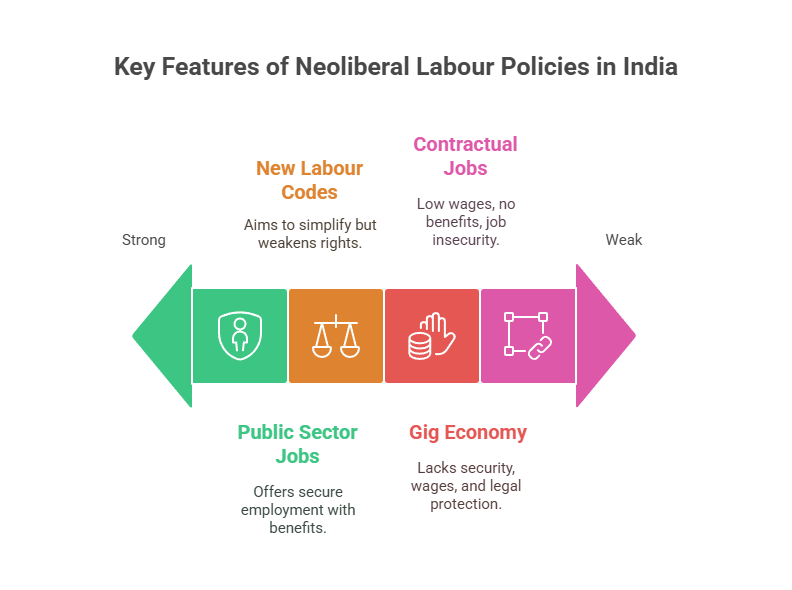
- Decline of Formal Employment: Neoliberal reforms have led to a steady decline in public sector jobs due to disinvestment and downsizing. The focus has shifted to the private sector, which often offers employment lacking job security, fixed tenure, or social benefits.
- Rise of Informal and Gig Work: Over 90% of India’s workforce is employed in the informal sector. Neoliberalism has promoted the gig economy through app-based platforms like Zomato and Uber, where workers are classified as “partners” with no social security, fixed wages, or legal protections.
- Labour Market Flexibility: To attract investments and promote ease of doing business, labour laws have been restructured to favor employers. The New Labour Codes (2019–2020), though aimed at simplification, have been criticized for weakening collective bargaining and labour rights.
- Outsourcing and Contractualization: Companies increasingly rely on third-party contractors to hire workers, reducing their own legal and social obligations. This results in contractualization of jobs with low wages, no benefits, and constant job insecurity for workers.
Sociological Analysis
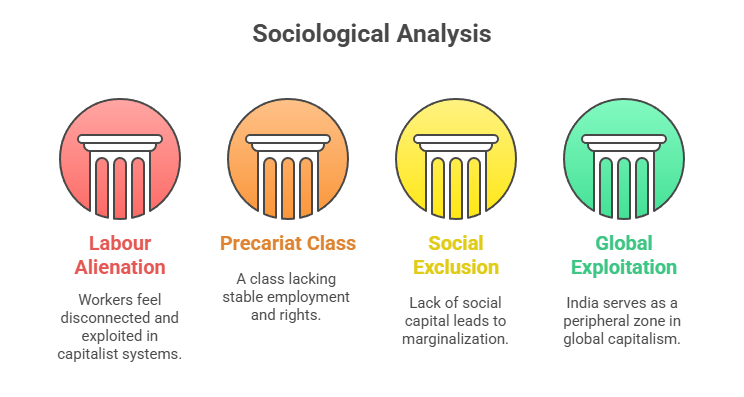
- Labour Alienation and Exploitation: Marx’s theory highlights that in capitalist systems, workers become alienated from their work, lacking control or connection to the product. In India, gig and contract workers often feel expendable and disconnected, mirroring Marx’s idea of the commodification of labour.
- Precariat Class: Guy Standing describes a new class—the “precariat”—that lacks stable employment, identity, or access to rights. India’s gig workers and informal labourers reflect this class, as they operate without benefits, job guarantees, or institutional support.
- Social Capital and Exclusion: Pierre Bourdieu’s concept shows how lack of social capital marginalizes informal workers. With no access to networks, legal systems, or protective institutions, they are systematically excluded from upward mobility and trapped in cycles of poverty.
- World Systems Theory: According to Wallerstein, countries like India serve as peripheral zones in global capitalism, providing cheap labour to multinational corporations. Neoliberal labour restructuring thus deepens global labour exploitation under the guise of economic growth.
Impacts on Society
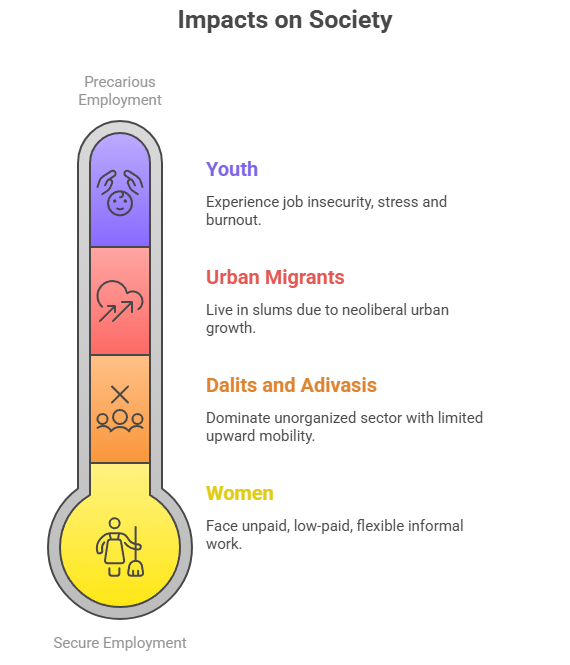
- Gender Disparity: Women are pushed into unpaid, low-paid, and flexible informal work.
- Caste and Class Inequality: Dalits and Adivasis dominate the unorganized sector with little opportunity for upward mobility.
- Urban Migration: Neoliberal urban growth has led to the proliferation of slums and informal labour colonies.
- Mental Health Crisis: Job insecurity has increased stress, burnout, and economic vulnerability among youth.
Contemporary Relevance
- PLFS (Periodic Labour Force Survey) 2023-24 shows stagnant labour force participation despite GDP growth.
- Gig Workers’ Unionization Movements are rising across India demanding rights and benefits.
- The Supreme Court recently recognized social security rights of gig workers as “essential for dignity.”
Conclusion
Neoliberal policies in India have redefined the nature of labour and employment, privileging economic efficiency over social justice. While creating new forms of work, they have simultaneously deepened vulnerabilities for the majority of the workforce. For policymakers, sociologists, and UPSC aspirants, understanding these structural shifts is key to addressing India’s employment crisis and social inequality.
PYQs
Paper 1
- How has the concept of alienation been used to understand the condition of workers in capitalist societies? – (2021)
- Discuss the concept of ‘precariat’ as a class in contemporary labour markets. – (2020)
- Explain how globalisation has affected the nature of work and employment in contemporary societies. – (2019)
- Examine the impact of post-industrial society on the nature of work. – (2016)
- What is meant by the term ‘contractualisation of labour’? How does it affect the class structure? – (2015)
- Explain the significance of ‘labour in the informal sector’ in the context of developing countries. – (2014)
- Critically examine the role of State in labour-capital relations in the neoliberal era. – (2013)
Paper 2
- Discuss how neoliberal economic reforms have affected labour relations in India. – (2023)
- Examine the growth of the gig economy and its implications for workers’ rights in India. – (2022)
- Critically examine the implications of New Labour Codes on workers in the unorganised sector. – (2020)
- Analyse the consequences of economic liberalisation on employment patterns in rural and urban India. – (2018)
- Write a note on the emergence of ‘footloose labour’ in the context of rural distress. – (2017)
- Examine the gender dimension of informal labour in India. – (2016)
- Discuss the challenges faced by trade unions in India in the context of a liberalised economy. – (2015)
|