Human civilization has advanced by responding to needs—food, shelter, security, dignity, and meaning. From the earliest hunter-gatherer communities to contemporary digital societies, need has acted as the primary driver of innovation, cooperation, and institutional development. However, when need ceases to be a measure of sufficiency and becomes an instrument for excess, it gradually mutates into greed. It is at this inflection point that a civilizational paradox emerges: the very impulse that once ensured survival begins to corrode moral foundations.
Hence, the aphorism “Need brings greed; if greed increases, it spoils breed” captures a profound ethical, social, and ecological truth. It suggests that unchecked greed not only degrades individual character but also contaminates social reproduction—of values, institutions, and even biological survival. Therefore, examining this idea is essential in an age marked by consumerism, inequality, environmental degradation, and ethical erosion.
MAIN BODY:
At the outset, it is important to distinguish between need and desire. Need is rooted in survival and dignity, whereas desire is often socially constructed and potentially limitless. Philosophers from Aristotle to Gandhi have emphasized moderation as the ethical mean. Aristotle’s concept of the “golden mean” argued that virtue lies between excess and deficiency, implying that needs must be satisfied without tipping into excess. Similarly, Gandhi’s assertion that “the world has enough for everyone’s need but not for everyone’s greed” highlights the moral economy of sufficiency.
Moreover, from a sociological perspective, needs are socially defined and historically contingent. Karl Marx viewed needs as shaped by modes of production, arguing that capitalism systematically expands needs to sustain accumulation. Consequently, what begins as genuine necessity often becomes artificially inflated consumption. Thus, while need is natural and inevitable, its social mediation determines whether it remains benign or degenerates into greed.
While need is finite, greed is inherently insatiable. This transition often occurs subtly, legitimized by narratives of growth, success, and competition. Adam Smith acknowledged self-interest as a driver of economic activity but cautioned against moral decay in The Theory of Moral Sentiments. In contrast, unregulated markets tend to normalize accumulation without ethical restraint.
Furthermore, globalization and consumer culture have accelerated this transition. Advertising, social media, and competitive lifestyles constantly redefine sufficiency upwards. As a result, individuals are encouraged not merely to meet needs but to outperform peers. Consequently, greed is no longer viewed as a vice but as ambition. This normalization marks a critical moral shift, wherein excess is celebrated and restraint is ridiculed.
As greed intensifies, it corrodes individual ethics. Psychological studies indicate that excessive materialism is associated with lower well-being, empathy, and life satisfaction. From a philosophical standpoint, greed narrows moral vision, reducing relationships to transactions and people to means rather than ends, in Kantian terms.
Moreover, greed fosters a culture of shortcuts—corruption, deceit, and exploitation. When success is measured solely by accumulation, ethical considerations become secondary. Consequently, individuals may rationalize immoral actions as necessary for survival or competitiveness. Thus, greed does not merely add vices; it displaces virtues such as compassion, honesty, and self-restraint.
Moving from the individual to the collective, the spoiling effect of greed becomes more pronounced. Societies characterized by extreme inequality often exhibit lower social trust, higher crime rates, and political instability. Thomas Piketty’s analysis of capital accumulation demonstrates how unchecked greed leads to concentration of wealth, undermining democratic ideals.
Furthermore, greed-driven systems exacerbate social exclusion. When resources are hoarded by a few, the many are deprived of basic needs. This not only violates principles of distributive justice, as articulated by John Rawls, but also erodes social cohesion. Consequently, societies become polarized, breeding resentment and conflict. In this sense, greed spoils the “breed” by weakening the moral and institutional fabric that sustains collective life.
Institutions are meant to mediate needs fairly; however, when greed infiltrates them, their legitimacy erodes. Political corruption, regulatory capture, and corporate malfeasance are manifestations of institutionalized greed. Max Weber warned against the “iron cage” of rationality, where efficiency eclipses ethical purpose.
In democratic systems, excessive influence of money distorts representation, turning public office into private gain. Similarly, in markets, profit-maximization without accountability leads to exploitation of labor and consumers. Thus, greed not only spoils individuals but also hollows out institutions, transforming them from instruments of public good into vehicles of private enrichment.
Perhaps the most literal interpretation of “spoiling breed” lies in environmental degradation. Human greed has pushed ecological systems to the brink. The relentless extraction of resources, driven by consumption beyond need, has resulted in climate change, biodiversity loss, and pollution.
From an ecological ethics perspective, this represents a failure to recognize intergenerational justice. Philosophers like Hans Jonas argued for an “ethic of responsibility” towards future generations. Greed, however, prioritizes immediate gain over long-term sustainability. Consequently, the biological basis of human survival is endangered, making greed not merely immoral but existentially threatening.
Greed also spoils the cultural “breed” by transmitting distorted values to future generations. When success is equated with wealth alone, education becomes instrumental rather than transformative, and relationships become utilitarian. Children raised in such environments may internalize competition over cooperation and entitlement over empathy.
Moreover, cultural narratives glorifying excess undermine traditions of restraint and sharing. As Emile Durkheim noted, anomie arises when norms lose their regulatory power. Greed-induced anomie leads to moral confusion, where boundaries between right and wrong blur. Thus, the spoiling of breed is not only biological or social but also cultural and moral.
Despite these challenges, history also offers countercurrents. Religious and philosophical traditions across cultures advocate restraint—Buddhist detachment, Islamic moderation (wasatiyyah), and Confucian harmony. Modern movements such as sustainable development, ethical consumption, and corporate social responsibility attempt to re-anchor economic activity in moral frameworks.
Furthermore, the concept of “enoughness,” advocated by thinkers like E.F. Schumacher in Small Is Beautiful, challenges the growth-at-all-costs paradigm. By redefining prosperity in terms of well-being rather than accumulation, societies can reconcile need with sustainability.
To prevent greed from spoiling breed, deliberate interventions are required. At the policy level, progressive taxation, welfare systems, and environmental regulations can curb excess. At the institutional level, transparency and accountability mechanisms are essential. However, structural measures alone are insufficient without moral renewal.
Education plays a crucial role in cultivating ethical reasoning and empathy. Civic education that emphasizes responsibility alongside rights can counteract greed-driven individualism. Additionally, cultural narratives must shift from glorifying accumulation to celebrating contribution and restraint.
Ultimately, the aphorism under consideration invites reflection on limits. Modernity often views limits as constraints to be overcome. However, philosophers like Ivan Illich and ecological thinkers argue that limits are enabling—they preserve balance and meaning. Greed arises when limits are denied; decay follows when limits are breached.
Thus, need must be understood not merely as economic demand but as a moral compass. When guided by wisdom, need fosters creativity and cooperation. When distorted by greed, it leads to decay and destruction. The challenge, therefore, is not to eliminate desire but to discipline it through ethical reflection.
CONCLUSION:
In conclusion, “Need brings greed; if greed increases, it spoils breed” encapsulates a timeless warning. Need is the engine of human progress, but greed is its corrosive excess. When greed dominates, it deforms individual character, fractures societies, corrupts institutions, degrades ecosystems, and transmits distorted values across generations. Conversely, when need is tempered by restraint, justice, and responsibility, it sustains both material prosperity and moral integrity.
Therefore, the task before contemporary society is to reclaim the moral distinction between sufficiency and excess. By reasserting ethical limits and redefining success beyond accumulation, humanity can ensure that need remains a source of growth rather than decay. In doing so, it can prevent greed from spoiling the breed—biological, social, and moral—and secure a sustainable and dignified future for generations to come.
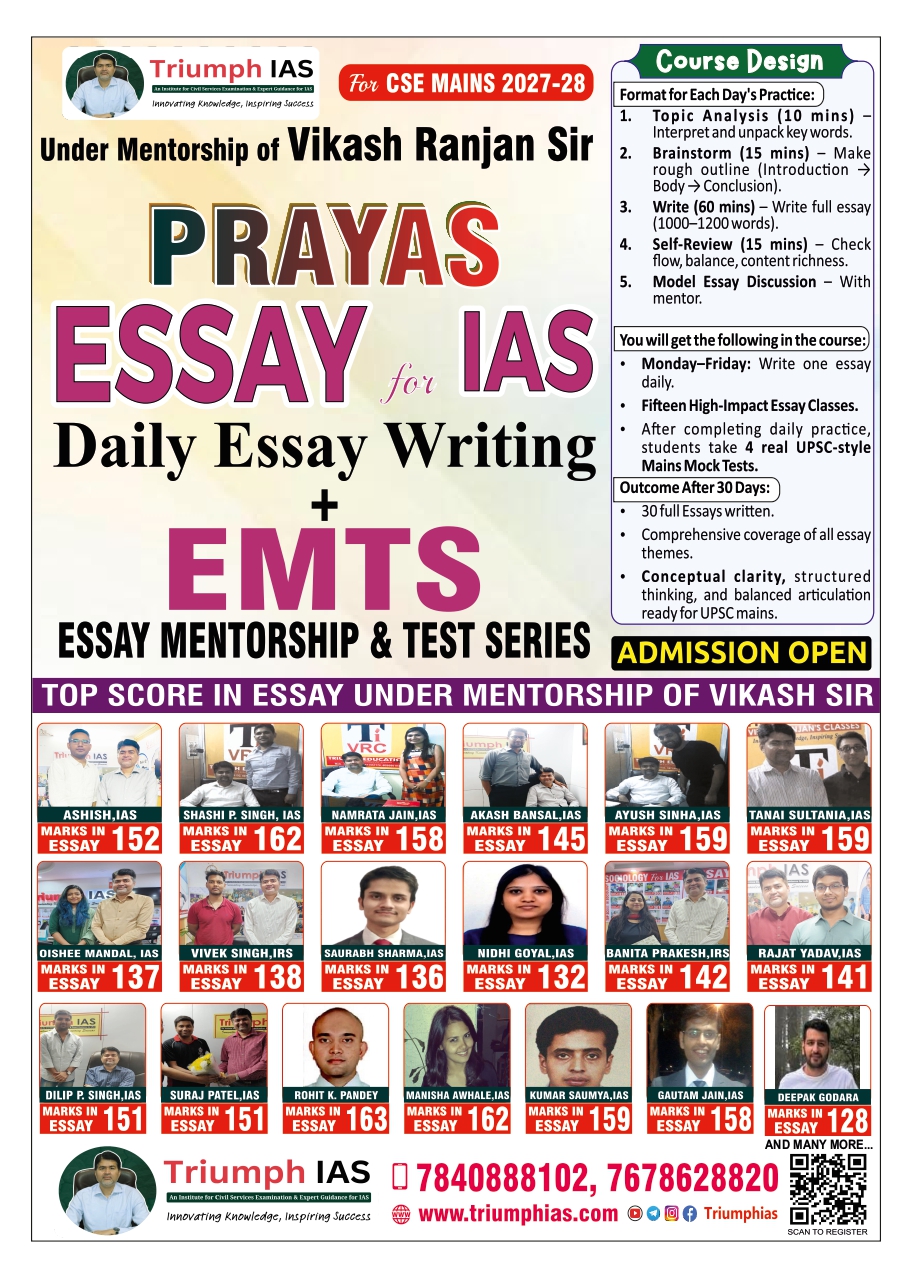
If you’re preparing for the UPSC Civil Services Examination (CSE), one paper that can unlock exceptional scores and a top rank is the Essay Paper. While General Studies and Optional Subjects are structured and syllabus-driven, the Essay writing segment is where individuality, critical thinking, and articulation truly shine.
Among various Essay programs available across India, Triumph IAS, under the expert mentorship of Vikash Ranjan Sir, offers the Best Essay writing Course for UPSC CSE. This comprehensive guide explores what makes this program unparalleled and why it should be part of every serious aspirant’s preparation strategy.