
NAVYA and the Sociology of Skilling
(Relevant for Sociology Paper 1: Stratification and Mobility)
|
The launch of the NAVYA initiative under PMKVY 4.0 to skill adolescent girls aged 16–18 in emerging sectors like AI, cybersecurity, and digital marketing is being framed as a leap towards gender justice. But from a sociological perspective, NAVYA represents more than a training program — it is a social experiment unfolding within entrenched structures of patriarchy, class inequality, education gaps, and cultural norms. Skill vs. Structure: What Are We Training Girls For?While NAVYA aims to skill girls for emerging sectors, the real question is — are we skilling them for integration or assimilation into a system that is already structurally exclusive? Structural Functionalist Lens (Parsons, Merton)NAVYA presumes that skill development will allow girls to perform “instrumental roles” in the economy. But in a society where expressive roles (domestic work, caregiving) are still socially assigned to women, vocational training risks being a band-aid over deeper gender role socialisation. Unless NAVYA also challenges gendered socialisation, the same girls trained in AI may still be forced into early marriage, domesticity, or underpaid informal jobs. Feminist Theories and NAVYA: Emancipation or Accommodation?
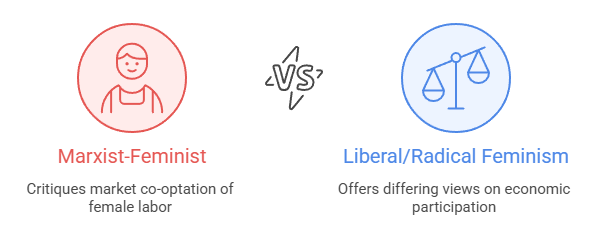
Marxist-Feminist LensFrom a Marxist-feminist perspective, NAVYA could be viewed as the commodification of adolescent female labour to meet market needs — integrating girls into sectors not for their empowerment, but for filling market shortages. Skilling becomes a form of reproductive labour repurposed for the market. As Silvia Federici would argue, this is not liberation — it is capitalist co-optation of gendered bodies under the guise of empowerment. Liberal Feminism vs. Radical Feminism
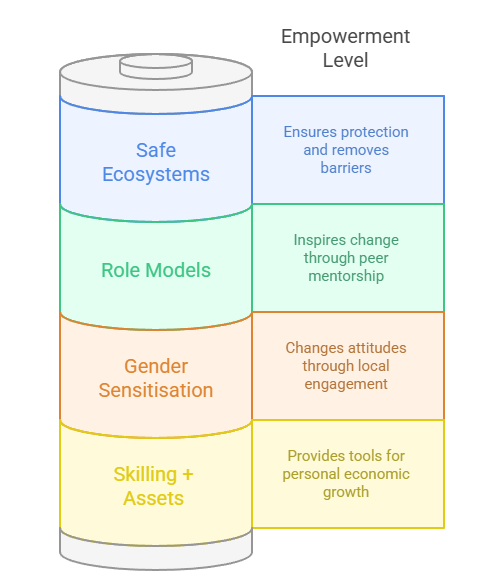
NAVYA might get girls into tech labs — but can it get patriarchy out of their homes? Intersectionality: Caste, Class, and RuralityKimberlé Crenshaw’s intersectionality theory is deeply relevant here. Most girls targeted by NAVYA are from aspirational districts — code for backward, marginalised, or rural regions. Their barriers to economic entry are not just gender, but caste, class, and geographic exclusion. A Dalit girl in Bihar entering a drone-training program doesn’t just need skills — she needs social capital, network access, legal protection, and a cultural shift in her family’s perception of female work. Sociologist Leela Dube has long highlighted how rural patriarchy and caste purity norms restrict girls’ mobility and choices. NAVYA must thus be understood not just as training, but as potential caste-class transgression, which invites social backlash if not supported holistically. The Indian Family and Girlhood: Sociology of AdolescenceGirlhood in India is not an individual stage — it’s a collective social position. NAVYA targets girls aged 16–18, an age deeply entangled with family honour, marriage negotiations, and gender policing in Indian society. According to Patricia Jeffrey and Roger Jeffery, in rural India, adolescent girls are seen as family property — to be protected, controlled, and ultimately “settled” through marriage. In such a setting, offering skilling without tackling the patriarchal family institution limits outcomes. NAVYA’s inclusion of POSH and POCSO awareness is crucial — but awareness alone cannot fight against normative structures that normalize gendered violence and control. Beyond Skills: Towards Sociological EmpowermentNAVYA’s modules on financial literacy, health, life skills indicate an attempt at holistic empowerment. From a sociological lens, this is the space where transformative potential exists. Empowerment is not about access — it is about autonomy.Drawing from Bina Agarwal, empowerment must be measured by:
NAVYA must therefore be assessed not by job placements alone, but by:
Sociological Suggestions for Strengthening NAVYA
Conclusion: NAVYA as a Sociological Project, Not Just a Skilling SchemeThe NAVYA initiative, while technocratic in design, is fundamentally a sociological project. It touches upon key themes of gender, youth, empowerment, and structural inequality. But to realise its emancipatory potential, it must go beyond vocational training and enter the realm of social transformation. True empowerment is not when girls are trained to work, but when they are free to choose whether to work, how to work, and on what terms. |
To Read more topics, visit: www.triumphias.com/blogs
Read more Blogs:
PM Dhan-Dhaanya Krishi Yojana: A Sociological Lens on Rural Transformation
Pharmaceutical Safety and the State: A Sociological Lens on Schedule M Reforms