
Modernizing India’s Public Distribution System (PDS): A Sociological Reflection on Digital Governance, Welfare, and Social Justice
(Relevant for Sociology Paper 1 & 2: Social change in Modern Society and Rural and Agrarian transformation in India)
|
The Public Distribution System (PDS) has long been a foundation of India’s welfare architecture, designed to ensure that the state fulfils its ethical and constitutional obligation to protect citizens from hunger. With the government launching a series of digital initiatives—including Bhandaran 360, ANNA DARPAN, ASHA, Smart EXIM Warehouse System, and modern steel silos—the PDS is entering a transformative phase focused on transparency, efficiency, and accountability. Yet the sociological significance of this transformation extends beyond technology; it raises deeper questions about welfare delivery, class and caste-based deprivation, digital inequality, power relations, and state–citizen interaction. This moment is an opportunity to analyze PDS not just as an economic system but as a social institution that mediates survival, dignity, and democratic citizenship. Understanding PDS through Sociological Lenses
The PDS is a welfare instrument under the Ministry of Consumer Affairs, providing essential commodities at subsidized rates to vulnerable households under the National Food Security Act (NFSA), 2013. From a sociological perspective, welfare programs such as PDS function as mechanisms of social protection, reducing vulnerability, enabling life chances, and preventing structural inequality from deepening.
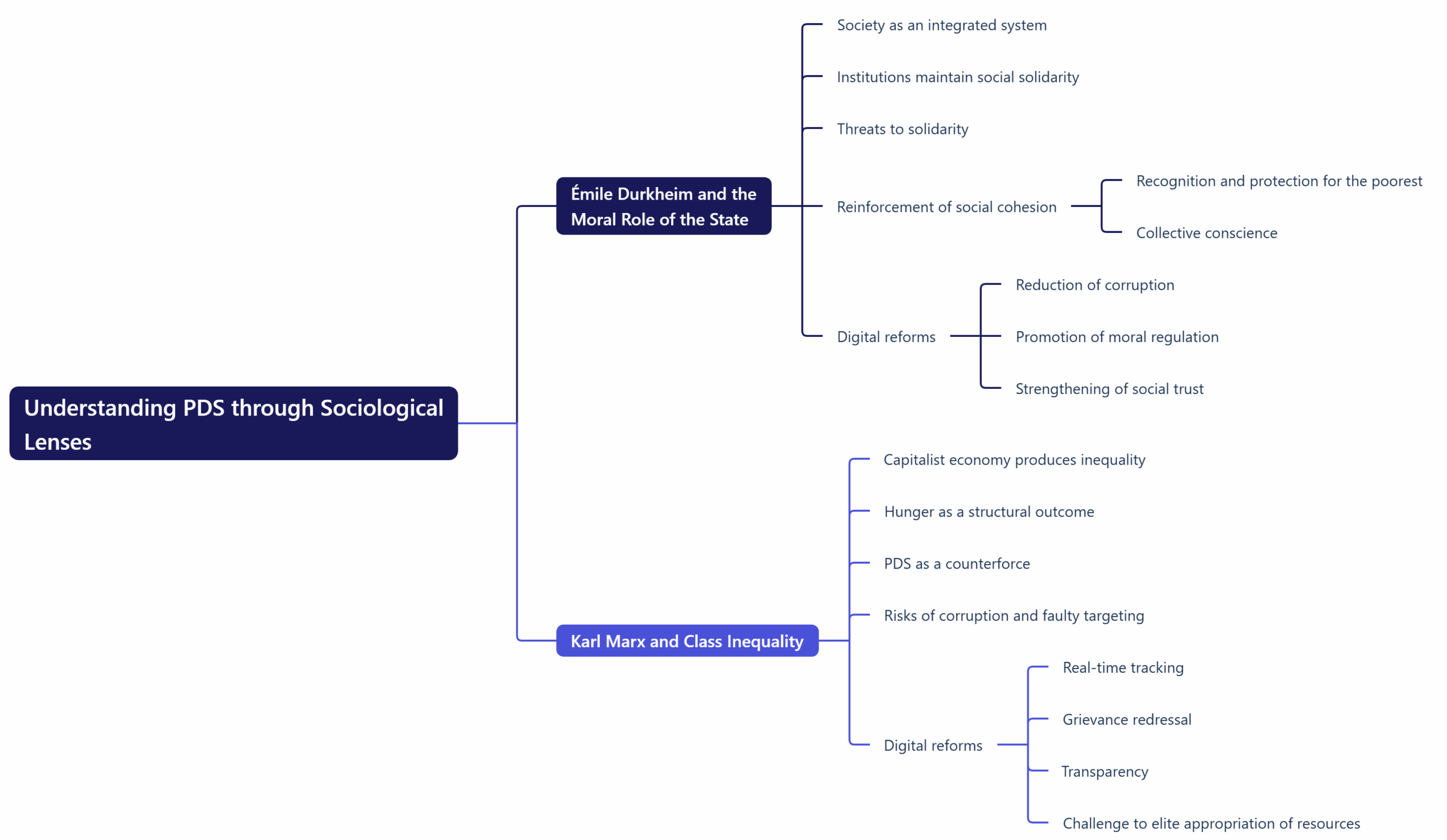
Durkheim viewed society as an integrated system where institutions maintain social solidarity. Hunger and starvation threaten this solidarity by eroding trust in institutions and intensifying anomie (social disorder). Welfare programs like PDS reinforce social cohesion by ensuring that even the poorest groups feel recognized and protected by the collective conscience. Digital reforms that reduce corruption promote what Durkheim calls moral regulation, strengthening social trust.
Marx argued that the capitalist economy inherently produces inequality and exploitation. Hunger is not an accidental problem but a structural outcome of unequal distribution and class oppression. PDS acts as a counterforce—an attempt by the state to mitigate exploitative market forces. However, if corruption, leakage, and faulty targeting exclude the poor, the system reinforces class conflict. Digital reforms such as real-time tracking, grievance redressal, and transparency challenge what Marx called the appropriation of public resources by elites. Digital Initiatives: A Step Toward Technological RationalityRecent reforms include:
Max Weber’s Bureaucratic RationalizationWeber believed modern societies rely on rational-legal authority and formal systems. PDS historically suffered from what Weber called bureaucratic red tape and inefficiency. Digital platforms automate tracking, decision-making, and monitoring, replacing discretionary control with standardized processes. This transition exemplifies Weber’s idea of rationalization, shifting welfare from personal domination to rule-based governance. Talcott Parsons & System IntegrationParsons argued that institutions must adapt to maintain equilibrium. Digital modernization fulfils the AGIL framework:
Structural Challenges That Persist
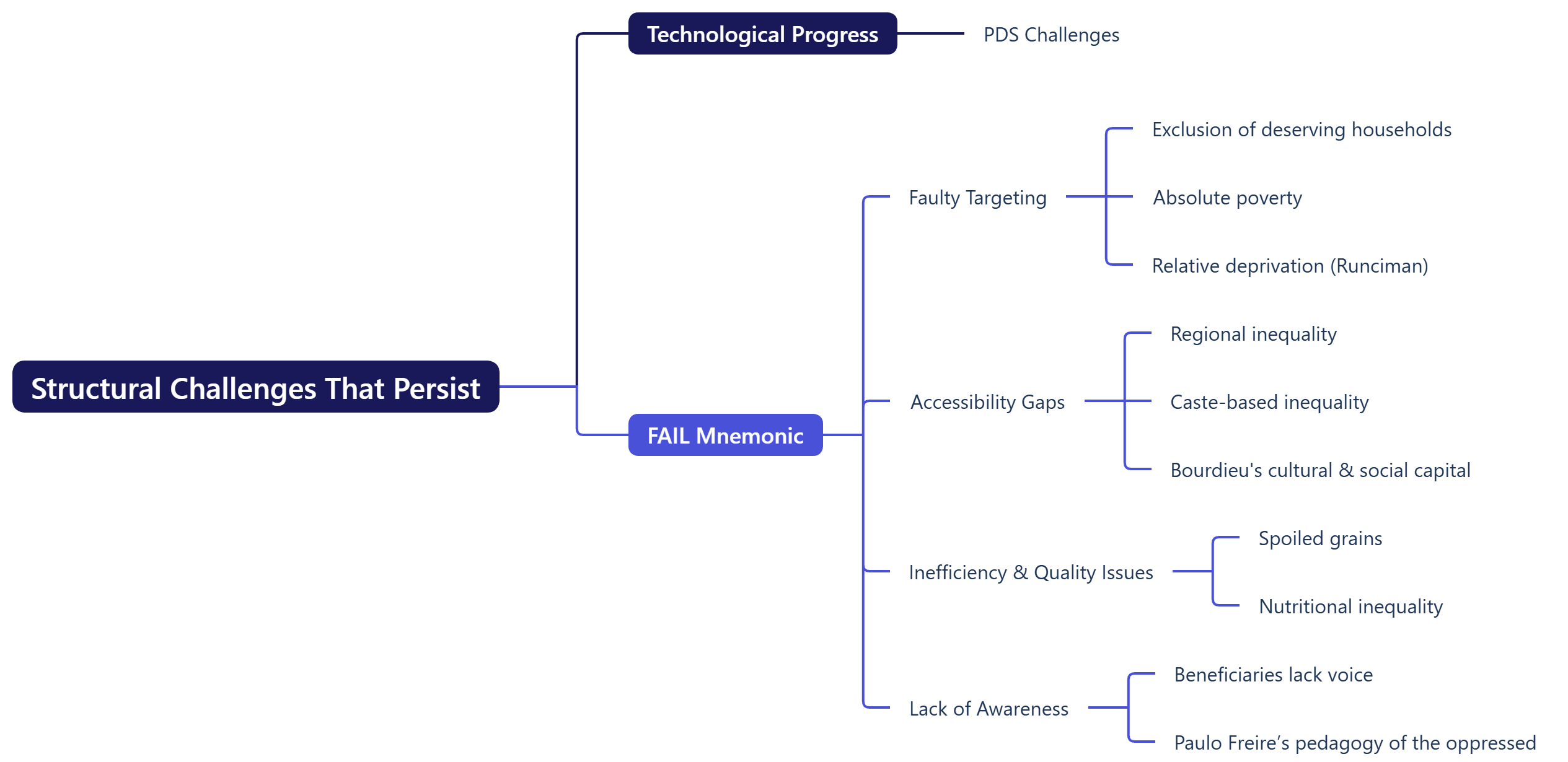
Despite technological progress, PDS faces entrenched structural distortions summarized using the mnemonic FAIL:
Pierre Bourdieu: Capital and Social ReproductionDigital PDS requires digital literacy, access to mobile networks, biometric authentication, and documents. Those lacking technological capital—elderly, women, Dalits, Adivasis, migrant workers—risk exclusion. Thus, digitization may unintentionally reproduce inequality rather than eliminating it, proving Bourdieu’s argument that institutions reproduce class hierarchies. Right to Food Campaign & Devendra Sharma’s critiqueCivil society reports reveal Aadhaar-related exclusions and delays, showing that technology without accountability can become tools of governance failure rather than empowerment. Digital Reforms and Last-Mile Delivery: ONORC as Social TransformationThe ONORC scheme allows migrant workers to avail rations anywhere in India—significant in a country where 45 crore people migrate for work.
Food security is not about handouts but expanding real freedoms. Digital PDS increases:
By enabling agency, technology becomes a means of enhancing capability rather than mere survival. Public Sphere & Participatory DemocracyJürgen Habermas argued that democracy strengthens when citizens question power and participate in governance. Platforms like ASHA, which collect feedback via AI calls, democratize accountability and challenge bureaucratic monopolies. Modernization is not simply digitization of warehouses but transformation of state-citizen interaction. Future Reforms Needed: Sociological Recommendations Mnemonic: GROW
Involving Women SHGs also aligns with feminist sociology (Devaki Jain) arguing that women’s community collectives strengthen grassroots democracy. ConclusionDigital initiatives in PDS represent a profound shift not merely in logistics but in the philosophy of welfare delivery in India. Through sociological lenses, this modernization reflects:
Technology is not a magic solution; it is a tool. Its true success lies in whether it reduces inequality, empowers marginalized voices, and strengthens the moral commitment of the state to protect life and dignity. Digital PDS modernization must therefore remain rooted in human-centered welfare, not merely technological performance. Only then will the system transform from a ration doling mechanism into an institution of justice, equity, and citizenship rights. |
To Read more topics, visit: www.triumphias.com/blogs