
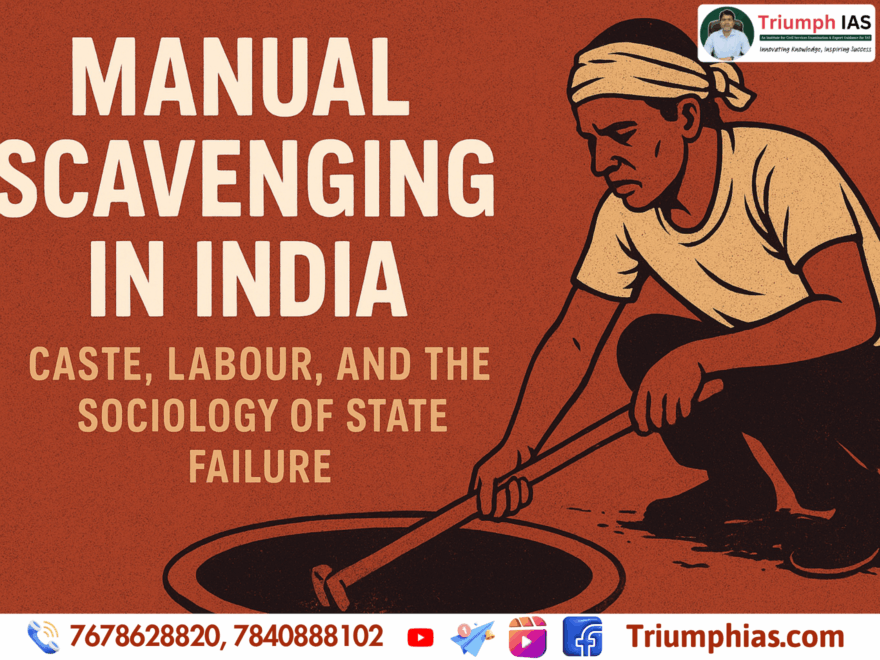
Manual Scavenging in India: Caste, Labour, and the Sociology of State Failure
(Relevant for Sociology Paper 2: Caste system, Rural and Agrarian transformation in India and Politics and Society)
|
The recent ruling of the Calcutta High Court, awarding ₹30 lakh compensation for four workers who died in a 2021 sewer-cleaning tragedy, has reignited a painful national conversation. Decades after legislating against manual scavenging, India continues to witness deaths inside septic tanks and sewers—grim reminders of caste, inequality, and institutional apathy still embedded in daily life. The workers’ deaths, described by the court as the result of “serious negligence,” highlight the hollowness of outdated norms such as the long-standing ₹10 lakh compensation fixed in 1993. More importantly, they bring to the forefront the sociological reality: manual scavenging is not merely a labour issue—it is a caste-based human rights crisis deeply woven into the social fabric of India. The Social Institution of Manual ScavengingIndia legally defines manual scavenging through the PEMSR Act, 2013 as the manual handling of human excreta from toilets, drains, pits, and railway tracks. But sociology pushes us to see beyond legislation. Louis Dumont, in Homo Hierarchicus, explains how purity–pollution hierarchies historically structured caste relations. The work of removing human waste, therefore, was not an occupation but a caste-imposed destiny. This is why manual scavenging persists even after legal bans: because the occupation is embedded in the logic of caste stratification, not simply in economic necessity. M.N. Srinivas would call this a case where “caste” overrides “class.” Even rising incomes, he argued, rarely erase caste-bound occupations. Manual scavenging is thus a textbook example of structural caste immobility, where dignity is denied not due to ability, but because the society refuses to unsee caste. Legal Promises vs. Sociological RealitiesThe state appears progressive on paper:
Yet, as of 2024, 58,000 people remain officially identified as manual scavengers. The disconnect between policy and practice is what Max Weber would call the “gap between formal-rational law and substantive justice.” Bureaucracy claims neutrality, but caste biases and institutional inertia subvert implementation. Ambedkar’s assertion that caste is “not merely a division of labour but a division of labourers” becomes painfully evident here. The state prohibits manual scavenging, yet municipalities outsource sewer cleaning to unregulated contractors who force Dalit labourers back into deadly pits—turning the law into a symbolic gesture rather than transformative justice. Caste, Labour, and Intergenerational EntrapmentManual scavenging exemplifies what Pierre Bourdieu calls habitus—the internalized system of social structures that shape aspirations, self-worth, and life choices. Children of manual scavengers grow up internalizing social stigma, low expectations, and limited mobility. Society, meanwhile, expects them to continue the same work, enforcing what sociologists call intergenerational occupational persistence. Dalit women face even harsher realities. The ILO notes a “triple burden”—caste, gender, and degrading labour. Their work embodies Patricia Hill Collins’ “matrix of domination,” where multiple oppressions intersect, generating intense psychological impacts: anxiety, depression, loss of self-esteem. Substance abuse among workers, often used to dull humiliation and pain, reflects Karl Marx’s alienation theory—work becomes so degrading that the worker retreats into escape mechanisms when the occupation strips away agency, pride, and humanity. Deaths in Sewers: Modernity’s Dark UnderbellyIndia aspires to become a global economic power. Yet sewer deaths expose the “dirty work” that sustains modern cities—hidden labour that the middle class depends on but refuses to acknowledge. Zygmunt Bauman’s modernity theory suggests that societies often outsource morally repugnant tasks to marginalized groups, keeping them invisible in the process. When sewer workers enter toxic pits, they are literally risking their lives so cities can flush and forget. Whereas Durkheim emphasized collective solidarity, manual scavenging represents what sociologist Loïc Wacquant calls urban marginality—the structural abandonment of certain populations who perform essential but socially despised labour. Why the State Continues to FailDespite laws and schemes like NAMASTE, SRMS, and Swachhta Udyami Yojana, systemic failures persist.
Foucault’s concept of bio-politics is visible here: the state decides whose lives matter and whose are disposable. Sewer workers die because their lives occupy the bottom rung of social value.
Sociologist Jan Breman argues that neoliberal economies increasingly rely on precarious informal labour. Municipalities outsource sewage work to unregulated contractors, who employ Dalit labourers without training or safety gear. This is not accidental—it is economically convenient.
Compensation norms stuck at 1993 levels show what Gunnar Myrdal called “soft states”—governments that pass laws but fail to enforce them due to corruption, social prejudice, and weak accountability.
Rehabilitation under SRMS or PM-DAKSH often collapses because beneficiaries lack market linkages, capital, or social networks—demonstrating Amartya Sen’s capability deprivation theory: real freedom is not just access to schemes, but the ability to convert them into meaningful life outcomes. The Way Forward: Mechanisation as Social JusticeFrom a sociological standpoint, ending manual scavenging requires more than technology—it requires dismantling caste-based labour structures. Mechanical sewer cleaning through SRUs, skill training, and district-level sanitation authorities can provide alternatives, but deep social change must accompany these. Even strict legal action must be paired with sensitization, caste-discrimination monitoring, regulation of private operators, and guaranteed dignified livelihoods. Mechanisation should not be framed as a technical upgrade but as a civilizational correction. ConclusionEliminating manual scavenging in India is not merely a matter of replacing buckets with machines; it demands dismantling caste hierarchies, enforcing legal responsibility, investing in rehabilitation, and transforming cultural attitudes that have long normalized the dehumanization of Dalit labour. While mechanisation, strict enforcement, and institutional reforms are essential, meaningful change will come only when society recognizes manual scavenging as a violation of dignity and citizenship, not a municipal inconvenience. By committing to systemic reforms that uphold equality, safety, and justice, India can move closer to the constitutional promise of abolishing untouchability and fulfilling the goals of SDG 6 and SDG 8, ensuring that no person’s life is lost—or predetermined—because of caste. |
To Read more topics, visit: www.triumphias.com/blogs
Read more Blogs:
Mahatma Jyotiba Phule: Reimagining Social Justice, Caste, and Education in 19th-Century India
Assam’s Anti-Polygamy Bill, 2025: Gender Justice, Personal Laws, and the Sociology of Reform