Introduction
The recent violence in Manipur, worsened by the Centre’s “free movement” directive, has reignited ethnic tensions between hill and valley communities. While positioned as a step toward peace and mobility, the move has instead deepened mistrust, caused civilian injuries, and led to yet another wave of displacement. This crisis offers a critical lens into how State policies, identity politics, and ethnic conflicts interact in complex social settings.
Understanding the Ground Reality in Manipur
The “free movement” policy by the Home Minister has triggered violent clashes, notably in the Kangpokpi district, leading to over 100 injuries and one civilian death. The timing—just before a Parliament session—highlights how symbolic political gestures can override community needs and local realities.
Instead of bridging divides, the policy has disrupted fragile reconciliation efforts between the Meitei and Kuki-Zo communities, both of whom have historically coexisted with simmering tensions over land rights, identity recognition, and administrative autonomy.
Sociological Analysis:
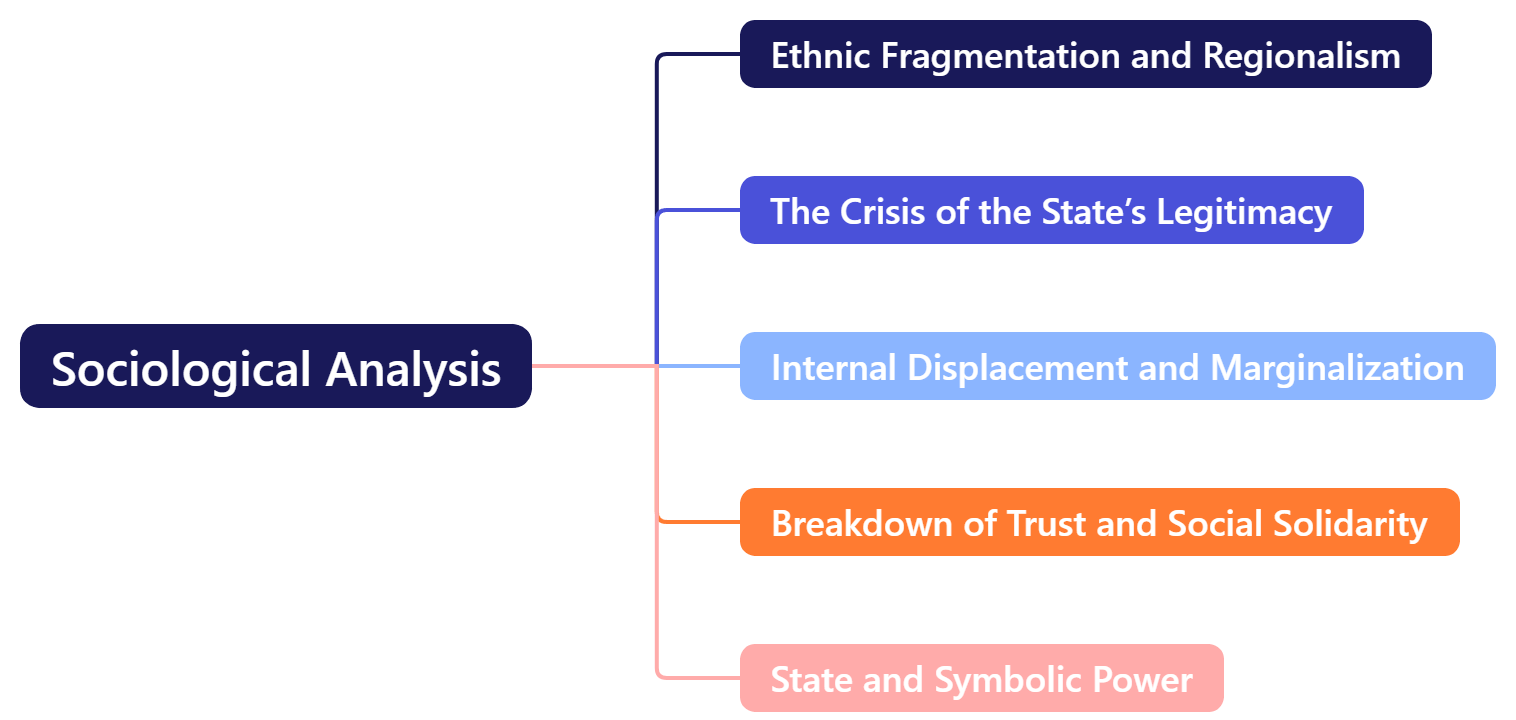
- Ethnic Fragmentation and Regionalism: The North-East has always been a mosaic of tribal identities, often competing for land, political recognition, and autonomy. Sociologists like T.K. Oommen have emphasized that regionalism in India often arises from ethno-political alienation, not just economic backwardness. In Manipur, the Kuki-Zo and Meitei groups have a history of competing territorial claims. Policies like “free movement” across contested districts ignore these lived tensions, further eroding trust.
- The Crisis of the State’s Legitimacy: Max Weber defined the state as the sole legitimate user of force. However, in Manipur, the state’s actions are perceived as biased or coercive, especially after the military killing of a civilian in Kangpokpi. This raises serious concerns around the legitimacy of state violence, and whether security forces are viewed as peacekeepers or participants in ethnic domination.
- Internal Displacement and Marginalization: Thousands of people from both communities are still internally displaced, living in relief camps. According to Johan Galtung’s concept of structural violence, the lack of education, healthcare, and rehabilitation is a form of institutional harm, invisible but deeply destructive.
- Breakdown of Trust and Social Solidarity: The eruption of violence despite peace talks and monitoring efforts shows a complete breakdown of collective conscience. Without a sense of mechanical solidarity, tribal and valley communities cannot rebuild trust. Durkheim’s theories on anomie are applicable here, where normlessness and political betrayal fuel rage and resentment.
- State and Symbolic Power: Pierre Bourdieu emphasized how symbolic power (like policy announcements) can shape public perception and legitimacy. The free movement policy was announced during Parliament, seemingly more for political optics than ground realities—fueling perceptions of central apathy.
Way Forward
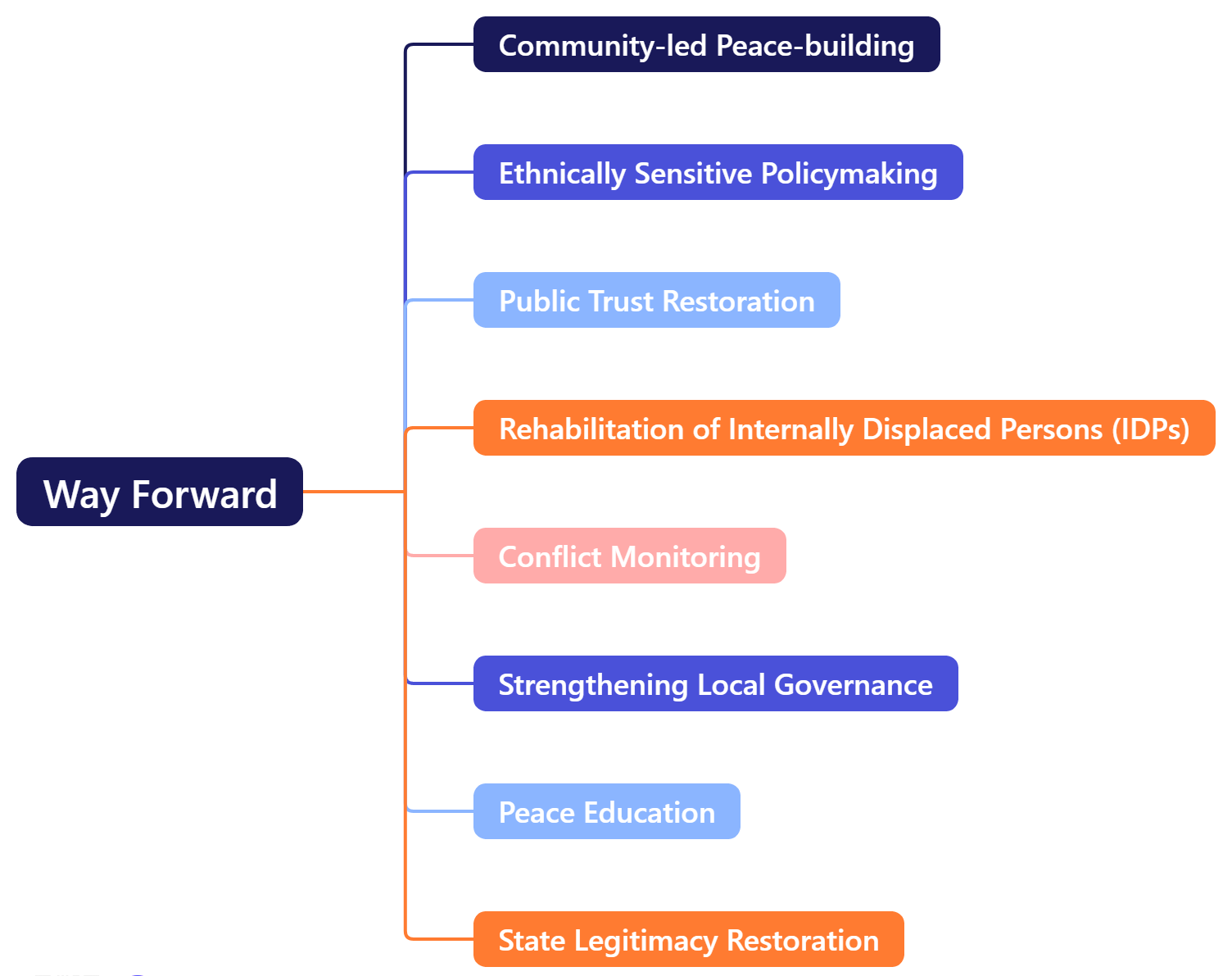
- Facilitate community-led peace-building efforts through inclusive dialogue with all ethnic groups.
- Ensure ethnically sensitive policymaking by involving local stakeholders in key decisions.
- Deploy impartial and accountable security forces to restore public trust.
- Rehabilitate internally displaced persons (IDPs) with dignity, livelihood support, and housing.
- Establish conflict-monitoring mechanisms using sociological and ethno graphic insights.
- Strengthen local governance and decentralization to give autonomy to tribal and hill councils.
- Introduce peace education and inter-community youth programs to counter stereotypes and promote harmony.
- Restore state legitimacy through transparency, accountability, and fairness in administration.
Conclusion
The situation in Manipur is not merely a law-and-order issue—it’s a deep sociological crisis involving identity, governance, and civil trust. It offers a chance to critically assess how top-down policy decisions can aggravate grassroots-level tensions, and how inclusive dialogue and trust-building are central to social harmony in a diverse nation like India. A sociologically informed, empathetic, and inclusive approach is the only sustainable path forward. This case demonstrates how theories of identity, power, and social order apply to real-world policy making and conflict resolution.
PYQs
Paper I
- Critically examine the Marxian view of state and its implications in resolving ethnic disputes. (2014)
- Explain the concept of social disorganization and its relation to communal violence. (2015)
- Analyze conflict theory in the context of ethnic violence. (2016)
- How do social movements emerge out of structural strain? Explain with relevant examples. (2017)
- Explain the role of the state in managing ethnic conflicts in plural societies. (2018)
- What is the significance of power and authority in understanding modern political conflicts? (2019)
- Discuss how the concept of identity is constructed and contested in multicultural societies. (2020)
- Evaluate the role of class and status in ethnic mobilization. (2021)
- Discuss the sociological perspective on violence as a means of achieving political objectives. (2022)
- Discuss the relevance of Durkheim’s theory of collective consciousness in managing ethnic crises. (2023)
Paper II
- What role does tribal identity play in political mobilization in North-East India? (2014)
- Examine the factors responsible for the rise of ethnic conflicts in North-East India. (2015)
- Explain how regionalism and ethnicity pose challenges to Indian democracy. (2016)
- Examine the impact of armed conflict and militarization on the everyday lives of people in the North-East. (2017)
- Analyze the impact of ethnic identity on the process of nation-building in India. (2018)
- Critically evaluate the role of the state in ensuring justice to marginalized ethnic groups. (2019)
- Discuss the role of insurgency and counter-insurgency in shaping the society of North-East India. (2020)
- Discuss the role of civil society in managing ethnic tensions in India. (2021)
- What are the sociological implications of state-imposed solutions on indigenous communities? (2022)
- Discuss the implications of displacement caused by ethnic violence on tribal societies in India. (2023)
|


