Introduction: Malnutrition and Obesity in India
India is witnessing a disturbing paradox: malnutrition and obesity are growing side by side, especially among the urban poor and low-income rural households. According to FAO data, more than 74% of Indians cannot afford a healthy diet, and this nutritional crisis has both sociological and public health consequences. The double burden of malnutrition—where undernutrition coexists with rising obesity and non-communicable diseases (NCDs)—is not just a biological or economic issue, but deeply social and structural.
Sociological Analysis
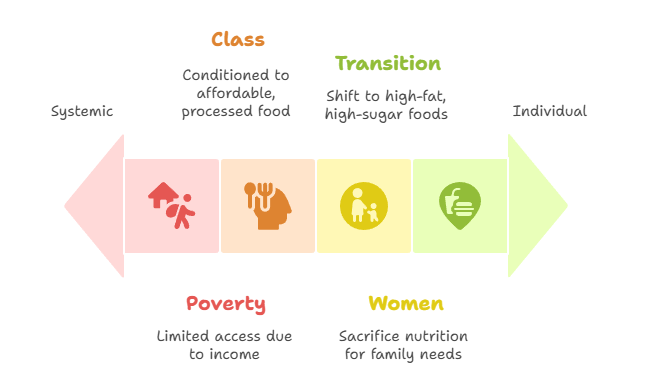
- Structural Poverty and Food Insecurity: According to Amartya Sen’s entitlement theory, access to food is not just about supply but about one’s ability to command food through income or resources. People cannot afford healthy alternatives due to her low-income status, highlighting structural barriers to nutrition.
- Dietary Inequality and Class Stratification: Pierre Bourdieu’s concept of cultural capital is useful here. Food choices are shaped not just by economic capital but by habitus—a product of class and culture. The poor are socially conditioned to eat what is available and affordable, often ultra-processed, high-carb, low-nutrient food.
- Gendered Dimensions of Malnutrition: Women, especially those from marginalized communities, often sacrifice their own nutrition for their families. This gendered malnutrition makes them more prone to both undernutrition (anemia, vitamin deficiency) and obesity-linked NCDs due to poor dietary diversity.
- Urbanization and Nutritional Transition: India is undergoing nutrition transition—a shift from traditional diets to high-fat, high-sugar, ultra-processed foods driven by urbanization and globalization. This shift disproportionately impacts the poor, who are targeted by cheap packaged food marketing and lack access to fresh produce.
Government Policies and Gap

- Public Distribution System (PDS) now focuses mostly on rice and wheat, neglecting pulses, legumes, and oils—leading to hidden hunger (micronutrient deficiency).
- Schemes like POSHAN Abhiyaan and National Nutrition Mission have yet to fully integrate concerns of urban poor and dietary diversity.
The absence of price subsidies on fruits, vegetables, and pulses makes healthy eating economically unviable.
Sociological Implications and Way Forward
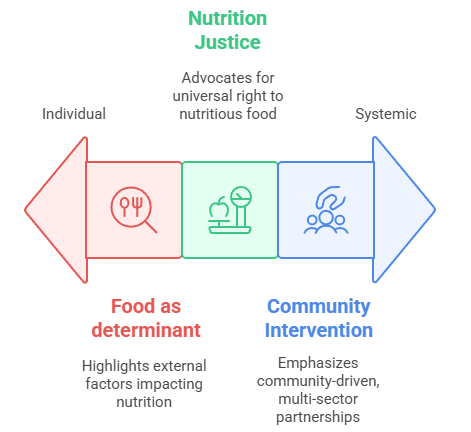
- Food as a Social Determinant of Health: Health is not merely the absence of disease but a socially shaped condition, as argued in the social determinants of health framework. Nutrition, in this context, is deeply intertwined with class, gender, and caste.
- Towards Nutrition Justice: What India needs is nutrition justice—a framework where the right to nutritious food is universal, and subsidies go beyond cereals to include vegetables, proteins, and millets (e.g., ragi as recommended by doctors).
- Community-Based Interventions: Grassroots innovations like urban kitchen gardens, millet promotion, and community kitchens can counter dietary poverty. These require civil society, local governance, and private sector partnerships.
Conclusion
The growing burden of malnutrition and obesity in India is not a personal failure but a structural crisis rooted in socioeconomic inequality, food policy gaps, and cultural conditioning. Addressing this requires a multidimensional strategy that combines nutrition-sensitive governance, sociological understanding, and equity-based public health interventions.
Previous Year Questions
Paper I:
- Discuss how cultural capital influences food consumption patterns in different social classes. (2022)
- Examine the impact of globalization on food habits and health outcomes in developing societies. (2021)
- How does poverty influence health outcomes? Discuss with reference to social determinants of health. (2020)
Paper II:
- Examine the changing nature of Public Distribution System (PDS) and its impact on food security in India. (2023)
- Discuss the gender dimensions of malnutrition in India. Why are women more vulnerable? (2019)
- Critically analyse the National Nutrition Mission (POSHAN Abhiyaan) in addressing undernutrition among children and women. (2018)
|