Introduction
The domain of reproduction, though biologically shared by both sexes, has historically been regulated and controlled by men in patriarchal societies. Whether in decisions related to contraception, childbirth, or abortion, male authority has shaped women’s reproductive autonomy across the globe. In India, this control is deeply embedded in social, cultural, economic, and political structures. The issue of male control over reproduction is not only a women’s rights concern but also a significant social problem, touching upon themes like patriarchy, power, gender roles, and bodily autonomy.
Understanding Male Control over Reproduction
Male control over reproduction refers to the domination of men over women’s reproductive choices—whether through cultural norms, institutional mechanisms, or interpersonal coercion. This control can manifest in multiple ways:
- Refusal to use contraception or forcing women to undergo sterilization.
- Denial of consent in decisions related to childbirth, abortion, or spacing.
- Cultural expectations around early marriage and repeated pregnancies.
- State-led family planning programs targeting women disproportionately.
Such control denies women bodily autonomy, contributes to gender-based violence, and exacerbates health risks.
Historical Context:
Patriarchy as a system of male dominance institutionalizes control over women’s sexuality and reproduction. In traditional societies:
- Reproduction was tied to lineage, inheritance, and property, making it important for men to control female fertility.
- Women’s value was linked to fertility, especially their ability to produce male heirs.
- Social norms enforced through religion, caste, and kinship structures have long subordinated women’s reproductive rights.
Even in modern times, these attitudes persist, albeit in more subtle and institutionalized forms.
Male Control in India:
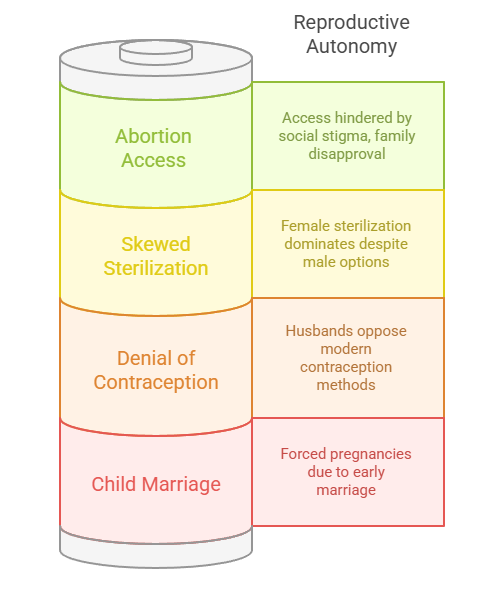
- Skewed Sterilization Trends
- As per National Family Health Survey (NFHS-5) data (2019–21), 75% of sterilizations in India are female sterilizations, despite male sterilization being safer and simpler.
- This indicates both policy bias and male refusal to participate in contraception.
- Forced Reproduction and Denial of Contraception
- In many households, women have no say in whether or when to conceive.
- Husbands often oppose modern contraceptive methods, citing tradition, masculinity, or suspicion.
- Child Marriage and Early Pregnancy
- Over 23% of Indian women aged 20-24 were married before age 18 (NFHS-5).
- Early marriage often results in forced and repeated pregnancies, driven by familial and patriarchal pressures.
- Abortion Rights and Male Influence
- While abortion is legal under the Medical Termination of Pregnancy (Amendment) Act, 2021, social stigma and husband’s or in-laws’ disapproval often prevent women from accessing it.
- Many women are forced to continue unwanted pregnancies or undergo illegal abortions under unsafe conditions.
Sociological Analysis
- Feminist Perspective
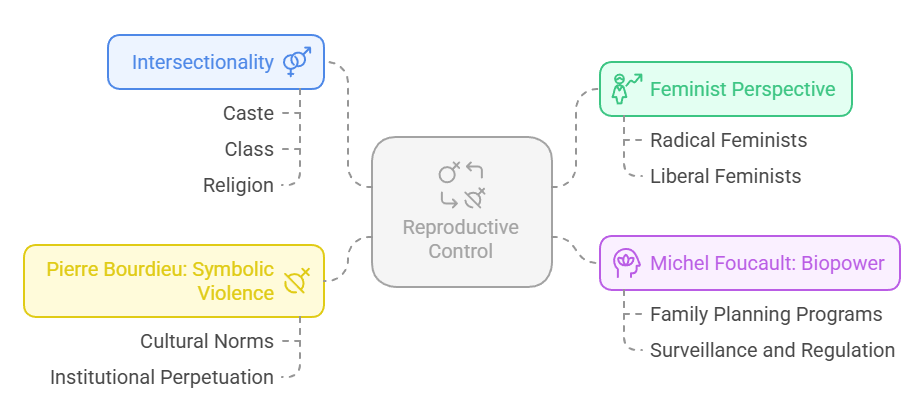
Feminist sociologists view male control over reproduction as a fundamental expression of patriarchal power. Scholars like Sylvia Walby emphasize that reproductive control allows men to maintain dominance within the private (family) and public (society) spheres.
- Radical feminists argue that control over women’s reproductive capacity is central to their oppression.
- Liberal feminists call for equal rights, access to contraceptives, and legal autonomy over the body.
- Michel Foucault: Biopower and Reproductive Surveillance
Foucault’s concept of biopower explains how states regulate populations through control of bodies and reproduction. In India, family planning programs, often targeted at women, become tools of surveillance and regulation, reducing women to their reproductive function.
- Pierre Bourdieu: Symbolic Violence
Bourdieu’s idea of symbolic violence helps understand how male dominance in reproductive decisions is internalized by women as cultural norms. This form of violence is subtle, normalized, and perpetuated through institutions like marriage, family, and religion.
- Intersectionality: Caste, Class, and Religion
Control over reproduction affects women differently based on caste, class, and religion:
- Dalit and tribal women are often coerced into sterilization through welfare conditionalities.
- Upper-caste women face pressure for son preference and high fertility for lineage preservation.
- Poor women have limited access to reproductive healthcare, deepening their vulnerability.
Consequences of Male Reproductive Control
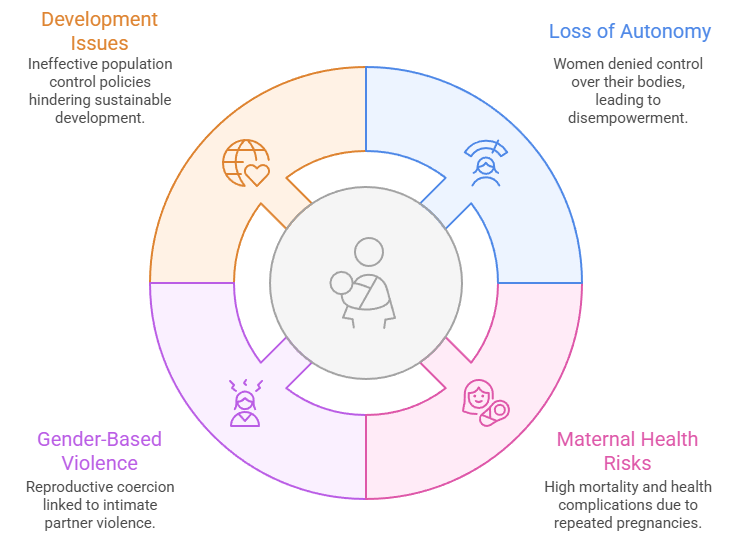
- Loss of Bodily Autonomy: Women are denied the right to make decisions about their own bodies, leading to disempowerment and marginalization.
- Maternal Health Risks: Repeated pregnancies without adequate spacing result in high maternal mortality, anaemia, and health complications.
- Gender-Based Violence: Reproductive coercion is linked with intimate partner violence, including marital rape, forced pregnancies, and abuse for not bearing sons.
- Population and Development Issues: Failure to engage men in family planning leads to ineffective population control policies and hampers sustainable development
Recent Developments and Reforms
- Mission Parivar Vikas
Launched by the Government of India to promote male participation in family planning and increase awareness about male sterilization (vasectomy). However, success has been limited due to social stigma.
- Medical Termination of Pregnancy (Amendment) Act, 2021
Increased the upper gestation limit for abortion in select cases and allowed unmarried women to seek abortion—a significant step toward reproductive justice.
- Supreme Court Rulings
- In X vs. Principal Secretary, Health and Family Welfare Department, Delhi (2022), the SC recognized that all women, irrespective of marital status, have a right to abortion.
- The judgment upheld bodily autonomy as a constitutional right, strengthening women’s reproductive rights.
Solutions and Recommendations
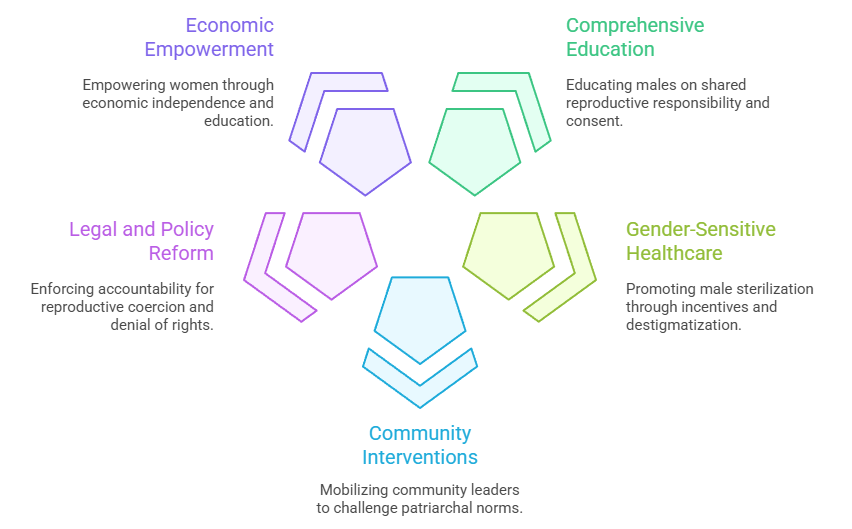
- Comprehensive Sexual Education: Educate boys and men on shared responsibility in reproduction, contraception, and consent.
- Gender-Sensitive Healthcare: Encourage male sterilization through incentives and destigmatization.
- Community Interventions: Mobilize ASHA workers, NGOs, and local leaders to challenge patriarchal norms at the grassroots.
- Legal and Policy Reform: Enforce accountability for reproductive coercion, marital rape, and denial of abortion rights.
- Empower Women economically and politically: Autonomy in decision-making increases when women have economic independence and access to education.
Real-Life Cases
- In Chhattisgarh (2014), a sterilization camp led to the deaths of 15 women due to unsafe conditions—a tragic example of coercive reproductive control targeting poor women.
- Cases of forced pregnancies among minors and judicial denial of abortion requests highlight how state and family patriarchies intersect to control women’s reproductive choices.
Conclusion
The issue of male control over reproduction lies at the intersection of patriarchy, power, and bodily autonomy. It reflects deeper structural inequalities where women’s choices are not their own, even in the most personal domain—reproduction. It highlights how control over female bodies maintains male dominance both in private and public spheres. Addressing this issue requires multi-dimensional strategies, combining legal reform, cultural change, and empowerment initiatives.
Previous Year Questions
Paper I:
- Explain how patriarchy operates in personal domains such as reproduction and family. (2020)
- Discuss the impact of social institutions on women’s autonomy. (2017)
Paper II:
- Critically analyze reproductive health issues in India from a sociological perspective. (2022)
- Write a note on coercive sterilization and reproductive rights in India. (2019)
|