

Mahaparinirvan Diwas and the Sociological Legacy of Dr. B.R. Ambedkar
(Relevant for Sociology Paper 2: Vision of Social Change in India)
|
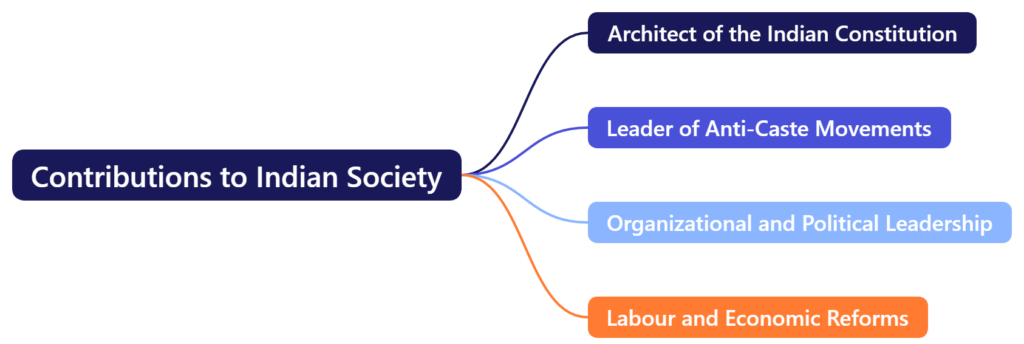
India commemorates Mahaparinirvan Diwas to honor Bharat Ratna Dr. Bhimrao Ramji Ambedkar, a jurist, economist, social reformer, and the principal architect of the Indian Constitution. While the day marks his death anniversary, it also serves as a moment to reflect on his enduring contributions to social justice, equality, and constitutional governance. Ambedkar’s life exemplifies the sociological intersections of caste, law, economics, and social reform, providing invaluable lessons for contemporary society. Dr. B.R. Ambedkar: A Sociological IconBorn on 14th April 1891 in Mhow, Madhya Pradesh, Ambedkar faced structural discrimination as a member of the Dalit community. His personal experiences of marginalization profoundly shaped his worldview and reformist agenda. Unlike purely legalistic interpretations, a sociological approach highlights how Ambedkar addressed structural inequalities, seeking systemic changes rather than mere moral exhortation. Ambedkar’s engagement with social reform, law, and politics reflects what sociologists like Pierre Bourdieu would describe as the accumulation of social, cultural, and symbolic capital. Despite systemic exclusion, Ambedkar strategically acquired education, credentials, and intellectual authority to challenge entrenched caste hierarchies. Mahaparinirvan Diwas: Symbolism and LegacyThe term Mahaparinirvan is rooted in Buddhist philosophy, commemorating the ultimate passing of enlightened individuals, as recorded in the Mahaparinibbana Sutta for Lord Buddha. Observing Dr. Ambedkar’s Mahaparinirvan Diwas symbolizes reverence for a life dedicated to liberation from social oppression, aligning with his founding of Navayana Buddhism, a modern interpretation of Buddhism emphasizing equality and social justice. His memorial at Chaitya Bhoomi, Dadar (Mumbai) has become a site of pilgrimage, reflecting both spiritual and sociopolitical dimensions of his legacy. Contributions to Indian Society
As Chairman of the Constituent Assembly’s Drafting Committee, Ambedkar ensured that the Constitution enshrined:
From a sociological standpoint, Ambedkar’s constitutional vision operationalizes legal pluralism, recognizing the coexistence of formal laws and social practices while attempting to mitigate systemic discrimination. The Constitution thus functions as a structural intervention, aiming to transform social hierarchies and redistribute power more equitably.
Ambedkar spearheaded historic movements challenging caste-based oppression:
These movements illustrate the sociology of social movements, a field studied by thinkers like Charles Tilly and Sidney Tarrow, emphasizing collective action as a mechanism to contest entrenched hierarchies. Ambedkar’s activism combined moral authority, legal reasoning, and grassroots mobilization, showcasing a multidimensional strategy to challenge oppression.
Ambedkar founded several organizations to institutionalize empowerment:
From a structural-functional perspective (Émile Durkheim), these organizations functioned to integrate marginalized groups into the political system while providing resources and social networks to strengthen collective identity.
As Labour Member of the Viceroy’s Executive Council (1942–46), Ambedkar introduced key labour protections:
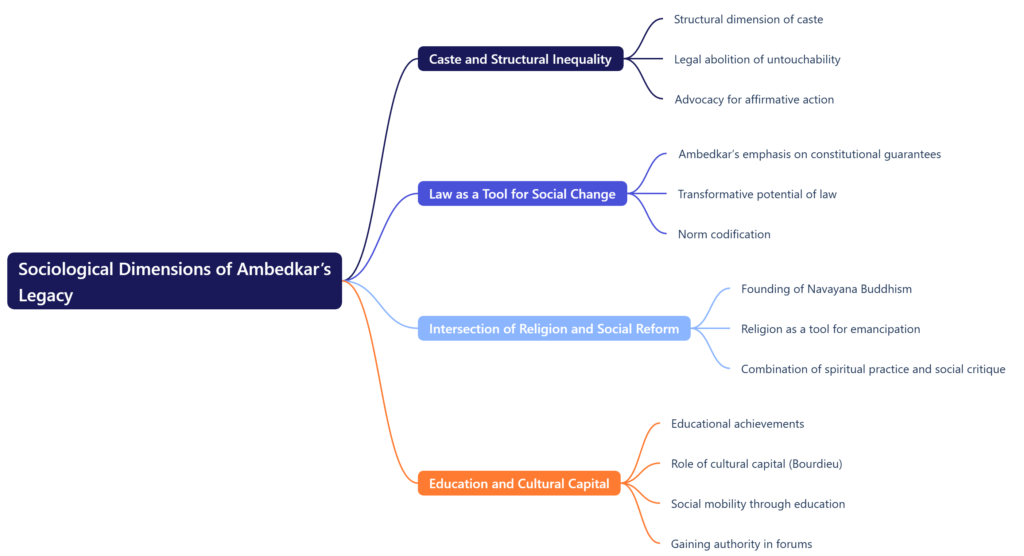
Economically, he contributed to the conceptual foundations of the Reserve Bank of India (1934) and the Finance Commission framework. His work reflects an understanding of the interconnections between economic justice and social equality, aligning with Amartya Sen’s capability approach, which emphasizes creating conditions for individuals to realize their potential. Sociological Dimensions of Ambedkar’s Legacy
Ambedkar’s work underscores the structural dimension of caste, which sociologists such as Louis Dumont and M.N. Srinivas have explored. By legally abolishing untouchability and advocating affirmative action, Ambedkar targeted institutionalized discrimination, challenging both symbolic and material hierarchies.
Ambedkar’s insistence on constitutional guarantees demonstrates the transformative potential of law. Sociologist Max Weber noted that legal rationality could stabilize societies by codifying norms; Ambedkar extended this insight, using law as a vehicle to alter social relations and redistribute power.
Ambedkar’s founding of Navayana Buddhism illustrates religion as a tool for social emancipation, echoing Émile Durkheim’s view that religion reinforces social solidarity. By combining spiritual practice with social critique, Ambedkar offered an ethical framework for resistance against caste oppression.
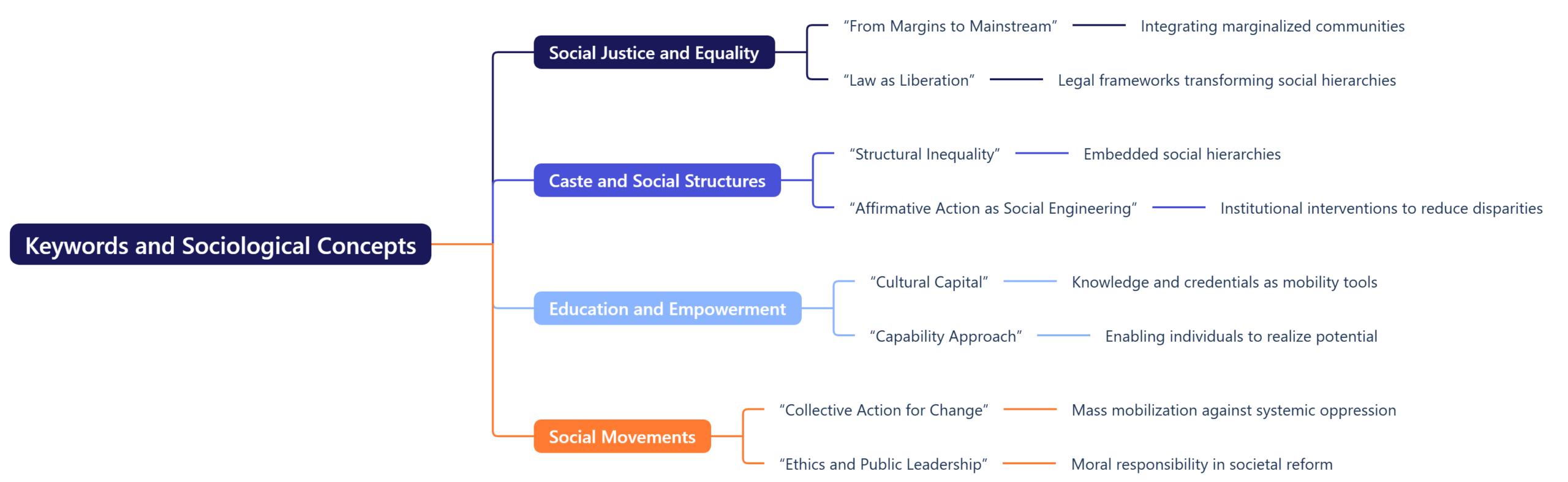
Ambedkar’s educational achievements—earning degrees from Columbia University and the London School of Economics—highlight the role of cultural capital (Bourdieu) in social mobility. Education enabled him to challenge structural barriers, formulate policies, and gain authority in national and international forums. Contemporary RelevanceEven decades after his passing, Ambedkar’s vision resonates with ongoing struggles against inequality. Issues such as caste discrimination, labor rights, minority protections, and social inclusion continue to shape public policy debates. His ideas also inform modern discussions on social justice, affirmative action, and inclusive economic development. Mahaparinirvan Diwas is not just a day of remembrance; it is a call to reflect on structural inequalities and the ways society can create conditions for equitable participation, dignity, and social mobility. Keywords and Sociological Concepts
Social Justice and Equality:
Caste and Social Structures:
Education and Empowerment:
Social Movements:
ConclusionDr. B.R. Ambedkar’s life and work exemplify the transformative potential of law, education, and social activism in addressing entrenched inequalities. Observing Mahaparinirvan Diwas allows society to remember his contributions while drawing lessons for contemporary struggles against social injustice. From a sociological perspective, Ambedkar combined structural analysis, legal reform, and grassroots activism to challenge caste hierarchies, advocate labor protections, and institutionalize equality. His legacy demonstrates that meaningful social change requires both systemic interventions and cultural transformation. As India continues to navigate issues of social inequality, labor rights, and minority protections, Ambedkar’s insights remain not only relevant but also essential for building an inclusive, just, and equitable society. |
To Read more topics, visit: www.triumphias.com/blogs
Read more Blogs:
Assam’s Anti-Polygamy Bill, 2025: Gender Justice, Personal Laws, and the Sociology of Reform
Dark Money and Democratic Deficit: A Sociological Analysis of Political Funding in India
One comment