Introduction:
The Indian society, long governed by normative structures like caste, religion, and family, is undergoing a quiet revolution. Live-in relationships—once considered taboo—are now increasingly visible in urban India, especially among the middle class, professionals, and youth. This shift mirrors deeper transformations in values, lifestyle choices, gender roles, and individual autonomy.
Why Live-in Relationships are in News?
Recently, the Supreme Court of India reiterated that live-in relationships are part of the right to life under Article 21, and no adult couple can be harassed for choosing to live together without marriage. In a few states, rising cases of violence, social ostracism, and even “honour killings” involving live-in couples have sparked legal and social debates. Furthermore, the debate around live-in partners’ rights under domestic violence laws has gained momentum.
Legal Landscape of Live-in Relationships in India
- The Protection of Women from Domestic Violence Act, 2005 recognizes live-in relationships by offering protection from abuse.
- The Supreme Court in Indra Sarma vs. V.K.V. Sarma (2013) identified five categories of live-in relationships that qualify for legal protection.
- However, lack of codified law and social stigma continue to restrict legitimacy and acceptance.
Sociological Analysis
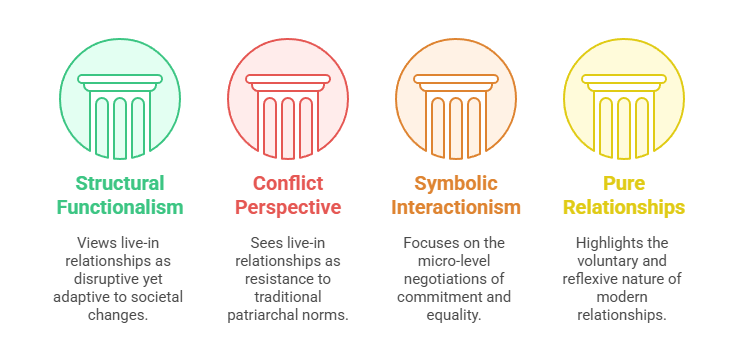
- Structural Functionalism: Talcott Parsons viewed the nuclear family as a stabilizing unit with clear role differentiation. Live-in relationships disrupt this structure, de-institutionalizing marriage, but also reflect adaptive strategies in a modernizing society where role expectations are renegotiated.
- Conflict Perspective: From a Marxist lens, live-in relationships challenge the bourgeois morality of institutionalized marriage. They represent a counter-cultural resistance to patriarchal property relations that historically tied marriage to inheritance and control over women’s sexuality.
- Symbolic Interactionism: George H. Mead would argue that Live-in partnerships reflect micro-level social negotiations, where meanings of commitment, intimacy, and gender equality are constantly redefined. The couple creates their own ‘norms’, often free from traditional familial and societal control.
- Pure Relationships: In Anthony Giddens theory of late modernity, Giddens posits that modern relationships are based on emotional intimacy and personal satisfaction rather than duty or tradition. Live-in relationships exemplify ‘pure relationships’—voluntary, reflexive, and contingent.
Factors Contributing to Rise in Live-in Relationships
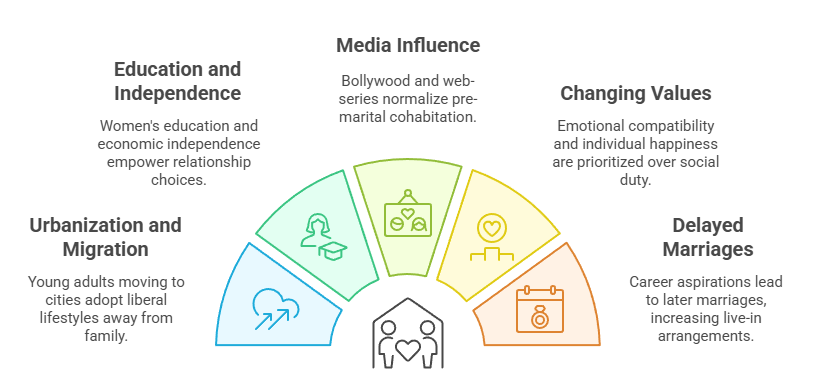
- Urbanization and Migration: Young adults in metro cities living away from family tend to adopt more liberal lifestyles.
- Education and Economic Independence: Especially among women, has allowed greater control over relationship choices.
- Media and Pop Culture: Bollywood and web-series have normalized pre-marital cohabitation.
- Changing Family Values: Preference for emotional compatibility and individual happiness over social duty.
- Delayed Marriages: Career aspirations push formal marriage to a later age, increasing chances of live-in arrangements.
Challenges
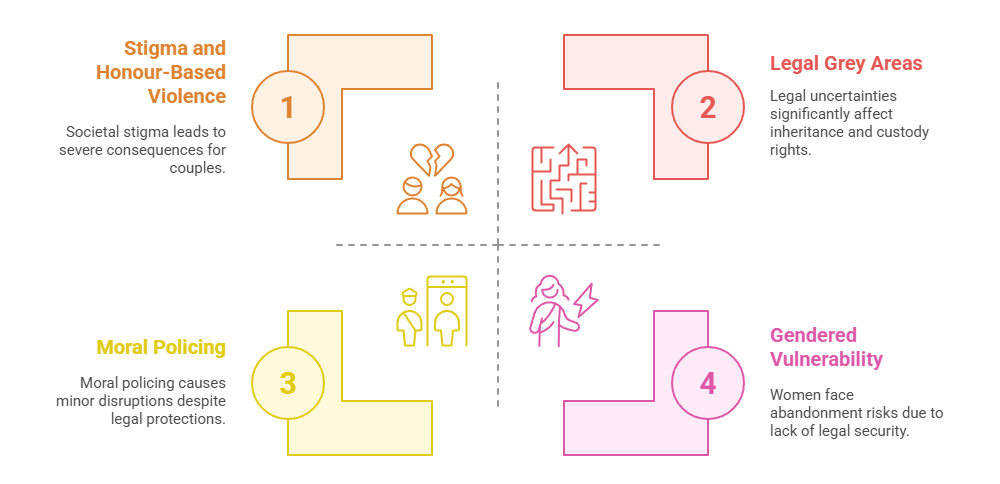
- Stigma and Honour-Based Violence: Rural and conservative societies often label live-in couples as “immoral”.
- Legal Grey Areas: Inheritance rights, child custody, and domestic violence protection remain unclear in many live-in setups.
- Moral Policing: Police and local vigilante groups often harass couples despite legal protections.
- Gendered Vulnerability: Women in live-in relationships may face abandonment without the security of marriage.
Case Study: The SC on Individual Autonomy (Lata Singh v. State of U.P., 2006)
The Supreme Court ruled that two consenting adults have the right to live together, and no one—including parents—can interfere. This judgment is often cited to protect couples who choose live-in arrangements, especially in inter-caste and inter-religious contexts.
Global Comparison
In countries like Sweden, France, and the U.S., cohabitation without marriage is common and legally recognized. India, while constitutionally secular and democratic, continues to struggle with societal conservatism.
Conclusion:
Live-in relationships challenge the monopoly of marriage over legitimacy and intimacy. The topic offers a lens to analyze how law, modernity, tradition, and individual agency interact in a transforming India. As India navigates the tension between constitutional morality and social morality, live-in relationships emerge not just as private arrangements, but as a site of contestation, rights, and recognition in a rapidly modernizing society
PYQs
Paper I:
- Discuss the transformation in the institution of marriage in the context of modern societies.
- How do changing norms around marriage and family affect the stability of social institutions?
Paper II:
- Discuss the impact of urbanization and economic independence on marriage and family in India.
- Examine the role of judiciary in reshaping the traditional family structure in India.
|


2 comments