
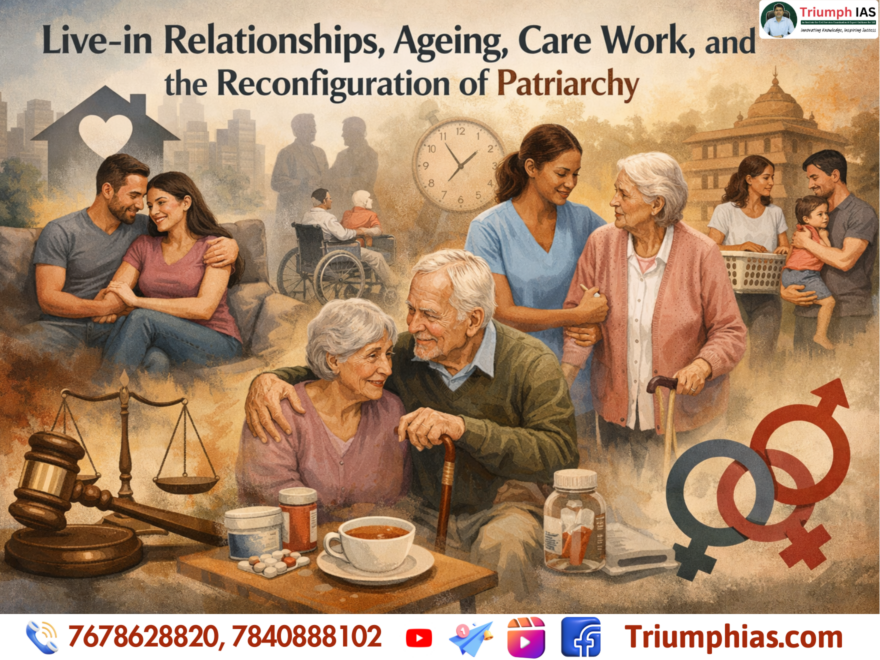
Live-in Relationships, Ageing, Care Work, and the Reconfiguration of Patriarchy
(Relevant for Sociology Paper I and II)
IntroductionThe family has long been regarded as a central institution of Indian society, deeply embedded in cultural traditions, kinship norms, and moral values. Classical sociologists viewed the family as a key agent of socialisation, reproduction of social norms, and emotional support. However, in contemporary India, family structures are undergoing significant transformation due to forces such as urbanisation, industrialisation, globalisation, rising education levels, women’s workforce participation, and changing value systems. These transformations are visible in the emergence of live-in relationships, the growing crisis of elderly care, the feminisation and invisibilisation of care work, and the restructuring rather than disappearance of patriarchy. This blog critically examines these changes using sociological theories, Indian empirical realities, and contemporary debates, making it highly relevant for Sociology Optional. Family as a Sociological InstitutionFrom a sociological perspective, family is not a static or natural unit but a socially constructed institution.
In India, however, the family historically performed multiple functions — economic, religious, educational, and welfare-related — especially through the joint family system. Traditional Indian Family StructureKey features included:
These structures ensured social security in the absence of a welfare state, but they were also marked by gender inequality and hierarchical relations. Forces Driving Change in Indian Family Structures1. Urbanisation and MigrationRural-to-urban migration has weakened joint family living, giving rise to nuclear families and single-person households. 2. Education and IndividualismRising education, especially among women, has fostered individual choice over collective decision-making. 3. Women’s Participation in Paid WorkEconomic independence has challenged traditional gender roles within the family. 4. Legal and Policy ChangesReforms related to divorce, inheritance, domestic violence, and live-in relationships have altered family norms. 5. Cultural GlobalisationExposure to global lifestyles through media has reshaped attitudes toward intimacy, marriage, and family. Anthony Giddens describes this as the emergence of the “reflexive project of the self”, where individuals actively construct their life choices rather than simply inheriting traditions. Live-in Relationships: Redefining Intimacy and MarriageSociological UnderstandingLive-in relationships represent a shift from institutionalised marriage to companionate or negotiated relationships. Giddens’ concept of the “pure relationship” is useful here — relationships entered for emotional satisfaction rather than social obligation. Indian ContextIn India, live-in relationships remain:
However, courts have increasingly recognised live-in relationships for:
This reflects what Ulrich Beck calls “institutionalised individualisation”, where individuals seek personal freedom while still relying on institutions like law for protection. Sociological Implications
Despite appearing radical, live-in relationships often reproduce gendered power relations, especially regarding emotional labour and social stigma borne disproportionately by women. Ageing, Longevity, and the Crisis of Elderly CareDemographic TransitionIndia is witnessing a rapid rise in the elderly population due to:
This has profound implications for family-based care systems. Traditional Model of Elder CareIn joint families:
Contemporary Challenges
This creates what sociologists call a “care deficit”. Feminist Perspective on Elder CareFeminist scholars argue that:
The weakening of family care systems without adequate state support leads to privatisation of care, through old-age homes and paid caregivers, often accessible only to middle and upper classes. Care Work: The Hidden Foundation of Family and EconomyWhat is Care Work?Care work includes:
Though essential, it remains economically undervalued. Feminist Sociological Insights
In India:
Paid Care and Class InequalityWith the decline of joint families:
Thus, family transformation does not eliminate inequality but redistributes it socially. Patriarchy: Decline or Reconfiguration?A common assumption is that modernisation weakens patriarchy. Sociology, however, suggests otherwise. Classical Patriarchy
Contemporary PatriarchyPatriarchy today operates in subtle and negotiated forms:
Deniz Kandiyoti’s concept of “patriarchal bargains” is crucial here. Women negotiate autonomy within patriarchal structures rather than fully escaping them. Live-in Relationships and PatriarchyEven in non-marital relationships:
Thus, patriarchy is not dismantled but restructured. Intersectionality: Family, Caste, Class, and RegionFamily change in India is uneven and stratified. Caste
Class
Region
Therefore, there is no single “Indian family” — only multiple, coexisting family forms. The Role of State and LawThe Indian state plays an ambivalent role:
Policies related to:
ConclusionChanging family structures in India reflect not a breakdown of the family, but its reorganisation under modern conditions. Live-in relationships challenge traditional marriage norms, ageing exposes the limits of family-based welfare, care work reveals deep gender inequalities, and patriarchy adapts rather than disappears. From a sociological perspective, the Indian family remains a site of negotiation, conflict, and continuity, shaped by intersecting forces of economy, culture, gender, and power. Understanding these transformations is crucial not only for academic analysis but also for designing inclusive social policies in a rapidly changing society. |
To Read more topics, visit: www.triumphias.com/blogs
Read more Blogs:
Global Diplomacy Takes Center Stage: The World Economic Forum at Davos