

Limits of Positivism in Studying Contemporary Social Movements
(Relevant for Sociology, Society [GS] )
IntroductionContemporary social movements—ranging from environmental activism and gender justice campaigns to digital protests and identity-based mobilisations—are complex, fluid, and deeply embedded in cultural meanings. Sociology, as a discipline, has traditionally relied on positivism to study social phenomena through objectivity, empirical observation, and general laws. While positivism contributed significantly to the scientific foundation of sociology, its limitations become evident when applied to contemporary social movements, which are dynamic, subjective, and context-specific. This blog critically examines why positivism alone is insufficient for understanding present-day social movements and highlights the need for alternative sociological approaches.  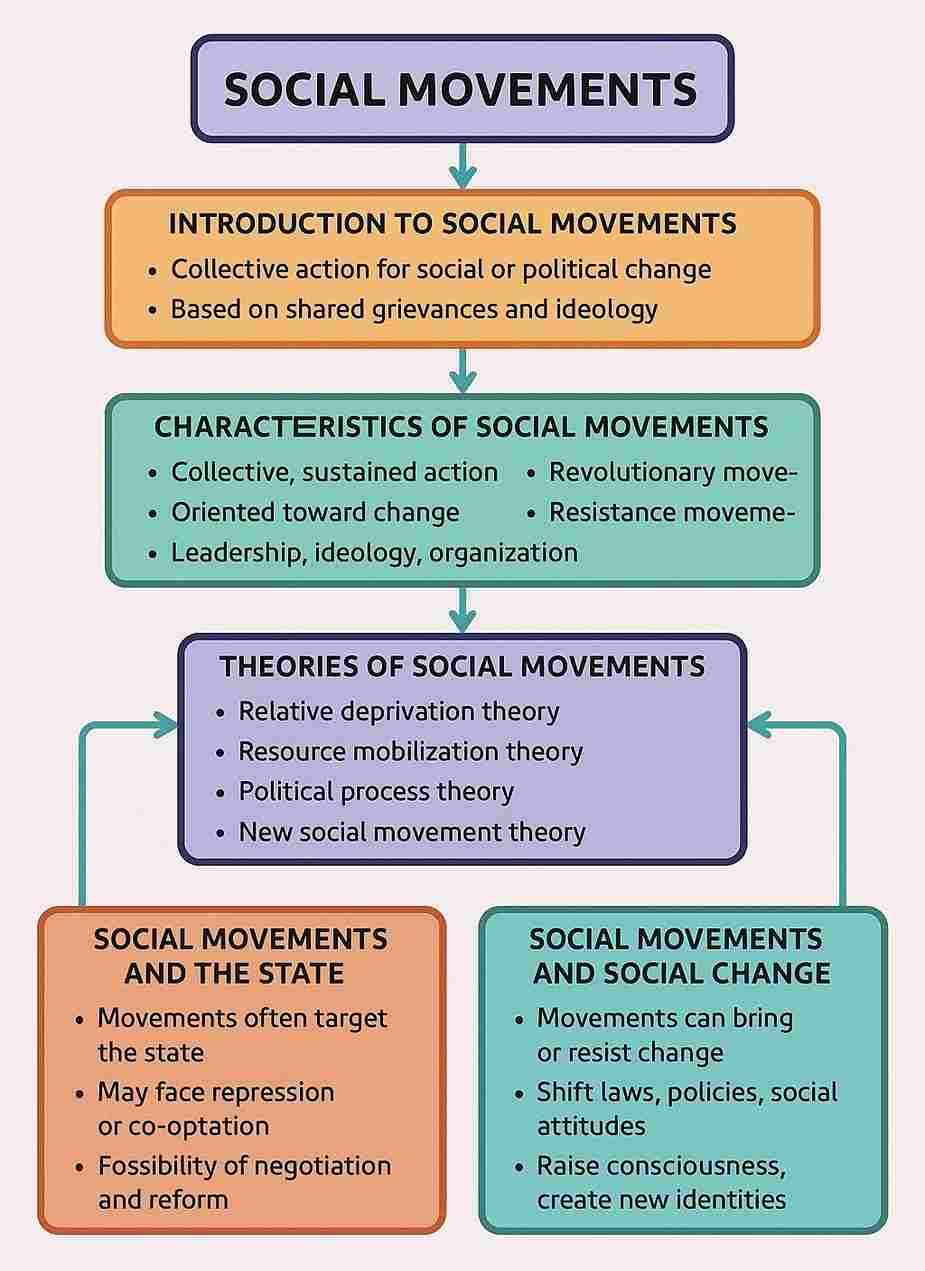 Dimension:Understanding Positivism in SociologyPositivism, associated with thinkers like Auguste Comte and Émile Durkheim, is based on the premise that social reality can be studied in the same manner as natural sciences. Its core features include:
While this approach is useful for studying structured institutions or demographic patterns, it encounters serious constraints when applied to the evolving nature of social movements. Nature of Contemporary Social MovementsModern social movements differ significantly from classical labour or class-based movements. They are:
These characteristics challenge the positivist assumption of stability, measurability, and predictability. Key Limits of Positivism in Studying Social Movements1. Neglect of Subjective MeaningsPositivism prioritises observable behaviour over actors’ interpretations and lived experiences. However, understanding why individuals participate in movements requires insight into emotions, identities, moral values, and perceptions of injustice—elements that cannot be fully captured through surveys or statistics. 2. Inadequacy in Capturing DynamismSocial movements are not static; they evolve rapidly in response to political opportunities, media narratives, and internal debates. Positivist models, which seek fixed variables and linear causality, struggle to explain such non-linear and unpredictable transformations. 3. Reductionism and Over-QuantificationBy reducing movements to variables like membership size or protest frequency, positivism risks oversimplifying complex processes. This reductionism ignores cultural symbols, ideological framings, and informal networks that often sustain movements. 4. Value-Neutrality as a ConstraintPositivism’s insistence on value-neutrality limits its ability to engage with power, ideology, and domination. Many contemporary movements explicitly challenge existing power structures, making it difficult to study them without normative engagement. 5. Eurocentric and Universalist BiasPositivist frameworks often assume universal social laws, overlooking local contexts, historical specificities, and Global South perspectives. This is particularly problematic when analysing indigenous, feminist, or postcolonial movements. Alternative Approaches Beyond PositivismTo overcome these limitations, sociologists increasingly adopt:
These approaches provide a more holistic and context-sensitive understanding of social movements. ConclusionPositivism has played a foundational role in establishing sociology as a scientific discipline. However, its methodological and epistemological constraints make it insufficient for studying contemporary social movements in isolation. The complexity, subjectivity, and fluidity of modern movements demand pluralistic and interdisciplinary approaches. For sociology—and particularly for UPSC aspirants—recognising the limits of positivism is essential to developing nuanced, critical, and application-oriented answers. |
UPSC CSE Mains – Practice Question
“Positivism is inadequate to explain the dynamics of contemporary social movements.”
Critically examine the statement with suitable sociological perspectives.
(250 words)
To Read more topics, visit: www.triumphias.com/blogs
Read more Blogs:
Can Social Sciences Be Value-Neutral in Polarised Societies?
2 comments