Why in News?
The Chief Justice of India recently emphasized that “legal aid is not charity but a moral duty”, highlighting it as a cornerstone of governance and the rule of law. His remarks came during the National Conference on Strengthening Legal Aid Delivery Mechanisms on National Legal Services Day (9th November 2025), which commemorates the enactment of the Legal Services Authorities Act, 1987.
This Act operationalizes the constitutional vision of equal justice for all, making legal aid accessible to marginalized and vulnerable groups in India.
Legal Aid as Social Justice
- Constitutional and Sociological Foundations
- Article 14 (Equality before Law) and Article 21 (Right to Life and Liberty) ensure that justice is not a privilege for the rich, reflecting a broader social contract (John Rawls).
- Article 39A of the Directive Principles mandates the state to provide legal aid, aligning with Amartya Sen’s capability approach, where access to justice enhances individual freedom and ability to participate in society.
- Legal aid addresses structural inequalities, serving historically marginalized groups like SC/ST communities, women, children, persons with disabilities, and victims of caste or ethnic violence.
- Legal Aid and Access to Justice
- Through National, State, and District Legal Services Authorities, the Act establishes a three-tier mechanism for systematic delivery of legal aid.
- Lok Adalats and Permanent Lok Adalats facilitate pre-litigation dispute resolution, reducing delays and litigation costs. This embodies Max Weber’s notion of rational-legal bureaucracy ensuring procedural efficiency while safeguarding rights.
Institutions and Initiatives Supporting Legal Aid
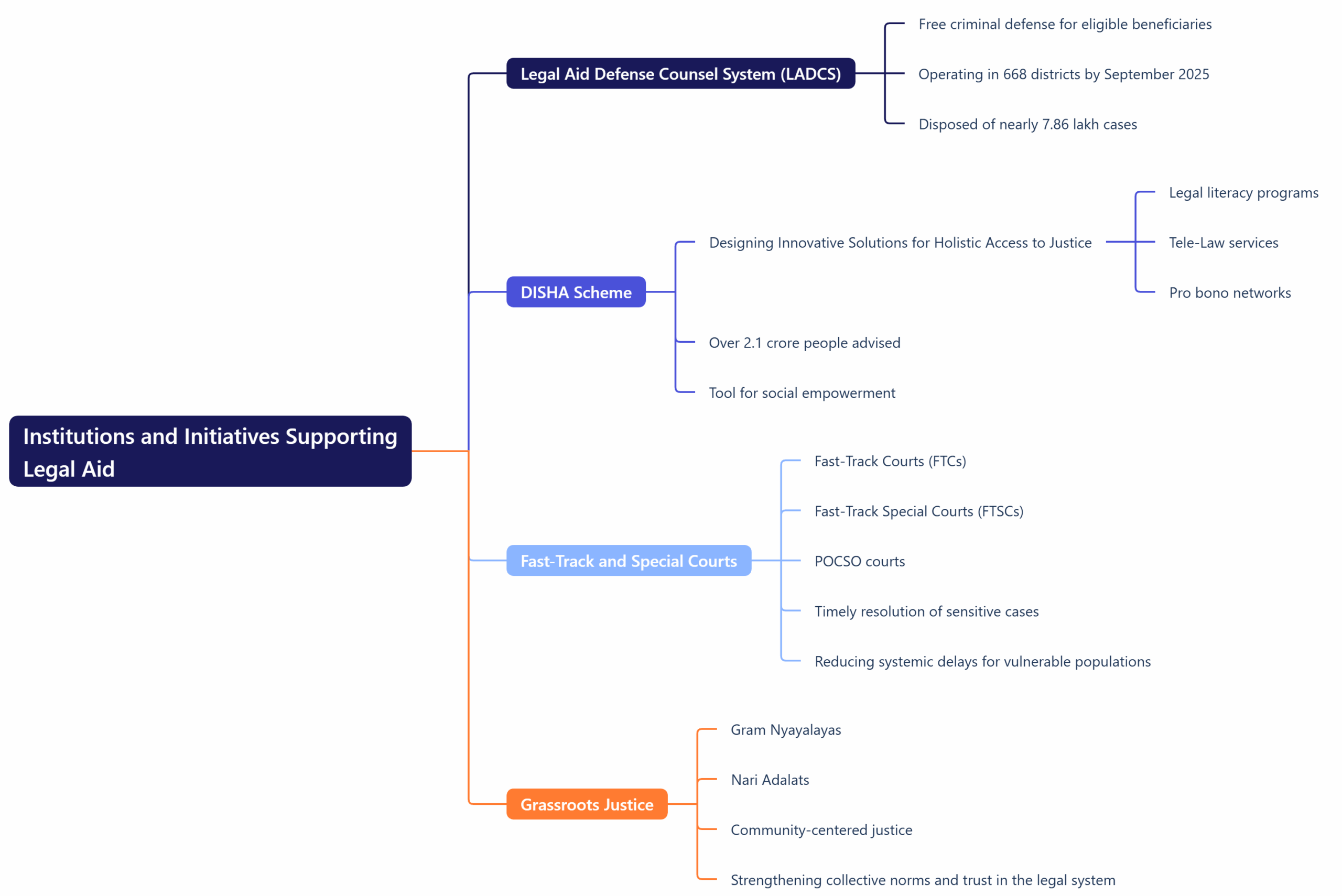
- Legal Aid Defense Counsel System (LADCS)
- Provides free criminal defense for eligible beneficiaries. By September 2025, LADCS operated in 668 districts, disposing of nearly 7.86 lakh cases.
- DISHA Scheme (Designing Innovative Solutions for Holistic Access to Justice)
- Implements legal literacy programs, Tele-Law services, and pro bono networks to reach remote and marginalized communities.
- Over 2.1 crore people have received advice and awareness under DISHA, reflecting the diffusion of legal knowledge as a tool for social empowerment.
- Fast-Track and Special Courts
- Fast-Track Courts (FTCs), Fast-Track Special Courts (FTSCs), and POCSO courts ensure timely resolution of sensitive cases, reducing systemic delays that disproportionately affect vulnerable populations.
- Grassroots Justice: Gram Nyayalayas and Nari Adalats
- Represent community-centered justice, echoing Durkheim’s theory of social cohesion where localized justice mechanisms strengthen collective norms and trust in the legal system.
Sociological Challenges in Legal Aid
- Fragmented Policy and Weak Continuity
- Frequent changes in leadership at NALSA and SLSAs disrupt long-term planning, reflecting institutional instability.
- Quality Gaps in Representation
- Free legal aid lawyers often lack specialized training, leading to low-quality representation—illustrating Bourdieu’s notion of unequal distribution of cultural capital, where legal knowledge and expertise remain concentrated.
- Social Barriers and Stigma
- Victims of domestic violence, caste-based discrimination, or trafficking may avoid legal recourse due to fear or social pressure. This aligns with Pierre Bourdieu’s social reproduction theory, where societal hierarchies perpetuate disadvantage.
- Low Awareness and Outreach Gaps
- Legal literacy campaigns often miss marginalized groups, showing urban-centric bias and unequal access to critical information.
Sociological Reforms for Strengthening Legal Aid
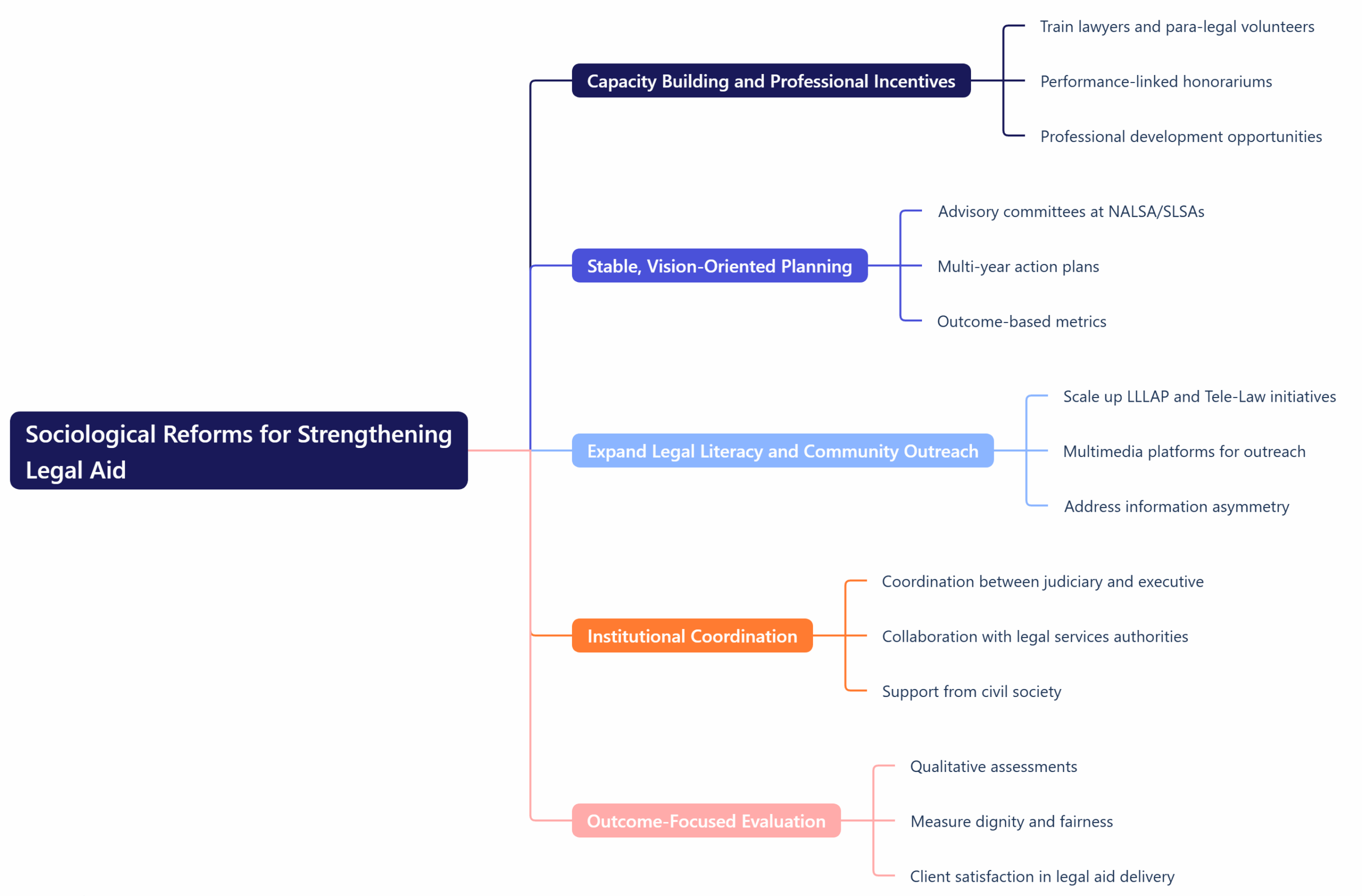
- Capacity Building and Professional Incentives
- Train lawyers and para-legal volunteers in sensitive domains, introduce performance-linked honorariums, and professional development opportunities.
- Stable, Vision-Oriented Planning
- Create advisory committees at NALSA/SLSAs to ensure continuity and develop multi-year action plans, incorporating outcome-based metrics.
- Expand Legal Literacy and Community Outreach
- Scale up LLLAP and Tele-Law initiatives, using multimedia platforms to reach rural and marginalized populations, bridging the information asymmetry that hinders access to justice.
- Institutional Coordination
- Enhance coordination between judiciary, executive, legal services authorities, and civil society to provide holistic support, counseling, and rehabilitation.
- Outcome-Focused Evaluation
- Move beyond quantitative reporting to qualitative assessments, measuring dignity, fairness, and client satisfaction in legal aid delivery.
Conclusion: Legal Aid as a Mechanism of Social Justice
Legal aid in India is not merely a charitable service—it is a moral and constitutional imperative that strengthens democracy, equity, and social cohesion. Through institutionalized mechanisms like NALSA, Lok Adalats, Fast-Track Courts, and Gram Nyayalayas, millions of citizens gain access to justice, especially the marginalized.
Sociologically, legal aid addresses structural inequalities (Bourdieu), enhances individual capabilities (Sen), strengthens social trust (Durkheim), and operationalizes rational-legal authority (Weber). However, challenges like low awareness, quality gaps, and fragmented implementation highlight the need for holistic, sustained reforms to ensure justice truly reaches every corner of the country.
|

One comment