Introduction
The National Education Policy (NEP) 2020 was launched as a transformative vision for Indian education. One of its key features—the three-language formula—aims to nurture linguistic proficiency and national integration. But in States like Tamil Nadu, it has triggered fierce resistance. The refusal to adopt Hindi as a third language has reignited long-standing debates about cultural identity, language politics, and Centre-State relations.
Why Tamil Nadu Said No
Tamil Nadu’s opposition to Hindi is deeply rooted in its Dravidian political legacy. The anti-Hindi agitations of the 1960s weren’t just linguistic protests—they were assertions of regional pride and autonomy. To this day, Tamil Nadu adheres to a two-language system (Tamil and English), viewing any imposition of a third language—particularly Hindi—as an infringement on its constitutional rights and a threat to cultural sovereignty.
The NEP’s Language Formula
While the NEP promotes multilingualism, critics argue it could lead to linguistic homogenization, especially with the promotion of Hindi over other regional languages.
Key Concerns
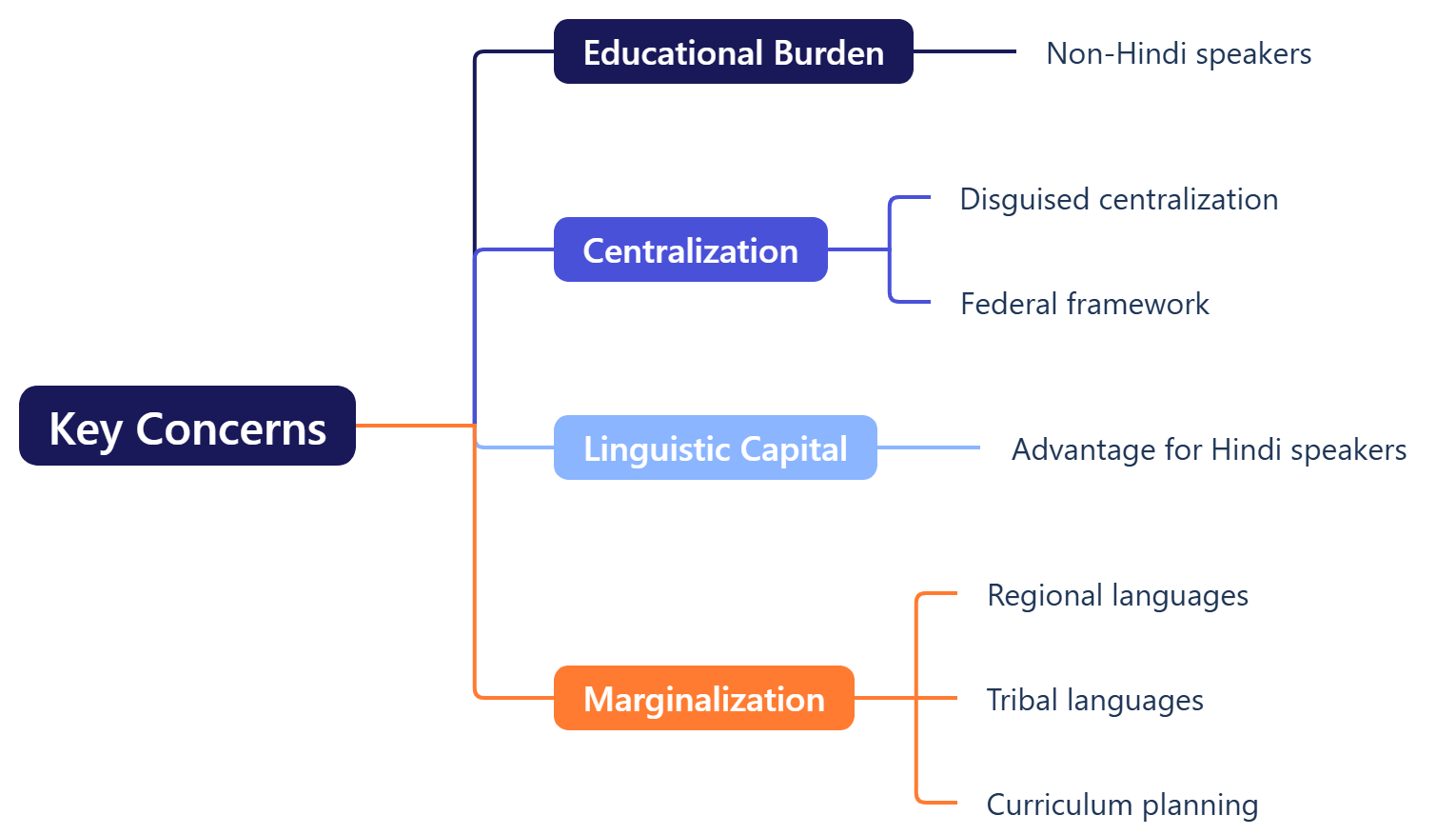
- Educational burden on non-Hindi speakers.
- Disguised centralization in a federal framework.
- Unequal linguistic capital—Hindi speakers may gain more advantage.
- Marginalization of regional and tribal languages in curriculum planning.
Sociological Analysis
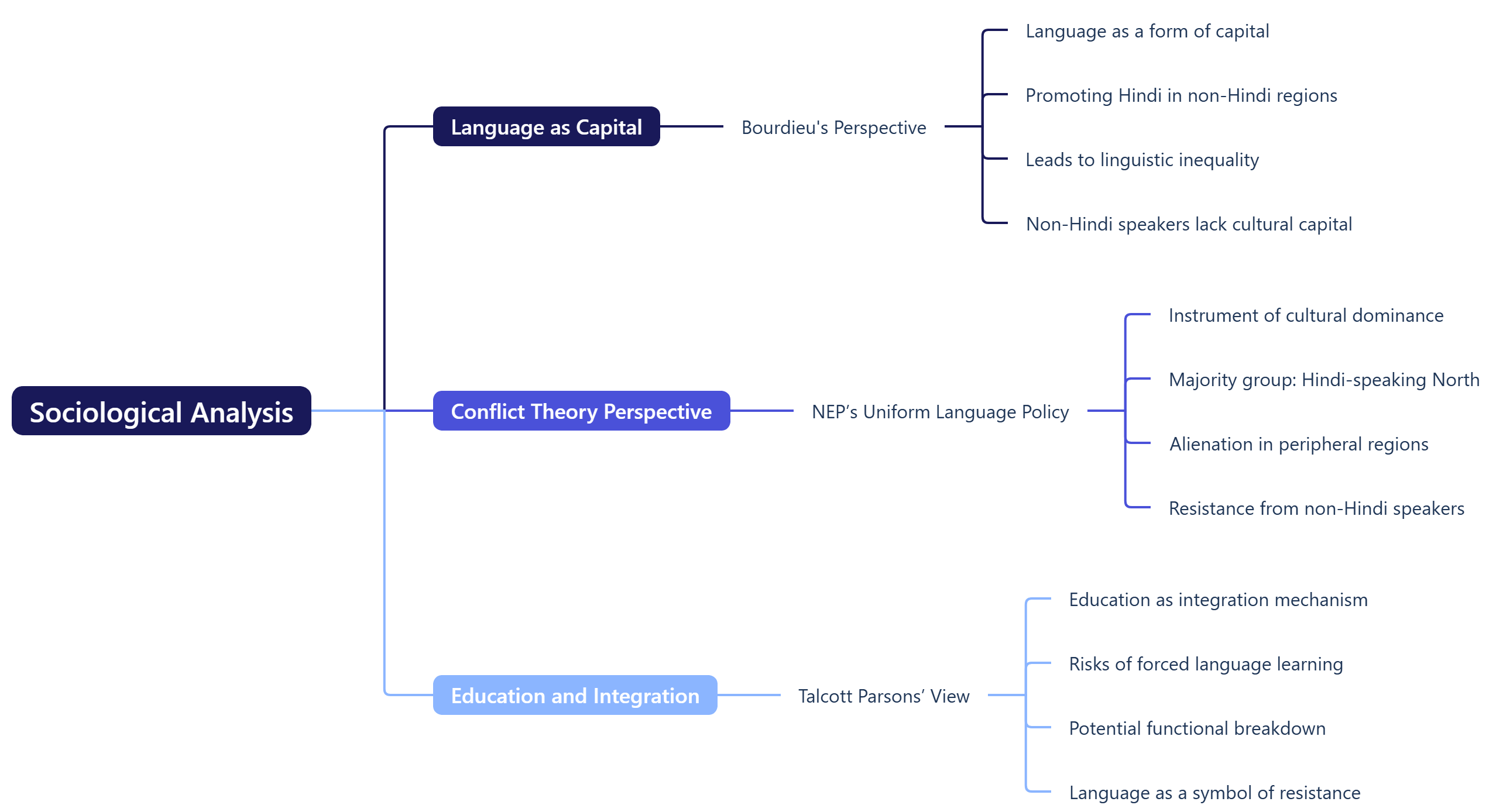
- According to Bourdieu, language is a form of capital. Promoting Hindi in non-Hindi regions creates linguistic inequality, where non-Hindi speakers lack access to dominant cultural capital.
- According to Conflict Theory Perspective, NEP’s uniform language policy is seen as an instrument of cultural dominance by the majority group (Hindi-speaking North), leading to alienation and resistance in peripheral regions.
- Talcott Parsons and Social Integration viewed education as a mechanism of integration. But forced language learning risks functional breakdown in societies where language symbolizes resistance.
Language and Federalism: A Structural Imbalance?
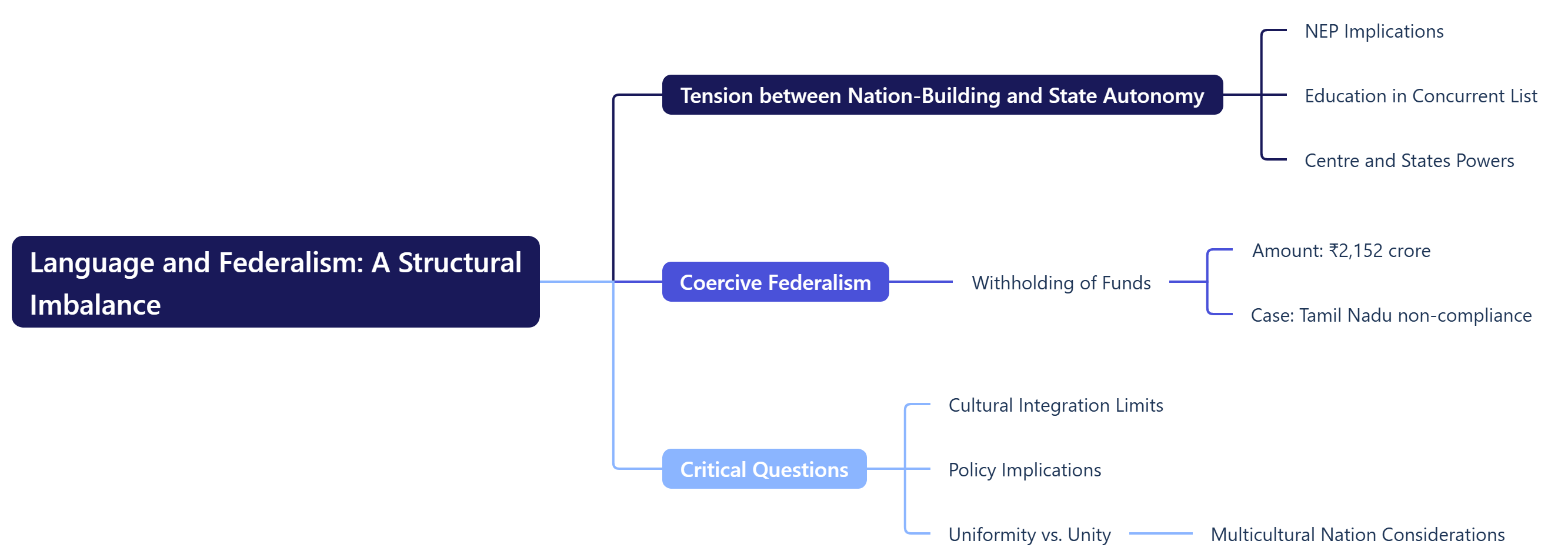
The NEP reveals the tension between nation-building and state autonomy. Education falls under the Concurrent List, meaning both Centre and States have powers. Yet, the withholding of funds (₹2,152 crore) from Tamil Nadu for non-compliance signals coercive federalism. It raises critical questions about:
- The limits of cultural integration through policy.
- Uniformity vs. Unity in a multicultural nation.
Conclusion
India’s strength lies in linguistic plurality, not uniformity. While the NEP aspires for unity, its implementation must be context-sensitive, respecting local histories and identities. True national integration cannot be legislated—it must be negotiated, through dialogue, inclusion, and respect for federal ethos.
PYQs
Paper 1
- Discuss Pierre Bourdieu’s concept of cultural capital in the context of the Indian education system. (2021)
- Discuss the relationship between education and social mobility. (2020)
- Analyze the role of education in promoting social integration in multi-ethnic societies. (2019)
- Explain how cultural lag affects social change with reference to Indian society. (2018)
- Examine the role of education in social stratification and social control. (2017)
- How do language and communication influence social structure? Explain with suitable examples. (2015)
Paper 2
- Critically examine the three-language formula and its implications for linguistic diversity in India.(2023)
- What is the role of education in addressing social inequalities in India? Evaluate the effectiveness of recent education policies. (2022)
- How does education policy in India reflect the tension between centralization and regional autonomy? Substantiate your answer with examples. (2021)
- Examine the impact of regionalism and language-based identity movements on Indian federalism. (2020)
- Language, ethnicity, and regional identity pose challenges to national integration. Discuss with reference to recent developments. (2018)
- Examine the role of regional political parties in protecting linguistic and cultural identities in India. (2016)
- Discuss the role of State policies in the preservation or marginalization of regional languages.(2015)
- Analyze the socio political impact of anti-Hindi agitations in Tamil Nadu in shaping regional identity and autonomy.(UPSC 2019)
|



It’s fascinating how the NEP 2020 attempts to promote unity through language while inadvertently reigniting old regional tensions. The case of Tamil Nadu really brings to light how language is more than a medium—it’s a marker of identity and resistance.