
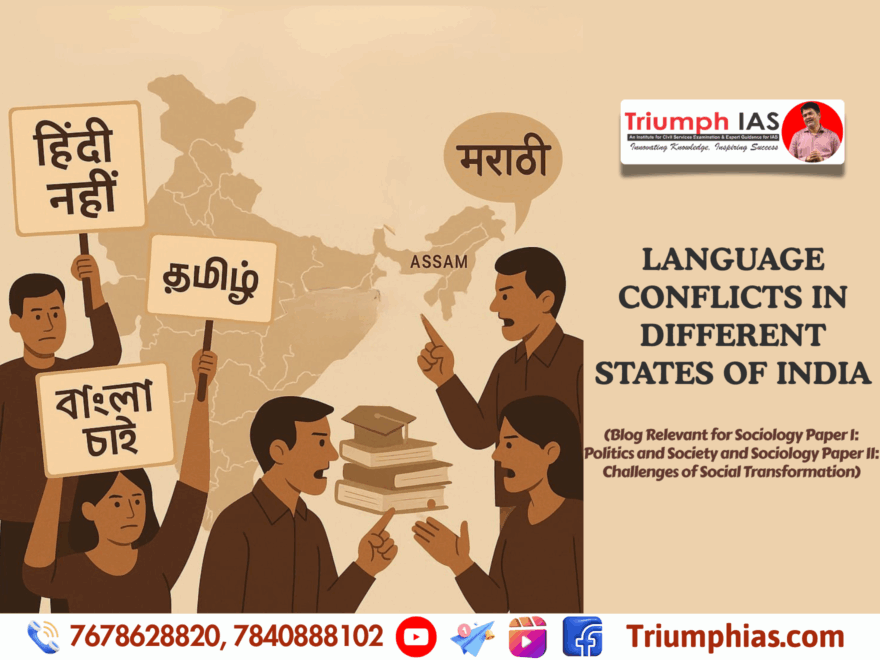
Language Conflicts in Different States of India
(Relevant for Sociology Paper I: Politics and Society and Sociology Paper II: Challenges of Social Transformation)
Introduction:Language is not just a tool of communication; it is deeply tied to identity, culture, and political assertion. In a country as diverse as India—home to 22 scheduled languages and over 19,500 dialects—language plays a vital role in shaping regional consciousness and inter-group relations. While the Indian Constitution protects linguistic diversity, language-based conflicts have emerged periodically in different states. These are often linked with issues of regional autonomy, cultural preservation, employment, and power relations, making them relevant to sociological debates on ethnicity, nationalism, and identity politics. Sociological Analysis
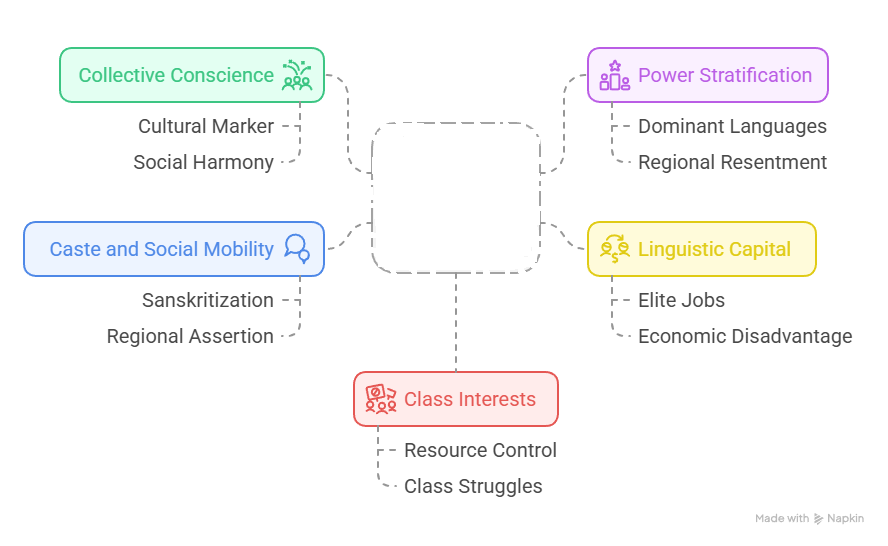
Durkheim viewed language as an expression of the collective conscience of a community. In India, linguistic communities perceive language as a sacred cultural marker. Any attempt to impose another language—especially by the state—is seen as a disruption of social harmony and cultural identity, resulting in resistance and conflict.
Max Weber emphasized that language is a resource for status and power. In India, those fluent in dominant languages like Hindi or English enjoy social and political privilege. Regional language speakers often perceive themselves as excluded from economic and bureaucratic mobility, sparking conflict and regional resentment.
According to Pierre Bourdieu, language acts as a form of symbolic capital. In India, mastery of English or Hindi opens access to elite jobs, education, and government services, while those proficient only in regional languages remain socially and economically disadvantaged, reinforcing class and caste inequalities.
M.N. Srinivas’s concept of Sanskritization reveals how lower castes tried to move up the social hierarchy by adopting the language and customs of upper castes. However, in post-independence India, regional languages became tools of assertion against this linguistic hegemony, especially by non-Brahmin castes and Adivasi communities.
From a Marxist perspective, A.R. Desai argued that language politics often reflect deeper class interests. Dominant groups use language to maintain control over resources, education, and governance. Language conflicts are therefore class struggles in disguise, especially when state policies prioritize Hindi or English over regional languages. Major Language Conflicts in Different States of India:
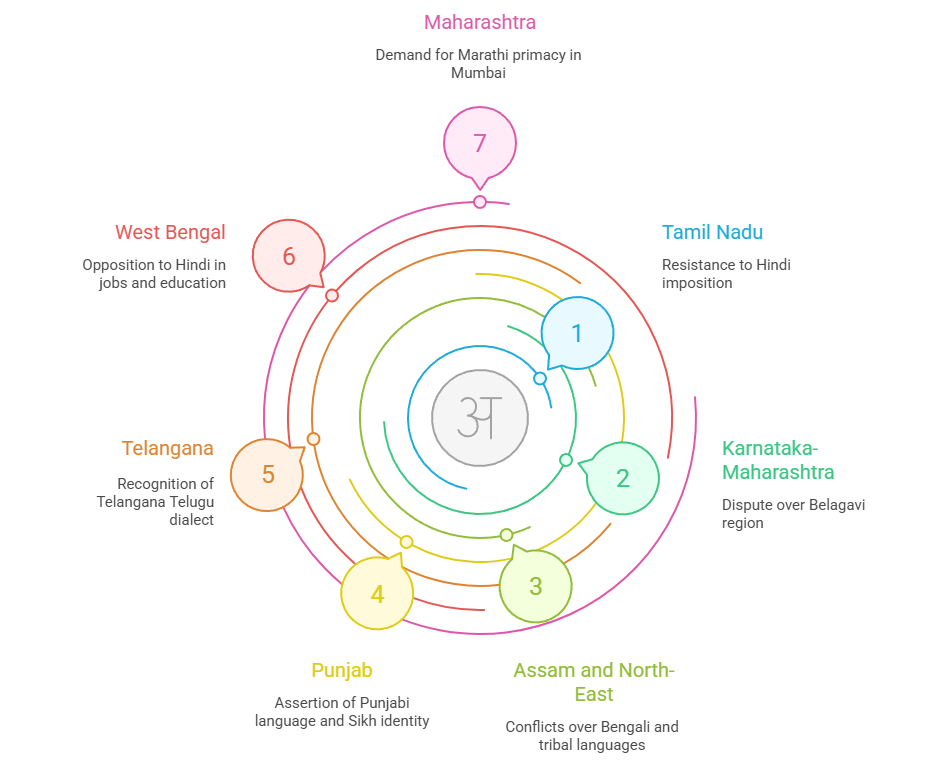
The 1965 Anti-Hindi agitations in Tamil Nadu were a response to the Centre’s attempt to impose Hindi as the sole official language. Led by Dravidian parties, the protests asserted Tamil identity and shaped the state’s long-standing resistance to Hindi in education and public administration.
In the Belagavi region, a linguistic conflict persists between Marathi and Kannada speakers. In 2023–24, tensions escalated over signboard language policies, with both states politicizing linguistic identity to assert territorial and cultural claims.
Assam has seen repeated conflicts over linguistic dominance, especially targeting Bengali-speaking migrants. Movements like the Assam Agitation and demands for language-based autonomy in Tripura and Meghalaya highlight ongoing ethno-linguistic tensions.
The Punjabi Suba movement linked Punjabi language with Sikh identity, leading to state reorganization in 1966. Language remains a cultural symbol, with ongoing concerns over the declining use of Punjabi in education and urban spaces.
The Telangana movement partly stemmed from the marginalization of its Telugu dialect by Andhra elites. Since statehood in 2014, there’s been growing recognition of Telangana Telugu in cultural and administrative spheres.
In West Bengal, protests have erupted over Hindi’s rising presence in central jobs and schools. Critics argue that such trends undermine Bengali cultural identity and regional autonomy.
Marathi groups opposed the increasing use of Hindi in Mumbai’s signage and services. Parties like MNS and Shiv Sena demanded primacy for Marathi, framing it as a defense of Maharashtra’s linguistic and cultural heritage. Implications of Language Conflicts
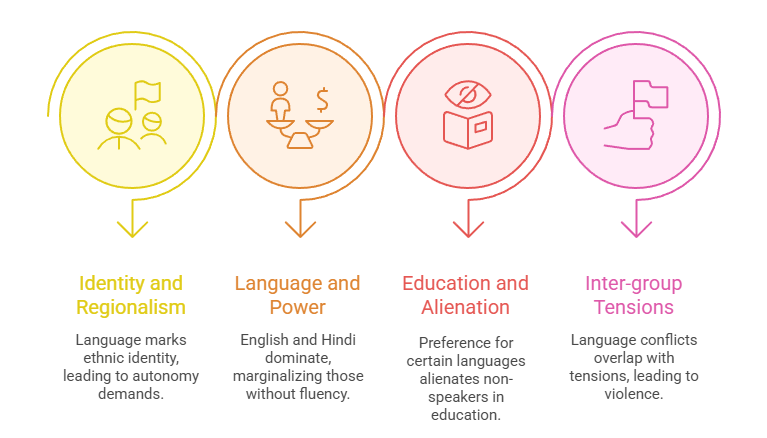
Language becomes a marker of ethnic and regional identity. In many cases, linguistic movements evolve into demands for statehood or autonomy, reshaping India’s federal structure.
As Bourdieu suggests, languages like English and Hindi enjoy symbolic dominance. Those without fluency in these are marginalized in education, employment, and governance, reinforcing class divisions.
The preference for English or Hindi in school curriculums, competitive exams, and digital platforms often alienates students from non-Hindi, non-English backgrounds, leading to educational inequality.
In some cases, language conflicts overlap with religious or ethnic tensions, turning into communal or xenophobic violence, as seen in Assam or parts of the North-East. Constitutional Provisions and Policy Measures
Recent moves like National Education Policy (NEP) 2020, which proposes promotion of Indian languages, have been viewed with skepticism by southern states fearing Hindi domination. ConclusionLanguage conflicts in India are not merely about communication—they are deeply sociological phenomena, tied to identity, power, access, and autonomy. From Tamil Nadu to Assam, the assertion of linguistic identity is a form of resistance against perceived central domination and cultural erasure. In a democratic and multilingual country like India, the challenge is to balance national integration with cultural pluralism. Addressing language conflicts requires not just constitutional safeguards but also inclusive policies in education, employment, and governance that respect regional aspirations. PYQsPaper I:
Paper II:
|

To Read more topics, visit: www.triumphias.com/blogs
Read more Blogs:
Strengthening India Disaster Preparedness: Towards a Resilient Nation
Best Sociology Optional IAS Coaching Online – Triumph IAS 2025 by Vikash Ranjan Sir
One comment