Introduction: Land Revenue Policies
India’s agrarian structure has been profoundly influenced by land revenue policies, both during colonial times and in the post-independence era. These policies have shaped land ownership patterns, class relations, and the socio-economic fabric of rural India.
Historical Context:
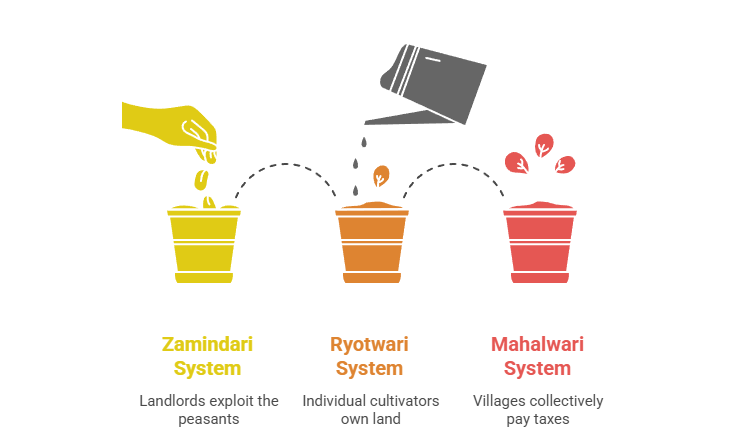
During British rule, three primary land revenue systems were introduced:
- Permanent Settlement (1793): Implemented in Bengal, Bihar, and Orissa, it granted zamindars ownership rights, leading to the creation of a landlord class that often exploited peasants.
- Ryotwari System: Applied in Madras and Bombay Presidencies, this system recognized individual cultivators (ryots) as landowners, making them directly responsible for tax payments.
- Mahalwari System: Used in parts of North-Western Provinces, it involved collective responsibility of villages (mahals) for tax payments.
These systems disrupted traditional agrarian relations, leading to increased peasant indebtedness and landlessness.
Post-Independence Land Reforms
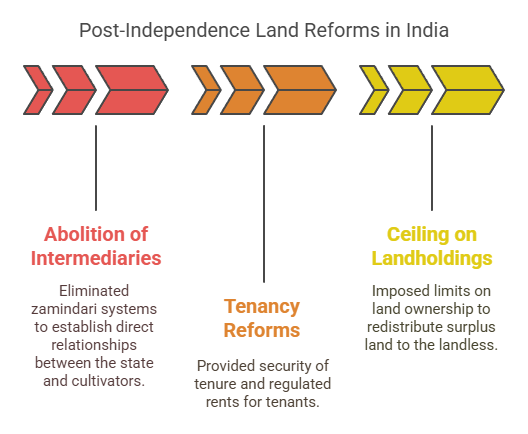
Post-1947, India undertook land reforms aiming to rectify historical injustices:
- Abolition of Intermediaries: Eliminated zamindari systems to establish direct relationships between the state and cultivators.
- Tenancy Reforms: Provided security of tenure and regulated rents for tenants.
- Ceiling on Landholdings: Imposed limits on land ownership to redistribute surplus land to the landless.
Despite these efforts, implementation varied across states, and challenges like loopholes and lack of political will hinder success.
Recent Developments
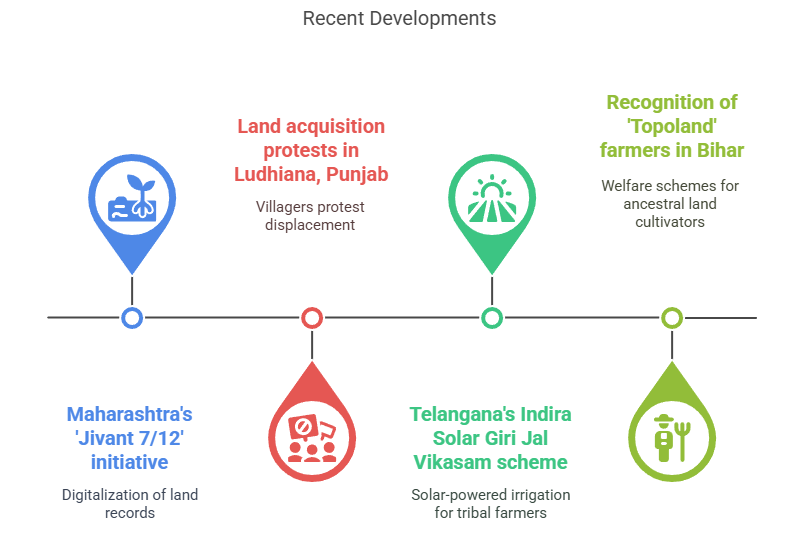
- Digitalization of Land Records: Maharashtra’s ‘Jivant 7/12’ initiative updated heirship information for over 5 lakh land titles, aiming to modernize land records and reduce legal disputes.
- Land Acquisition Protests: In Ludhiana, Punjab, villagers protested against proposed land acquisition for urban estates, fearing displacement and inadequate compensation.
- Empowerment of Tribal Farmers: Telangana launched the ₹12,600 crore Indira Solar Giri Jal Vikasam scheme to provide solar-powered irrigation to tribal farmers, enhancing their agricultural productivity.
- Recognition of ‘Topoland’ Farmers: Bihar government extended welfare schemes to farmers cultivating ancestral land (‘topoland’) not officially recorded, acknowledging their contributions to agriculture.
Sociological Analysis
- Agrarian Class Structure: The agrarian society in India comprises various classes:
- Landlords (Maliks): Own large landholdings, often deriving income without direct cultivation.
- Peasants (Kisans): Small landowners who cultivate their land.
- Landless Laborers (Mazdoors): Work on others’ land for wages.
Land revenue policies have historically favored landlords, intensifying inequalities.
- Rural Inequality and Caste Dynamics: Land ownership in India is closely tied to caste hierarchies. Upper castes traditionally own more land, while lower castes and Dalits often remain landless, perpetuating socio-economic disparities.
- Gender Disparities: Women, despite contributing significantly to agriculture, often lack land rights, leading to economic dependence and marginalization.
- Impact of Land Reforms: While land reforms aimed to democratize land ownership, their uneven implementation has limited their effectiveness in transforming the agrarian structure.
Conclusion
Land revenue policies have played a pivotal role in shaping India’s agrarian structure. While historical policies entrenched inequalities, recent initiatives aim to address these issues. However, for meaningful transformation, policies must be implemented effectively, considering the socio-economic and cultural complexities of rural India.
PYQs
Paper 2
- Examine the impact of colonial land revenue policies on the agrarian structure in India. (2022)
- Discuss how British colonial policies transformed caste and community structures in India. (2021)
- How did the British policy of education impact Indian society? (2020)
- Critically evaluate the role of colonialism in the rise of new social classes in India. (2019)
- What was the impact of colonialism on Indian village communities? (2018)
- Discuss the impact of Western education and modern professions on the Indian middle class during colonial rule. (2017)
- How did colonial interventions in tribal areas affect tribal society and economy? (2016)
- Discuss how colonialism led to social reform movements in India. (2015)
- What were the major transformations in Indian economy and society under colonial rule? (2014)
- How did colonial administration change the nature of caste? (2013)
|



One comment