

Justice Delayed, Justice Denied: A Sociological Lens on India’s Execution Petition Crisis
(Relevant for Sociology Paper 1: Stratification and Mobility)
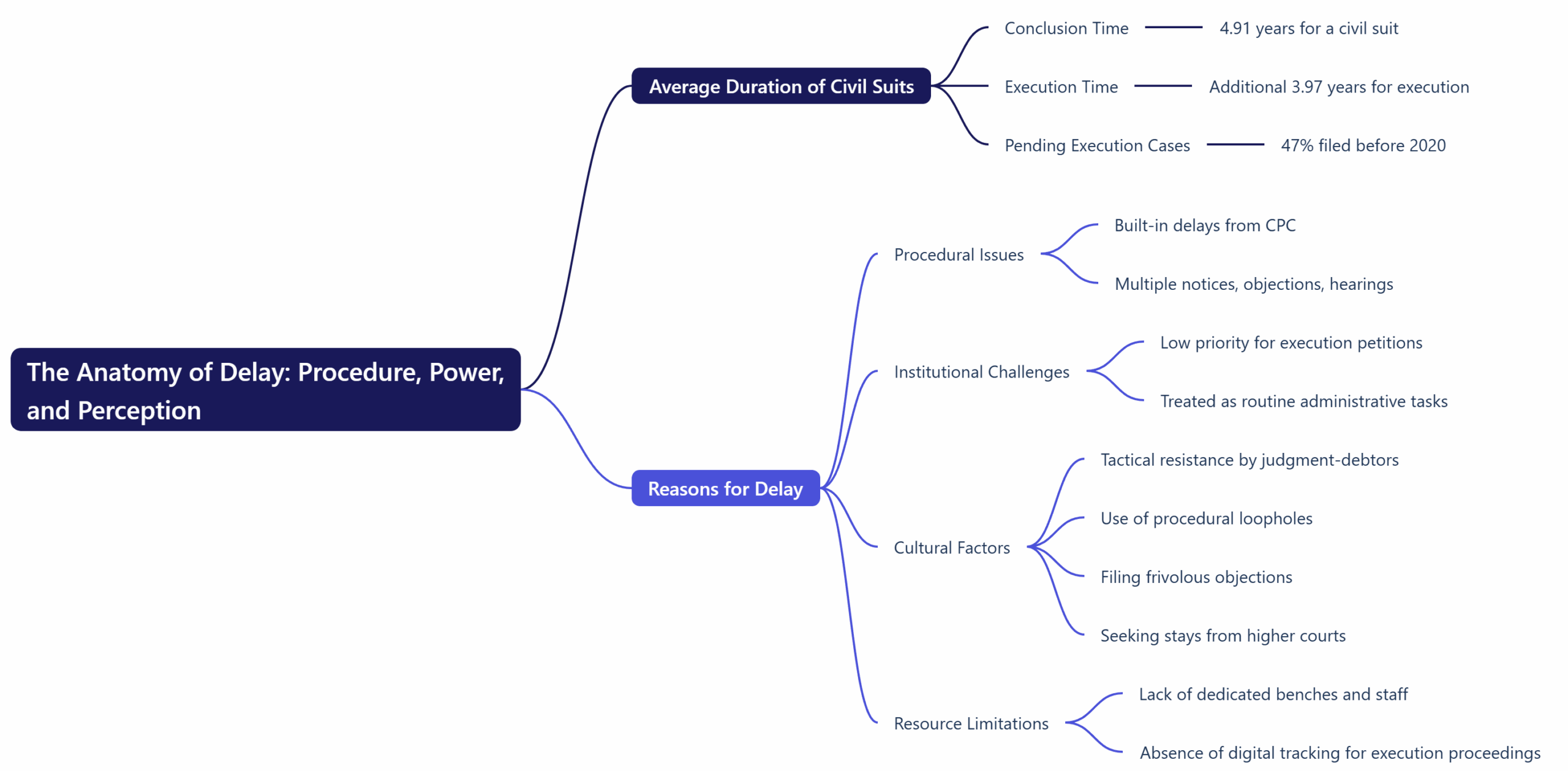
Introduction: The Final Step That Never ArrivesWinning a court case in India does not necessarily mean justice has been served. For thousands of litigants, the verdict is only the beginning of another long, exhausting wait — the wait for execution. As of mid-2025, over 8.82 lakh execution petitions are pending before district courts across the country. A staggering 3.38 lakh new petitions were filed in just six months, prompting the Supreme Court to describe the situation as “alarming” and “highly disappointing.” An execution petition is supposed to be the final step of civil litigation — the process through which a decree-holder enforces the court’s judgment, whether it involves recovering money, obtaining property, or compelling specific performance. Governed by Order XXI of the Code of Civil Procedure (1908), it should ideally be a straightforward administrative process. Yet, in India’s lower judiciary, it has become a symbol of systemic inertia and social despair. The issue, while seemingly legal, carries deep sociological significance — exposing the distance between law in books and law in action, and reflecting how procedural delay corrodes public faith in justice. The Anatomy of Delay: Procedure, Power, and Perception
Data from the National Judicial Data Grid (NJDG) paints a grim picture:
In short, the implementation of justice can take almost as long as the initial litigation — sometimes longer. Why does this happen? The reasons are procedural, institutional, and cultural:
The outcome is a cycle of institutional fatigue — where decrees are reduced to paper victories, and the judiciary’s legitimacy erodes under the weight of its own delays. But beneath these technicalities lies a deeper sociological question: What happens to a society when justice itself becomes inaccessible in practice? The Social Cost of Judicial PendencyFrom a sociological perspective, the pendency of execution petitions is more than a bureaucratic inefficiency; it is a social wound that undermines the very moral foundation of the legal order. For litigants — especially ordinary citizens without influence — the years spent chasing enforcement bring emotional exhaustion, economic ruin, and social disillusionment. They lose not only time and money but also faith in institutions. When the state fails to ensure timely justice, social trust erodes. According to Émile Durkheim, institutions derive legitimacy from their ability to sustain collective conscience — a shared belief in moral order. The Indian judiciary’s inability to deliver the fruits of judgment fractures that conscience, creating what Durkheim called “anomie” — a state of normlessness and moral disintegration. Justice delayed thus becomes a form of social deviance — a breakdown of the moral regulation that keeps society cohesive. Moreover, pendency reinforces structural inequality. The wealthy and powerful can afford prolonged litigation; the poor cannot. In Pierre Bourdieu’s terms, the law — rather than being neutral — becomes a field of symbolic violence, reproducing class hierarchy under the guise of procedural fairness. The Bureaucratic Machine: Weber’s “Iron Cage” in ActionMax Weber’s concept of bureaucratic rationalization offers a profound lens for understanding the Indian judiciary’s procedural paralysis. Weber saw bureaucracy as both efficient and dehumanizing — a system that values rules over results. Execution proceedings exemplify this paradox perfectly. They are governed by a meticulously detailed procedural code, intended to ensure fairness. Yet, in practice, this hyper-legalism becomes a cage of endless paperwork, adjournments, and formalities. What was meant to secure justice now obstructs it. Judicial officers become, in Weber’s words, “specialists without spirit” — bound by forms, files, and deadlines but unable to deliver meaningful outcomes. The pendency of execution petitions, therefore, reflects the pathology of modern rationality: justice mechanized but immobilized. Sociological Perspectives on Justice and Delay
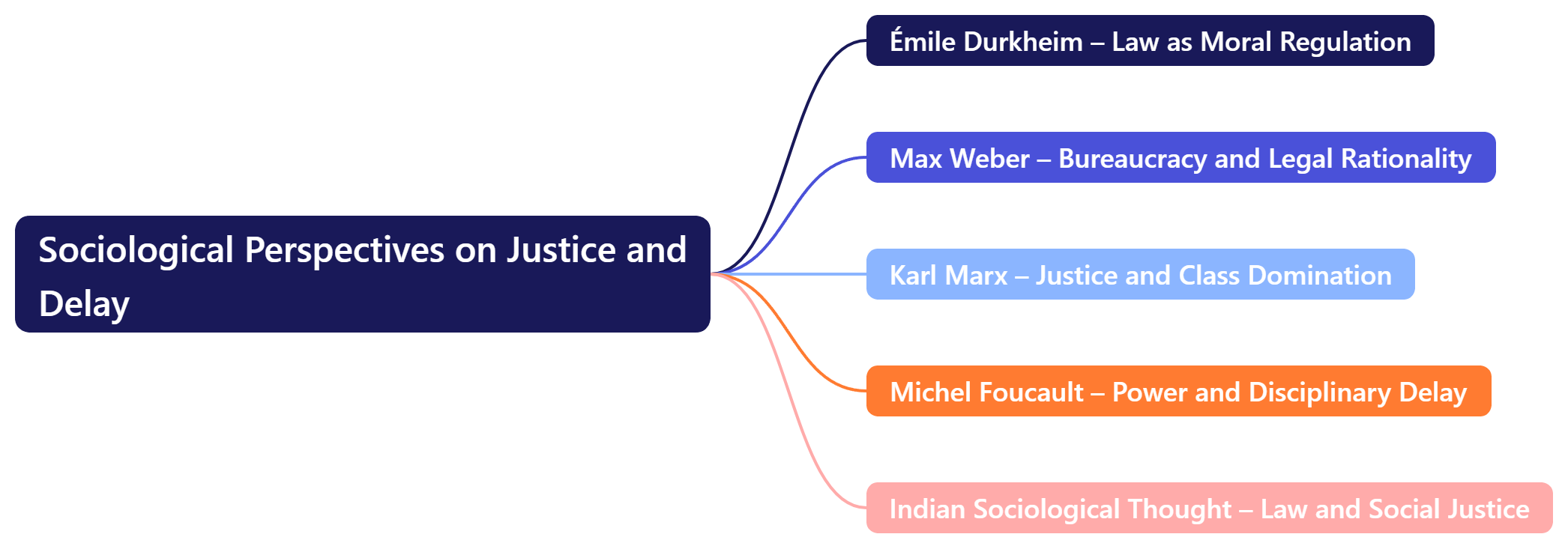
To understand the crisis more deeply, it is worth turning to key sociological thinkers who have examined the relationship between law, power, and social order.
Durkheim viewed law as a reflection of a society’s moral values. In a healthy society, law reinforces social solidarity by embodying collective norms. But when law loses its moral credibility — when court orders are unenforced — the very fabric of social trust disintegrates. The massive backlog of execution petitions signifies a moral failure of the state to uphold its normative promises.
Weber’s theory helps explain how a system designed for precision and neutrality turns into an “iron cage” of inefficiency. The lower judiciary’s adherence to procedural orthodoxy — issuing notices, awaiting documents, and tolerating non-compliance — transforms law into ritual rather than remedy.
From a Marxian standpoint, the law is not an impartial arbiter but a tool that reflects class interests. The delays in execution favor those with greater resources to sustain litigation — landlords, corporations, and elites — while the working class and small claimants suffer. The pendency of execution petitions, therefore, reproduces class inequality within the legal system.
Foucault’s idea of “disciplinary power” suggests that institutions control individuals not just through punishment but through procedures, surveillance, and waiting. In this sense, judicial delay becomes a disciplinary mechanism — citizens internalize powerlessness as they wait for years for the system to move. The process itself becomes the punishment.
Indian sociologists like Upendra Baxi and André Béteille have long noted that the formal structure of law in India often fails to resonate with lived realities. The execution crisis epitomizes this gap: a modern legal code operating within a socially stratified and resource-scarce context. The result is legal modernity without social efficiency. Institutional Efforts and Their Sociological ImplicationsThe Supreme Court has not remained silent. It has issued multiple directives to the High Courts and district judiciary to dispose of execution petitions within six months. In 2021, then CJI S.A. Bobde outlined 14 mandatory directions for speedy disposal. In March 2025, the apex court reiterated its concern and ordered real-time monitoring of execution cases through digital data systems. While these reforms are essential, their impact depends on what sociologist Anthony Giddens calls “structuration” — the dynamic interplay between institutional rules and human agency. Judicial reform cannot merely change rules; it must change the culture of compliance that normalizes delay. Digitization, dedicated execution benches, and performance audits can help, but without an accompanying change in mindset, the legal system risks remaining trapped in ritualistic bureaucracy rather than responsive governance. Conclusion: The Social Meaning of Judicial TimeThe pendency of execution petitions reveals more than a procedural flaw — it reflects a crisis of legitimacy. When justice takes a decade to materialize, the moral contract between citizens and the state frays. Sociologist Robert Merton once observed that when institutional means fail to achieve socially approved goals, individuals experience strain — they may withdraw faith or seek alternative means. Applied to India’s judiciary, this strain manifests as rising cynicism, private settlements, and extra-legal remedies — symptoms of a society where formal justice is perceived as futile. Ultimately, the execution crisis forces us to confront an uncomfortable truth: justice delayed is not just justice denied; it is society denied. The path forward demands more than procedural reform — it requires a sociological reimagining of justice as a living, participatory process rooted in accountability, empathy, and human dignity. Only when the final step of justice is no longer the final struggle can the judiciary reclaim its place as the moral anchor of Indian democracy. |
To Read more topics, visit: www.triumphias.com/blogs
Read more Blogs:
Poverty in a Warming World: The Sociology of Overlapping Hardships
Invisible Yet Indispensable: The Social Urgency of Empowering India’s Domestic Workers