
Judicial Review, Environmental Governance, and Development: A Sociological Analysis of the Supreme Court’s Recall of the Vanashakti Verdict
(Relevant for Sociology Paper 2: Challenges of Social Transformation)
|
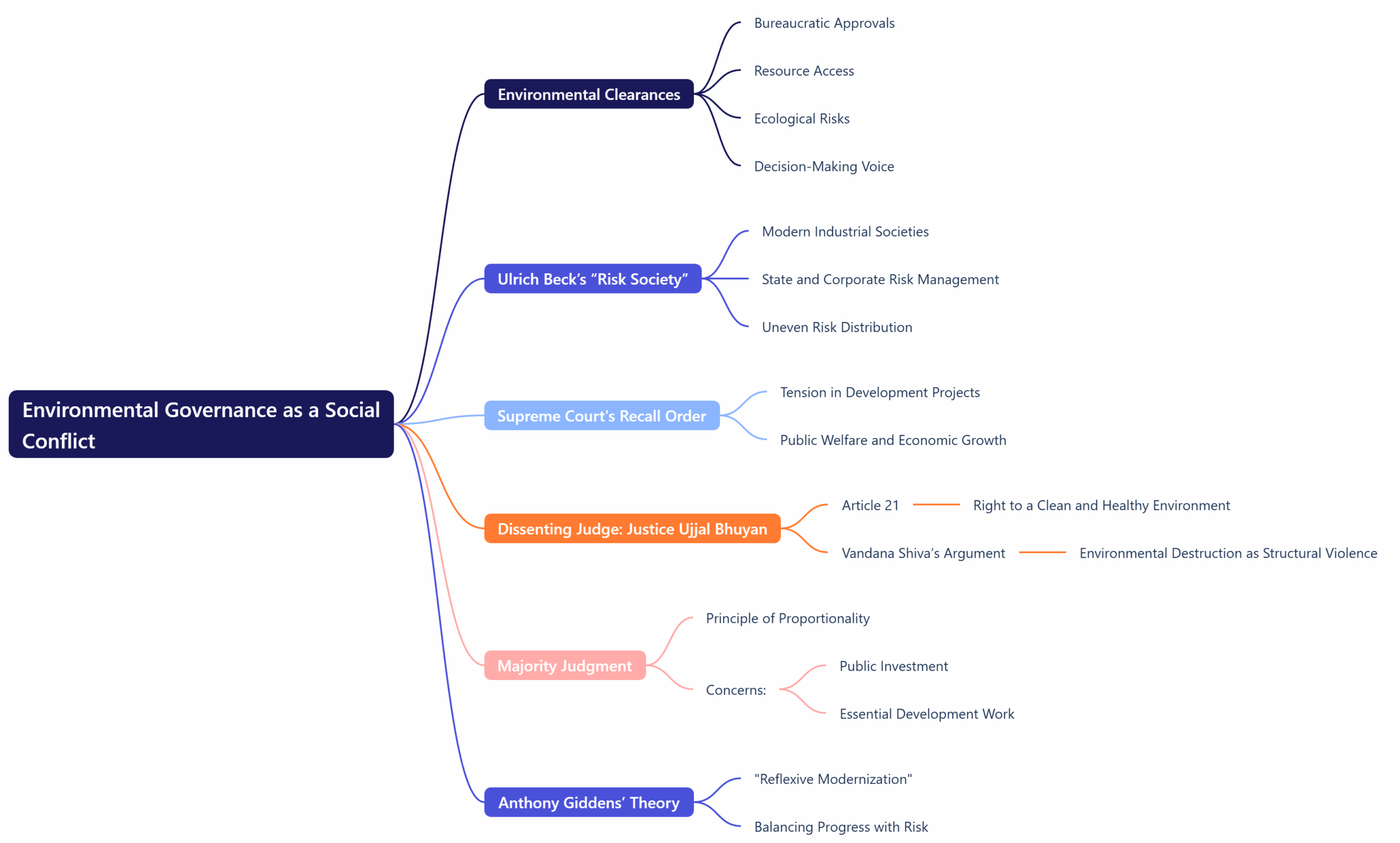
The recent decision of the Supreme Court of India to recall the 2025 Vanashakti judgment— which had previously barred ex-post facto (retrospective) Environmental Clearances (ECs)—has revived a deep sociological debate around environmental justice, developmental priorities, and the State–market–community relationship. The ruling, delivered by a 2:1 majority, reflects a constitutional–developmental dilemma: Should environmental regulation operate strictly on the precautionary principle, or should judicial interpretation accommodate the developmental needs of a rapidly industrializing society? From a sociological standpoint, environmental governance cannot be understood merely as a legal–administrative process; rather, it must be contextualized within issues of social inequality, power distribution, state capacity, corporate influence, and environmental citizenship. Scholars such as Ulrich Beck, Ramachandra Guha, Amita Baviskar, Arturo Escobar, Vandana Shiva, and Anthony Giddens argue that modern environmental conflicts are embedded in structural inequalities where marginalized groups disproportionately bear ecological burdens while benefits accrue to industrial and elite interests. Environmental Governance as a Social Conflict
Environmental clearances are not just bureaucratic approvals—they determine who has access to resources, who bears ecological risks, and who has the voice to participate in decision-making. Ulrich Beck’s “Risk Society” framework explains modern industrial societies as arenas where state and corporate actors produce and manage risks but distribute them unevenly. The Supreme Court’s recall order reflects this tension: development projects promise public welfare and economic growth, but environmental degradation disproportionately affects tribal groups, rural poor, fishing communities, and informal workers. The dissenting judge, Justice Ujjal Bhuyan, grounded his view in Article 21—Right to a clean and healthy environment, echoing Vandana Shiva’s argument that environmental destruction is a form of structural violence against vulnerable communities. The majority judgment, however, emphasized the principle of proportionality, arguing that imposing strict prohibitions could jeopardize crores of public investment and halt essential development work, aligning with Anthony Giddens’ theory of “reflexive modernization,” where institutions attempt to balance progress with risk. The Sociology of Law and Judicial ReviewThe recall of the Vanashakti judgment is a significant moment for sociology of law, highlighting how courts mediate between competing social interests. Émile Durkheim argued that law is an expression of the collective conscience; modern societies require laws that adapt to evolving needs. The Court’s review under Article 137 reflects this adaptive legal reasoning. However, Marxist sociologists such as Pierre Bourdieu and Nicos Poulantzas view law as a tool that often legitimizes dominant class interests. From this perspective, retrospective ECs may appear as state–corporate alliances that legalize ecological harm under the guise of national development. Amita Baviskar’s work on environmentalism of the poor argues that judicial decisions involving environmental governance must center subaltern voices rather than privileging techno-bureaucratic rationality. Ex-Post Facto Clearances and Regulatory InstitutionalismEnvironmental compliance systems embody bureaucratic rationality. Following Max Weber’s concept of rational-legal authority, regulatory frameworks like EIA 2006, PARIVESH, and NGT environmental compensation mechanisms exist to introduce predictability and accountability. Retrospective approvals risk bureaucratic erosion by allowing post-violations to be regularized—potentially weakening deterrence. However, the majority judgment suggests that rigid implementation without room for exception may produce institutional paralysis and economic stagnation. This resonates with Herbert Simon’s theory of bounded rationality, which acknowledges practical constraints within administrative decision-making. The Court emphasized that procedural delays rather than deliberate violations were responsible for several EC lapses and that infrastructure essential to public welfare—like hospitals, water pipelines, transportation networks—should not be demolished on procedural grounds. Environmental Justice and PowerEnvironmental sociology emphasizes power dynamics surrounding access to resources. The recall ruling can be assessed through John Rawls’ theory of justice, which prioritizes fairness and protection of vulnerable groups. If ex-post clearances regularize illegal industrial activity affecting tribal or ecologically sensitive zones, justice is violated. If blocking retrospective approvals halts essential welfare projects and employment, justice is still violated—but in a different way. Similarly, Arturo Escobar’s post-development theory critiques how development discourse often overrides indigenous environmental knowledge. The recall decision highlights ongoing tensions: indigenous communities and ecology being sacrificed to the imperatives of capitalist growth. Precautionary vs. Proportionality Principles: Competing Paradigms
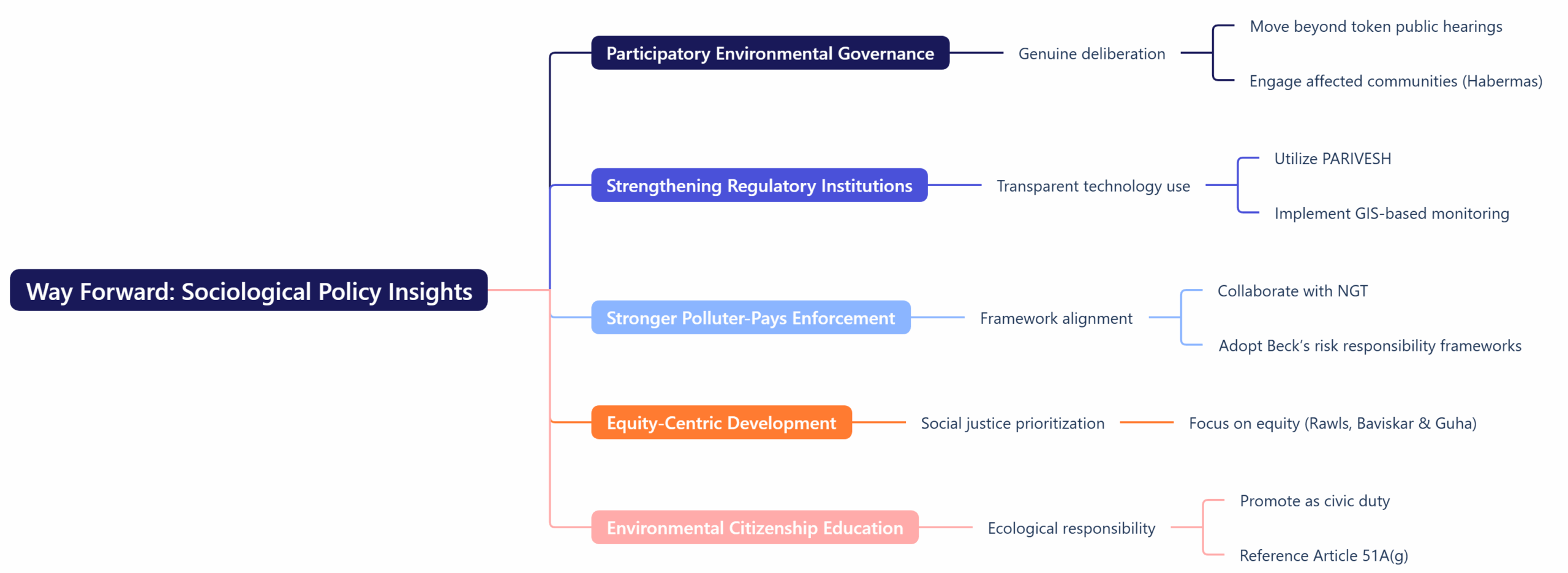
The dissenting view argues retrospective ECs reward violators, weakening environmental citizenship. The majority view argues that proportionality ensures development-with-compliance, more realistic in a country balancing poverty alleviation and economic growth. Community Participation, Public Accountability & DemocracyEnvironmental Impact Assessments require public hearings, but sociological research shows these often function as symbolic exercises dominated by technical experts, powerful firms, and bureaucrats. Habermas’ theory of communicative action emphasizes the need for deliberative democracy—open, inclusive decision-making spaces. Strengthening:
is important to restore accountability and prevent state-corporate collusion. Way Forward: Sociological Policy Insights
Move beyond token public hearings to genuine deliberation with affected communities (Habermas).
Ensure transparent use of technology such as PARIVESH and GIS-based monitoring.
Align with NGT and Beck’s risk responsibility frameworks.
Prioritize social justice as argued by Rawls, Baviskar & Guha.
Promote ecological responsibility as a civic duty under Article 51A(g). ConclusionThe Supreme Court’s recall of the Vanashakti verdict symbolizes a critical crossroads in India’s environmental governance. It reveals the sociological struggle between ecological justice, economic development, and legal rationality. The majority judgment reflects a pragmatic, flexible developmental vision, while the dissent foregrounds environmental rights and moral accountability. Ultimately, sustainable development in India requires transparent regulation, participatory democracy, ecological restoration, and strong community-based governance—ensuring that growth is not achieved at the cost of environmental degradation and social injustice. |
To Read more topics, visit: www.triumphias.com/blogs
Read more Blogs:
Reference Group Theory and Its Applicability Across Different Social and Cultural Contexts
Generative AI in India: A Sociological Lens on Technology, Power, and Governance
One comment