Introduction
In an era driven by profit margins and market segmentation, the Indian joint family emerges as an unintended but significant threat to capitalist growth. While corporations celebrate the nuclear household model that increases consumption, the joint family quietly subverts this economic model by pooling resources and reducing redundant spending. In this blog, we explore how the traditional Indian joint family is a socio-economic structure that resists the logic of consumer capitalism—and why that matters for sociology.
Why the Joint Families Disrupts Consumer Markets
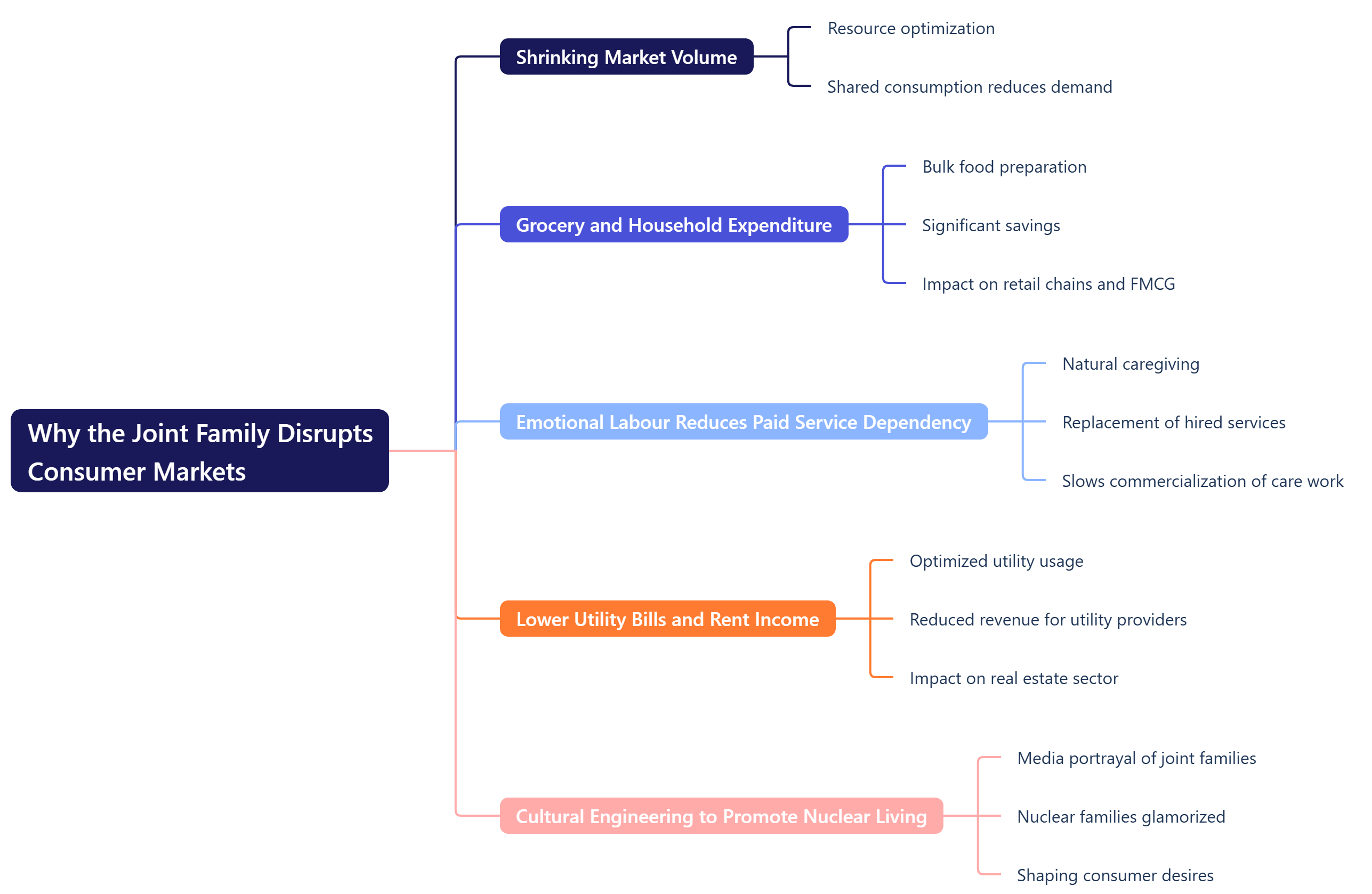
- Shrinking Market Volume: Joint families optimize resource usage. With one refrigerator, one dining table, and one vehicle serving multiple members, the overall market demand drops. Capitalism thrives on individual purchases—this shared consumption undercuts the market’s growth potential.
- Grocery and Household Expenditure: In a joint family, food is prepared in bulk, leading to significant savings. This hits retail chains and FMCG companies hard, as their growth models rely on frequent, small-volume purchases that come with nuclear or individual households.
- Emotional Labour Reduces Paid Service Dependency: Joint families naturally provide care work—nurturing children, caring for the elderly, supporting unemployed or underemployed family members. This emotional economy replaces the need for hired care, counseling, or domestic services, slowing down the commercialization of care work.
- Lower Utility Bills and Rent Income: When six members live in one house rather than three smaller ones, electricity and water usage are optimized. This reduces revenue for utility providers and the real estate sector, which thrives on individual tenancy and rental income.
- Cultural Engineering to Promote Nuclear Living: The portrayal of joint families in media and advertisements has shifted. They’re often shown as chaotic, backward, or restrictive. Instead, independence and nuclear families are glamorized as modern and aspirational—shaping consumer desires in favor of capitalism.
The Sociological Lens: What Are We Really Seeing?
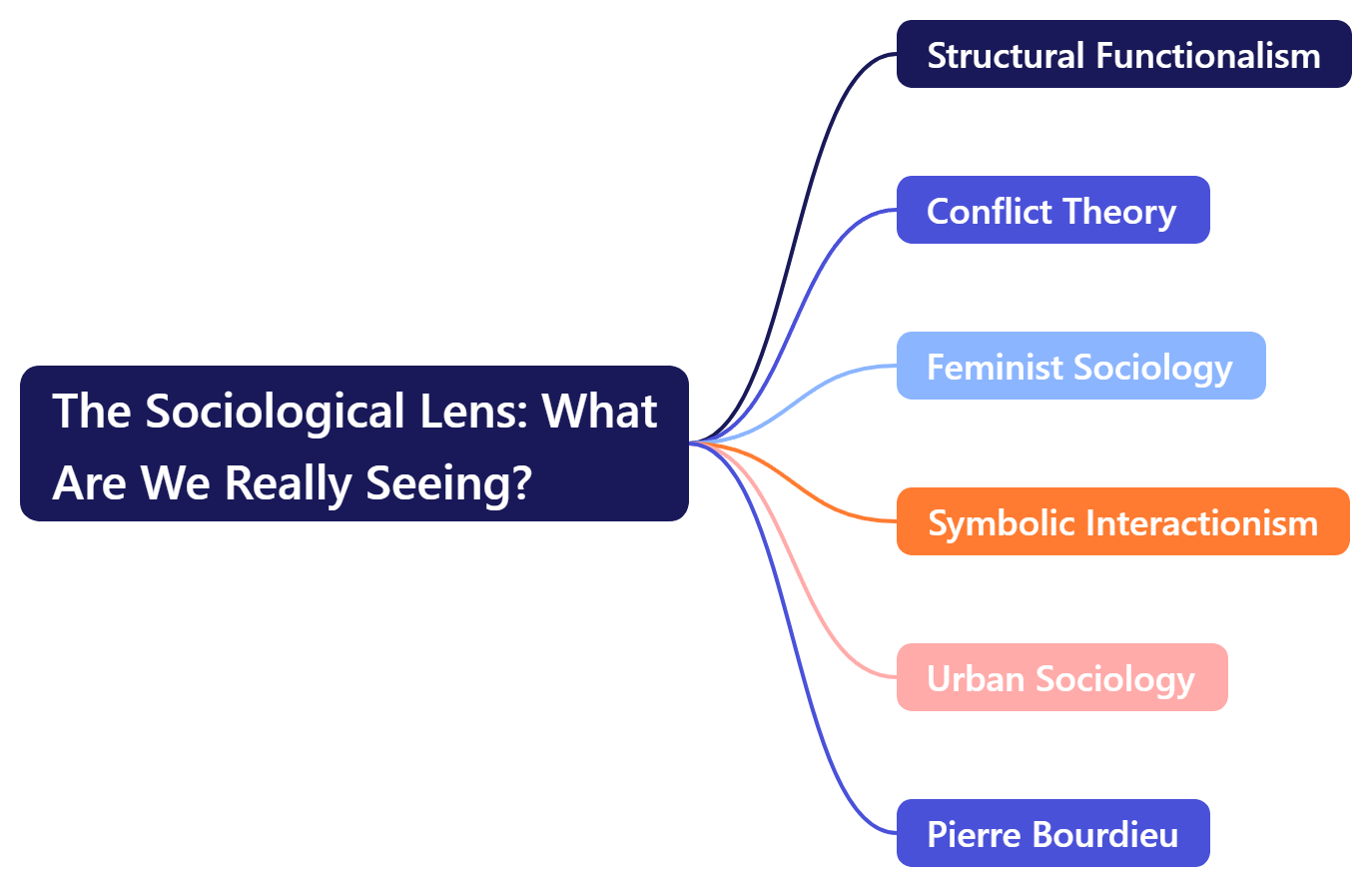
- Structural Functionalism – Talcott Parsons theorized that the nuclear family is best suited for industrial societies because it is “mobile, compact, and adaptive.” In this framework, joint families are seen as inefficient in urban-industrial economies. However, the joint family can be interpreted as a counter-institution that continues to fulfill not only economic but also emotional, protective, and stabilizing roles, challenging the assumptions of functionalism in modern India.
- Conflict Theory –From a Marxist perspective, joint families act as a form of collective ownership of resources, which resists alienation and commodification. The shared use of goods limits the reproduction of capital and frustrates the capitalist cycle of production-consumption-profit. Moreover, neo-Marxist scholars like Gramsci would highlight how capitalism promotes “cultural hegemony” through media and advertising that glorify nuclear households.
- Feminist Sociology – The joint family system performs extensive unpaid emotional and domestic labour, traditionally shouldered by women. Hochschild’s Emotional Labour concept of the “second shift” becomes relevant here—joint families distribute this labor across members, reducing reliance on the market economy for domestic services (e.g., babysitting, elder care). Capitalism’s need to commodify care is hindered.
- Symbolic Interactionism – Symbolic interactionists focus on everyday meaning-making. In joint families, identity is shaped through interdependence, shared narratives, and collective rituals. In contrast, the capitalist economy nurtures individualism and consumer identity, often shaped by media symbols that discredit collectivism. This reflects Berger and Luckmann’s theory of social construction of reality.
- Urban Sociology – Urbanization leads to anonymity and fragmentation. The joint family acts as a microcosmic rural enclave in urban chaos, resisting consumerist alienation. Georg Simmel’s theory of urban life posits the “blasé attitude” and commodified relationships—something joint families combat through emotional anchoring.
- Pierre Bourdieu – Joint families transmit cultural capital (values, traditions, social etiquette) across generations. Capitalism, however, thrives on habitual disembedding—encouraging people to break ties, relocate, and reconfigure family structures. Bourdieu’s concept of “habitus” shows how lifestyle choices in joint families resist consumerist socialization.
Conclusion
Capitalist economies rely on individualism and fragmentation. But joint families, in resisting this model, offer an alternative blueprint for sustainable and emotionally fulfilling living. As India modernizes, preserving the values of interdependence and shared well-being might not just protect cultural heritage—it might also challenge the very foundations of unchecked consumerism.
Stay rooted. Stay resistant. The joint family is not just tradition—it’s quiet rebellion.
PYQs
Paper I
- Discuss the functional necessity of the nuclear family in modern industrial society. (2015)
- How does Marx’s notion of base and superstructure explain the capitalist transformation of family structures? (2017)
- How do media and communication influence kinship and socialization patterns in society? (2018)
- Examine the role of symbolic interactionism in understanding everyday life within family structures. (2019)
- Discuss how emotional labour is differently experienced by men and women within the family context. (2020)
- Analyze how modernity affects the institution of family using Bourdieu’s concept of habitus. (2021)
- Examine the interplay of tradition and modernity in family values in contemporary India. (2022)
- Examine the impact of capitalism on social institutions like marriage and family. (2023)
Paper II
- Examine the changing patterns of family in India in the context of urbanization. (2014)
- Discuss the persistence of joint family traditions in urban Indian society. (2015)
- Analyze the role of joint family in the maintenance of kinship and caste solidarity. (2016)
- Examine how globalization is transforming Indian family structures. (2018)
- Explain the impact of consumerism on the cultural institutions of Indian society. (2019)
- Evaluate the sociological impact of OTT platforms and digital media on family life in India. (2021)
- Discuss how the economic dependency within joint families influences gender relations. (2022)
- Analyze the conflict between consumerism and collectivist family values in contemporary India. (2023)
|



One comment