

Intensive Parenting
(Relevant for Sociology Paper I: Systems of Kinship; Social Change in Modern Society and Sociology Paper II: Systems of Kinship)
IntroductionIn recent years, “Intensive Parenting” has emerged as a prominent parenting style, particularly among urban middle and upper classes in India and globally. It is characterized by high levels of time, emotional involvement, financial investment, and constant supervision in a child’s life. This trend is not just a personal family choice but also a reflection of broader sociological changes in education, class aspirations, gender roles, and neoliberal ideologies. This blog explores the concept of intensive parenting through the lens of sociology, highlighting its implications for Indian society, education, social inequality, gender roles, and the future of parenting. What is Intensive Parenting?Intensive parenting refers to a child-centered parenting approach where parents are highly involved in all aspects of their child’s development. Key characteristics include:
The concept was popularized by sociologist Sharon Hays in her book “The Cultural Contradictions of Motherhood” (1996), where she defined it as an ideology rooted in expert-guided, time-intensive, and emotionally absorbing child-rearing practices. Sociological Analysis
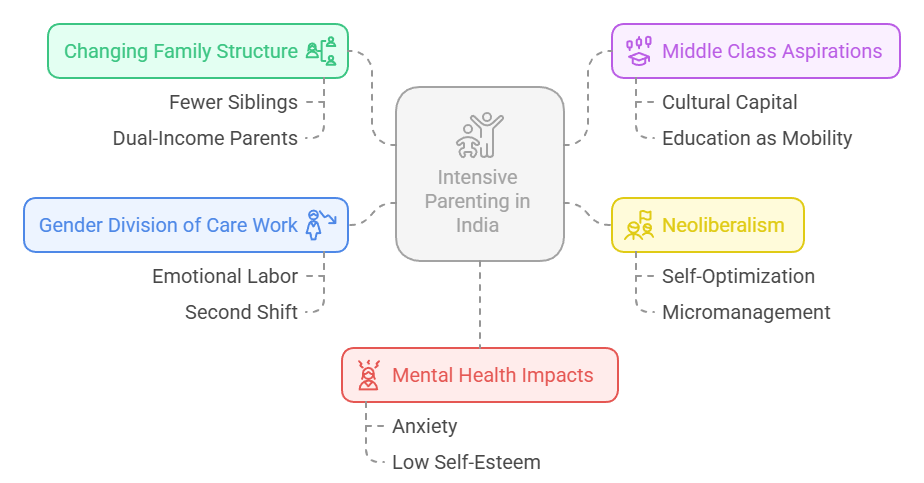
Intensive parenting is closely associated with the rise of the nuclear family system, especially in urban India. With fewer siblings and dual-income parents, there’s a growing focus on providing the “best” for the only or limited number of children. The traditional collective responsibility of extended families in raising children has shifted to individual parental responsibility.
Pierre Bourdieu’s concept of cultural capital is relevant here. Parents invest in children’s extracurricular activities, private tuition, and competitive coaching to secure better life chances, thus reproducing middle-class status. Education becomes the primary tool of upward mobility, and parenting becomes a project to ensure success in a highly competitive society.
In neoliberal economies, the responsibility of success is shifted from the state to the individual. Parents feel pressured to compensate for inadequate public education and healthcare systems by micromanaging their children’s lives. Parenting becomes a competitive endeavor, aligning with the neoliberal ethic of self-optimization.
Although both parents may participate, intensive parenting often falls disproportionately on mothers. Sociologist Arlie Hochschild’s concept of “emotional labor” and “second shift” applies here—working mothers take on the additional responsibility of ensuring the child’s success. This reinforces patriarchal gender roles under the guise of modern parenting.
Children raised under intensive parenting often face issues like anxiety, low self-esteem, and burnout. They grow up under pressure to excel in academics, sports, music, and social conduct. The sociological concept of “performance society” (Byung-Chul Han) shows how neoliberalism turns even children into performers. Intersectionality:
Case Study:In Indian metro cities like Delhi, Mumbai, and Bengaluru, parents often start preparing their children for IITs, AIIMS, or Ivy League schools as early as kindergarten. Schools promote competitive entrance coaching, and children juggle academics with music classes, Olympiad training, and coding bootcamps. The parenting approach is not just about nurturing but curating a résumé. This education-focused intensive parenting reinforces class divisions: only those with economic and cultural capital can afford this lifestyle, leaving behind children from marginalized communities. Implications of Intensive Parenting on Indian Society
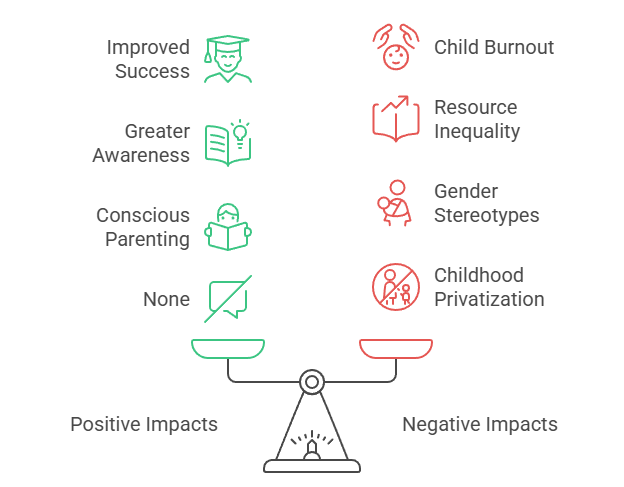
Positive Impacts:
Negative Impacts:
Policy Relevance
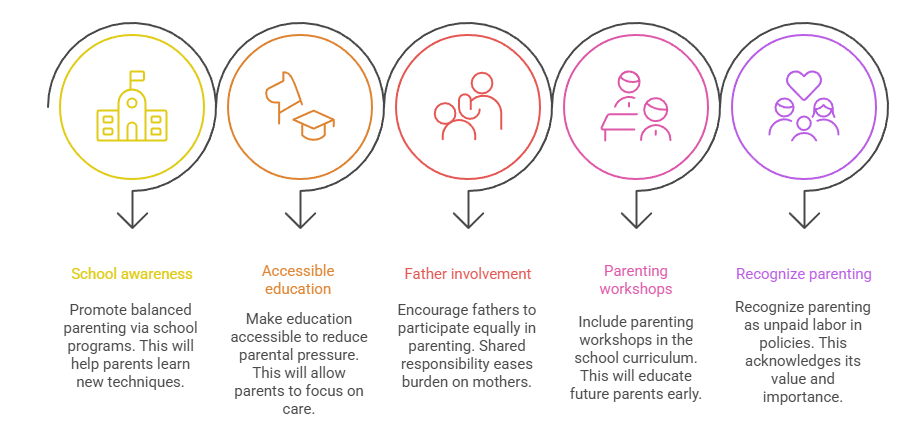
Recommendations
ConclusionIntensive parenting, while emerging as a well-meaning style to ensure children’s success, is deeply embedded in class, gender, and neoliberal structures. It reflects broader transformations in Indian society’s family system, education model, and economic aspirations. While it may secure better life outcomes for some, it also widens social inequality and reasserts patriarchal roles. A sociologically informed approach can help reimagine parenting in ways that are equitable, sustainable, and nurturing—not just for children, but for parents too. PYQsPaper I –
Paper II
|
To Read more topics, visit: www.triumphias.com/blogs
Read more Blogs:
Empowering Women: Navigating Climate Change, Challenges, and Solutions| Triumph IAS
One comment