Introduction: Injustice of Manual Scavenging
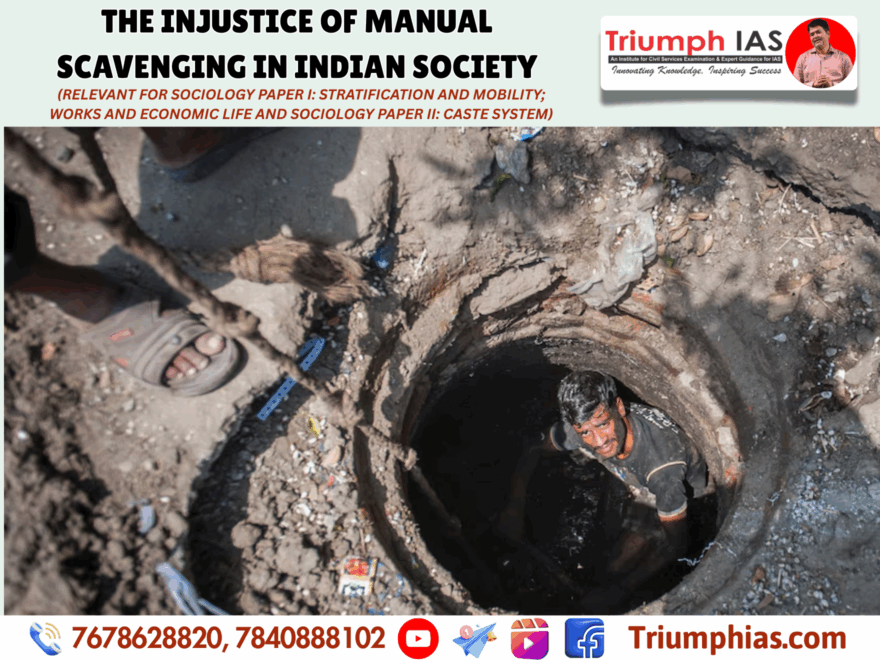
Manual scavenging in India is not merely a sanitation issue; it is a deeply entrenched caste-based practice perpetuated over centuries. From the pages of ancient Hindu scriptures to colonial bureaucracies, this practice has been historically legitimized, institutionalized, and reinforced. Despite laws like the Prohibition of Employment as Manual Scavengers and their Rehabilitation Act, 2013, manual scavenging remains a harsh reality for thousands. This blog explores the historical, sociological, and policy dimensions of manual scavenging, making it a crucial topic for Sociology and caste-based inequality discourses.
Historical Evolution of Manual Scavenging in India
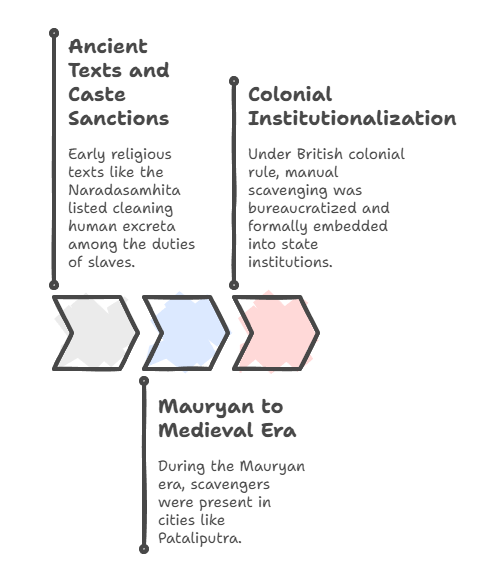
- Ancient Texts and Caste Sanctions: Early religious texts like the Naradasamhita listed cleaning human excreta among the duties of slaves. The Manusmriti further entrenched this hierarchy by assigning degrading tasks to lower castes, framing their servitude as a religious duty. The Vajasaneyi Samhita referenced Chandals and Paulkasas as responsible for disposing of night soil. These texts laid the foundation for associating specific occupations with caste identity, establishing what sociologists describe as an ascriptive occupational system.
- Mauryan to Medieval Era: During the Mauryan era, historical records note the presence of scavengers in cities like Pataliputra. With the advent of Muslim rule, war captives were employed to dispose of human waste and eventually formed segregated castes like the Bhangis and Mehtars. These developments contributed to the emergence of occupational endogamy—a rigid system where caste dictated both profession and marital alliances, exemplifying M.N. Srinivas’s concept of caste rigidity.
- Colonial Institutionalization: Under British colonial rule, manual scavenging was bureaucratized and formally embedded into state institutions such as the military, railways, and judiciary. The 1931 Census estimated around two million individuals engaged in scavenging, reflecting how colonial governance legitimized and expanded the practice. Additionally, industrialization disrupted artisan and farming livelihoods, forcing many marginalized castes into this degrading occupation for survival.
Sociological Analysis:
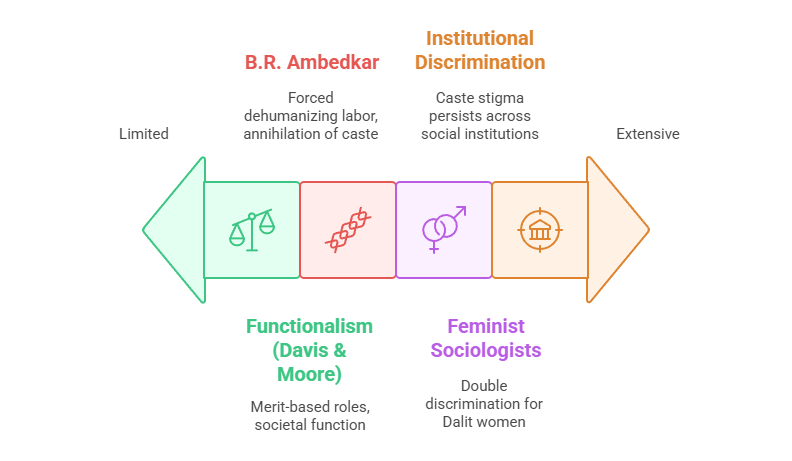
- Functionalism and Caste Stratification: According to Davis and Moore, social roles are merit-based and functional for society. However, this theory collapses in the Indian context, where caste-based occupations like scavenging are hereditary and laden with stigma, denying individuals the opportunity to rise through merit or skill.
- B.R. Ambedkar’s Critique: Dr. B.R. Ambedkar viewed the caste system as a form of graded inequality, where Dalits were forced into menial and dehumanizing labor. He emphasized that the true liberation of these communities requires not just economic upliftment but the complete annihilation of caste.
- Intersectionality: The identity of manual scavengers is not shaped by caste alone—it intersects with class and gender. Feminist sociologists such as Gail Omvedt and Sharmila Rege have highlighted how Dalit women suffer double discrimination: as women and as members of oppressed castes, making them disproportionately vulnerable in sanitation work.
- Institutional Discrimination: Even after religious conversion or relocation, scavenging communities often remain confined to the same occupations. This persistence illustrates how caste stigma transcends boundaries, embedded deeply within social institutions and collective consciousness.
Contemporary Reality and Legal Interventions
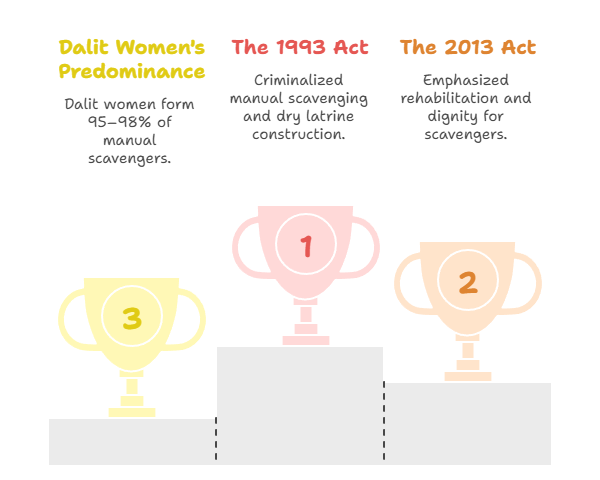
- The 1993 Act criminalized manual scavenging and dry latrine construction.
- The 2013 Act emphasized rehabilitation and dignity.
- Despite this, manual scavenging continues, particularly among Dalit women — who form 95–98% of manual scavengers, according to recent studies.
Sociologist B.N. Srivastava and Bindeshwar Pathak note how patriarchy, caste, and state neglect intersect to perpetuate this occupation.
Current Affairs and Policy Challenges
- Cases like those reported in Human Rights Watch (2014) and news from Maharashtra’s Jalgaon show how even educated Dalits are forced into manual scavenging due to caste bias in rural governance.
- Panchayats and police often reinforce caste hierarchies, making legal redress difficult.
- The Swachh Bharat Abhiyan has not eradicated manual scavenging because dry latrines and unsafe sewer practices still exist, especially in semi-urban and rural areas.
Conclusion:
Manual scavenging is not just a profession but a symbol of India’s unyielding caste hierarchy. From scriptural justifications to colonial legitimization and modern institutional apathy, the practice reflects how social stigma, not skill, has historically dictated labor in India. Sociologically, it underscores the need for a radical transformation of caste structures, not just policy reforms. Until caste is delinked from occupation and social dignity is ensured, manual scavenging will remain a stain on India’s democratic promise.
PYQs
Paper 1:
- What is meant by ‘occupational mobility’? Discuss the obstacles to occupational mobility for lower caste communities in India. (2015)
- What do you understand by ‘social exclusion’? Explain how caste-based occupations in India lead to exclusion and marginalization. (2017)
- What is ‘ascribed status’? Discuss how it influences social mobility in the context of caste-based occupations. (2018)
- Discuss the functionalist view of social stratification. How far is it relevant in explaining caste inequalities in India? (2020)
- Examine B.R. Ambedkar’s views on caste and social justice. How are they relevant today in addressing caste-based occupational roles? (2021)
- Explain the concept of ‘intersectionality’. How can it be applied to understand the situation of Dalit women in caste-based occupations? (2022)
- Explain the role of ideology in the maintenance of social stratification. How does Hindu religious ideology sustain caste-based occupations? (2023)
- Examine how caste-based division of labour impacts dignity and human rights in India. (2024)
Paper 2:
- Explain how religious and cultural texts have contributed to the marginalization of certain castes through prescribed occupations. (2015)
- Write a note on ‘untouchability’ and its different forms in contemporary Indian society. (2016)
- Critically examine the impact of the Prohibition of Employment as Manual Scavengers and their Rehabilitation Act, 2013. (2018)
- Discuss the continuing prevalence of manual scavenging in India despite legal prohibitions. What sociological factors contribute to its persistence? (2019)
- Examine the status of sanitation workers in urban India. What does their condition reveal about caste and urban development? (2022)
- What are the challenges faced by Dalit women in Indian society? How do caste and gender intersect to affect their lives? (2023)
- Discuss how state policies have succeeded or failed in providing dignity and alternative livelihood to scavenging communities. (2024)
|



One comment