Introduction: Industrialization on Caste in India
Industrialization in India has weakened ritual hierarchies in workplaces, expanded mobility through education and migration, and shifted status from birth to skills and income. Yet caste persists through recruitment networks, marriage, housing, neighbourhood segregation, and political mediation of jobs. The result is not the end of caste but its recomposition as class, status, and power intersect in old and new ways.
What changes with industrialization?
- Occupational shift: From hereditary, caste-regulated work to factory and service jobs.
- Urbanisation and migration: People leave village ties, join mixed workforces, and live in anonymous cities.
- State and market expansion: Labour laws, contracts, education, banking, and large firms reorganize production.
- Technology and platforms: From mills and PSUs to IT parks, logistics, and the gig economy.
These forces weaken the jajmani logic and ritual ranking at the point of production, but they do not automatically erase caste in society.
Sociological Analysis
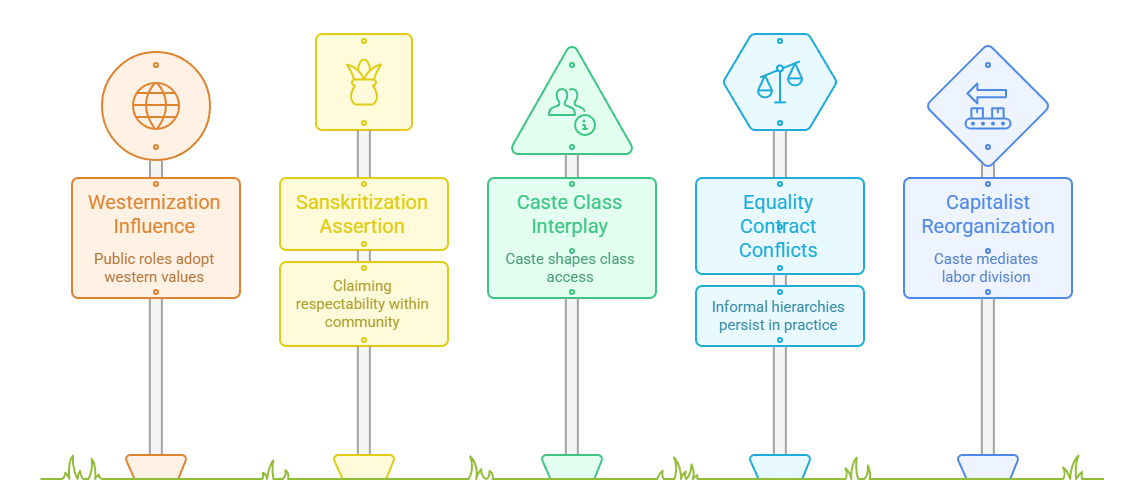
- N. Srinivas: Industrial jobs, schooling, and city life encourage Westernisation in public roles, while upwardly mobile groups may use Sanskritisation to claim respectability at home and in community spaces. People often live both processes at once.
- André Béteille: Class positions emerge in industry, yet caste, class, and power Caste shapes who enters which class locations through schooling quality, networks, and referrals.
- Louis Dumont: Modern industry values equality and contract. Even so, informal hierarchies slip into everyday practice, such as who gets client-facing work or who is considered “a culture fit.”
- R. Desai (Marxist lens): Capitalist development reorganizes labour through subcontracting and cost control. Caste can mediate this reorganization by sorting some groups into riskier tasks and others into supervisory roles.
- R. Ambedkar: Caste is a system of graded inequality. Industrialization offers tools for change, like education and urban jobs, but these tools need constitutional safeguards, fair recruitment, and strong grievance systems to translate into real equality.
Theory to evidence
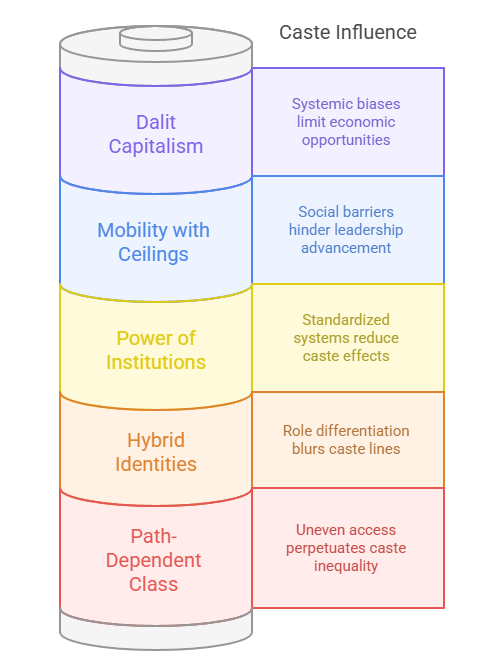
- From caste to class: Industrialization pushes a shift from status by birth to status by market and credentials. But class positions are path-dependent. If schooling quality, English, and networks are uneven by caste, then class outcomes remain unequal.
- Hybrid identities: A software engineer may identify as middle class at work and vote or marry along caste lines at home. This is role differentiation rather than hypocrisy.
- Power of institutions: Where recruitment is standardized, grievance redressal strong, and housing integrated, caste effects reduce. Where subcontracting dominates and hiring is opaque, caste quietly returns as a sorting device.
- Mobility with ceilings: First-generation graduates enter modern sectors, but leadership tracks can stall without mentoring, networks, or cultural capital. Glass ceilings here are social, not ritual.
- Dalit capitalism vs structural constraints: Success stories matter, but credit access, collateral norms, and buyer networks still privilege historically advantaged groups. Policy nudges and public procurement can shift this balance.
Historical Phases:
1) Late colonial period: Railways, ports, mining, and textile mills pulled workers across regions and castes. Recruitment still moved through village headmen and caste networks. Ritual restrictions reduced inside mills, but housing and eating remained segregated.
2) Nehruvian heavy-industry era: Steel plants and PSUs standardized wages and procedures. Trade unions often framed demands in class terms, yet informal hierarchies in promotions, hostel allocation, and neighbourhoods lingered. Reservation in state jobs opened mobility for SCs and STs, especially in PSUs.
3) Post-1991 liberalisation: Private services and informal manufacturing expanded. Sub-contracting and casualisation diluted union power and formal protection. Caste became a network advantage for entry-level referrals, supply contracts, and local political mediation in industrial clusters and SEZs.
4) Platform and digital economy: IT/ITES, logistics, ride-hailing, delivery platforms, and e-commerce fulfilment centres bring mixed teams and competency metrics. Yet algorithmic ratings, vendor ecosystems, and real-estate segregation can reproduce unequal risks and ceiling effects.
Linking industrialization and caste
- Erosion of hereditary occupations: Leather, weaving, artisanal and service castes diversified into factory and service roles. Ritual pollution norms matter less on shopfloors than in villages.
- Factory discipline and contractual equality: Time clocks, wage grades, and safety rules treat workers as standardized units, weakening ritual hierarchy at work.
- Urban mixing with social sorting: Cities create mixed workplaces but segregated housing. Caste endogamy in marriage remains strong, maintaining cultural boundaries while earning patterns change.
- Education as a converter of status: Technical diplomas, engineering and management degrees transform cultural capital into class mobility for many lower- and middle-caste youth.
- Reservation and public employment: SC/ST and later OBC quotas in the public sector and higher education widened entry points to industrial careers. In the private sector, change depends more on CSR, diversity charters, and reputation pressure than on law.
- Dominant caste capital: Land-rich groups converted agrarian surplus into transport fleets, sugar mills, real estate, and contracting firms, turning status into business power in regional economies.
- Recruitment through informal networks: Even in formal industries, first jobs often come through relatives and community links. Networks can help one group cluster in certain plants, lines, or shopfloor roles.
- Informalisation and subcontracting: When firms push work to contractors, protections weaken. Workers from vulnerable caste groups concentrate in the most hazardous, low-margin tasks.
- Entrepreneurship and supplier diversity: Dalit and Adivasi entrepreneurship grows in logistics, construction subcontracts, and services around large plants. Access to credit, mentoring, and market linkages remain the bottleneck.
- Collective action, unions, and politics: Class-based unions coexist with caste associations and community leaders who broker jobs, shifts, and compensations. Both forms of organisation shape everyday outcomes.
Where caste weakened, where it persisted
Weakened
- Ritual hierarchy at work: Standard operating procedures reduce space for purity rules.
- Occupational fixity: People switch sectors across generations.
- Public interaction: Mixed teams, uniforms, canteens, and compliance audits normalize equal treatment.
Persisted or recomposed
- Marriage and kinship: Endogamy stabilizes caste identity despite workplace mixing.
- Housing and neighbourhoods: Segregation by community or affordability mirrors caste lines.
- Hiring channels and promotions: Networks and subtle bias shape who gets interviews, training, client-facing roles, and leadership tracks.
- Risk distribution: The dirtiest, riskiest jobs in waste handling, tanneries, construction, and subcontracted tasks often draw workers from historically disadvantaged communities.
- Politics of local industry: Land acquisition, compensation, and plant jobs are brokered through dominant local groups.
Case-Studies
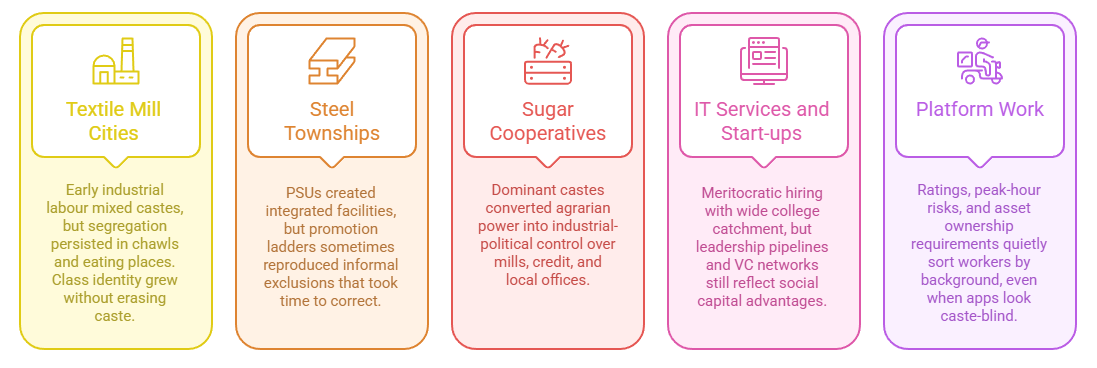
- Textile mill cities: Early industrial labour mixed castes, but chawls and eating places often remained segregated. Class identity grew without erasing caste.
- Steel townships: PSUs created integrated schools, hospitals, and sports clubs. Yet promotion ladders sometimes reproduced informal exclusions that took time to correct.
- Sugar cooperatives: Dominant castes converted agrarian power into industrial-political control over mills, credit, and local offices.
- IT services and start-ups: Meritocratic hiring with wide college catchment. Leadership pipelines and VC networks still reflect social capital advantages.
- Platform work: Ratings, peak-hour risks, and asset ownership requirements (vehicle loans) quietly sort workers by background, even when apps look caste-blind.
Current issues
- Debates on private-sector diversity: Voluntary charters, supplier diversity, and corporate reporting.
- Skill India and apprenticeship pipelines: Who benefits most from skilling funnels into manufacturing and logistics.
- Migration and rental markets: Caste and community clauses in housing societies that indirectly shape labour mobility.
- ESG and social audits: Pressure on firms to disclose inclusion metrics and contractor practices.
Conclusion
Industrialization in India has loosened the grip of ritual hierarchy at the workplace, diversified occupations, and widened mobility via education, urbanisation, and state policy. Yet caste has not vanished. It has recombined with class through hiring networks, neighbourhoods, marriage, and political brokerage. Where institutions are transparent and rights-based, caste effects recede; where markets are opaque and work is subcontracted, caste returns as an informal sorting mechanism. The task ahead is to deepen equal opportunity—fair recruitment, mentoring, supplier diversity, strong grievance systems—so that industrial growth translates into substantive rather than merely formal equality.
PYQs
Paper 1
- What is the difference between natural and social inequality? Give examples from caste and class dimensions. (2018)
- “Modernisation presupposes class society; however, caste, ethnicity and race are still predominant. Explain.” (2019)
Paper 2
- Is caste system changing, weakening or disintegrating in India? (2015)
- Discuss André Béteille’s account of the relationship between caste, class and power as a change from symmetrical to asymmetrical. (2016)
- Compare the pressing problems of a Dalit poor family living in an urban slum with a similar family in a rural setting. (2017)
- What do you understand by discrete castes and muddled hierarchies? (2018)
- Is industrial development in India a bane or a boon to agrarian class structure? Substantiate with examples. (2019)
- Urban settlements in India tend to replicate their rural caste-kinship imprints. Discuss the main reasons. (2021)
- Contextualize Louis Dumont’s concept of ‘binary opposition’ with reference to caste system in India. (2023)
|

2 comments