
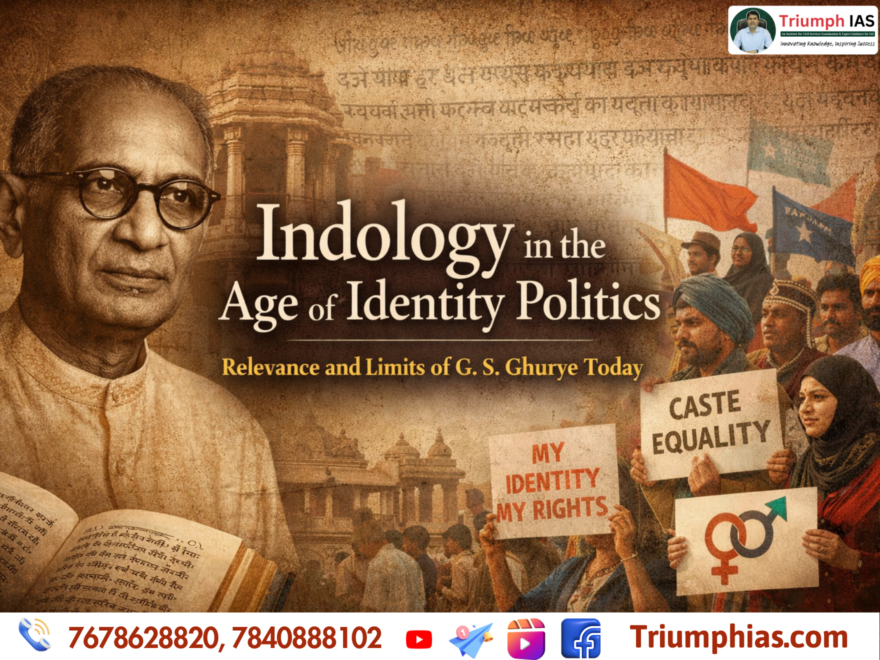
Relevant for Sociology Optional Paper 1, Paper 2, and GS Paper I (Indian Society)
IntroductionThe discipline of Indian sociology has long been shaped by the intellectual legacy of G. S. Ghurye, whose Indological approach emphasized the study of Indian society through classical texts, traditions, and cultural continuities. In the contemporary context of identity politics—marked by assertions based on caste, religion, ethnicity, and gender—the relevance of Ghurye’s framework warrants both recognition and critical scrutiny. DimensionGhurye’s Indological perspective sought to understand Indian society as a civilizational continuum rooted in texts such as the Vedas, Smritis, and Puranas. He emphasized the integrative features of Indian society, particularly the cultural unity underlying apparent diversity. His work on caste, for instance, highlighted its structural and cultural dimensions, portraying it as a system with historical depth and functional aspects. This approach offered a macro-civilizational lens, enabling scholars to interpret Indian social institutions within their indigenous context rather than through purely Western theoretical frameworks. In the present era, however, identity politics has reconfigured the sociological landscape. Marginalized communities—Dalits, Adivasis, women, and religious minorities—are increasingly asserting their voices, challenging dominant narratives that often gloss over inequalities. From this perspective, Ghurye’s approach appears limited. His emphasis on cultural unity has been criticized for underplaying structural inequalities and power asymmetries embedded in caste and social hierarchies. For instance, while he acknowledged caste as a key institution, he did not foreground its oppressive dimensions to the extent later scholars like B.R. Ambedkar did. Yet, dismissing Ghurye outright would be intellectually reductive. His work remains relevant in at least three significant ways. First, in an age of hyper-fragmentation, his emphasis on cultural integration offers a counterbalance to excessive identity-based polarization. It reminds scholars and policymakers of the need to locate diversity within a broader framework of social cohesion. Second, his insistence on using indigenous sources and categories contributes to the ongoing project of decolonizing sociology. As debates around epistemic justice gain momentum, Ghurye’s method provides an early template for grounding social theory in local knowledge systems. Third, his interdisciplinary approach—blending sociology, anthropology, and Indology—continues to inspire holistic analyses of Indian society. However, the limits of Ghurye’s framework are equally instructive. His reliance on textual sources often privileged upper-caste perspectives, marginalizing subaltern voices that are central to contemporary sociological inquiry. Moreover, his approach tends to be descriptive rather than critical, lacking a robust engagement with questions of power, resistance, and social change. In the context of identity politics, where lived experiences and contestations are central, this becomes a significant limitation. Therefore, the way forward lies not in choosing between Ghurye and contemporary critical perspectives, but in synthesizing them. An enriched sociological framework would combine Ghurye’s civilizational insights with the critical, empirically grounded approaches of modern sociology. Such a synthesis would enable a more nuanced understanding of Indian society—one that acknowledges both its integrative traditions and its deeply embedded inequalities. ConclusionIn conclusion, Ghurye’s Indological approach retains enduring relevance as a foundational perspective in Indian sociology, particularly in its emphasis on cultural continuity and indigenous frameworks. However, in the age of identity politics, its limitations necessitate critical engagement and theoretical expansion. The challenge for contemporary sociology is to build upon this legacy while addressing its blind spots, thereby creating a more inclusive and reflexive understanding of Indian society. |
UPSC Civil Services (Mains) Question
Q. “Critically examine the relevance of G. S. Ghurye’s Indological approach in understanding Indian society in the context of contemporary identity politics.” (250 words)
To Read more topics, visit: www.triumphias.com/blogs
Read more Blogs:
There is no path to happiness; Happiness is the path – Triumph IAS & Vikash Ranjan Sir
 SANDESH JAIN [B.Tech] SOCIOLOGY STRATEGY #UPSC CSE 2025
 𝐖𝐡𝐚𝐭 𝐦𝐚𝐤𝐞𝐬 𝐭𝐡𝐢𝐬 𝐚𝐜𝐡𝐢𝐞𝐯𝐞𝐦𝐞𝐧𝐭 𝐞𝐱𝐭𝐫𝐚𝐨𝐫𝐝𝐢𝐧𝐚𝐫𝐲 𝐢𝐬 𝐡𝐢𝐬 𝐒𝐨𝐜𝐢𝐨𝐥𝐨𝐠𝐲 𝐎𝐩𝐭𝐢𝐨𝐧𝐚𝐥 𝐬𝐜𝐨𝐫𝐞:
 𝐓𝐎𝐓𝐀𝐋 𝐒𝐎𝐂𝐈𝐎𝐋𝐎𝐆𝐘 𝐌𝐀𝐑𝐊𝐒: 𝟑𝟎𝟗
 𝐏𝐚𝐩𝐞𝐫 𝟏 – 173 Marks 𝐏𝐚𝐩𝐞𝐫 𝟐 – 136 Marks
 Single Source Preparation- Only #Vikash #Ranjan Sir’s Sociology Foundation Class Notes, Discussions, Application Strategies & Answer Writing Practice. No multiple books or Scattered Materials, No PDFs, No Free YouTube Time Wastes, No other Essentials.
 Offline Classroom Program
 Live Online Classes
 Tablet Course (Learn Anytime)
One comment