Introduction
Soil, the foundation of agriculture and ecological balance, is in crisis. India, with 140 million hectares of cultivable land, is facing alarming levels of soil degradation, threatening food security, farmer livelihoods, and environmental sustainability. With over 30% of India’s land already degraded, addressing the soil health crisis is no longer optional—it is imperative for national development. As per the latest reports from the Indian Council of Agricultural Research (ICAR) and the United Nations, soil health is rapidly deteriorating due to excessive chemical use, poor land management, and climate change. A sustainable path forward demands immediate and holistic interventions.
Understanding Soil Health and Its Importance
Soil health refers to the soil’s capacity to function as a living ecosystem that sustains plants, animals, and humans. Healthy soil ensures:
- Nutrient cycling and plant productivity
- Water retention and filtration
- Carbon sequestration to combat climate change
- Biodiversity support in microbial and insect life
Without fertile soil, agricultural output declines, which directly affects food prices, employment in rural areas, and India’s economic growth—given agriculture’s 18% contribution to GDP and employment for nearly 50% of the population.
Current Status of Soil Health in India
As of 2024:
- 29.7% of India’s total land area (approx. 96.4 million hectares) is facing degradation, according to ISRO’s Desertification and Land Degradation Atlas.
- Loss of soil organic carbon, critical for fertility, is widespread.
- States like Rajasthan, Maharashtra, Gujarat, Jharkhand, and Madhya Pradesh are the worst affected.
- Overuse of fertilizers: India uses 160 kg/ha of fertilizers annually, far above the recommended average, leading to nutrient imbalance and soil toxicity.
- Monoculture cropping, deforestation, and poor irrigation practices further exacerbate the situation.
Major Causes of Soil Degradation
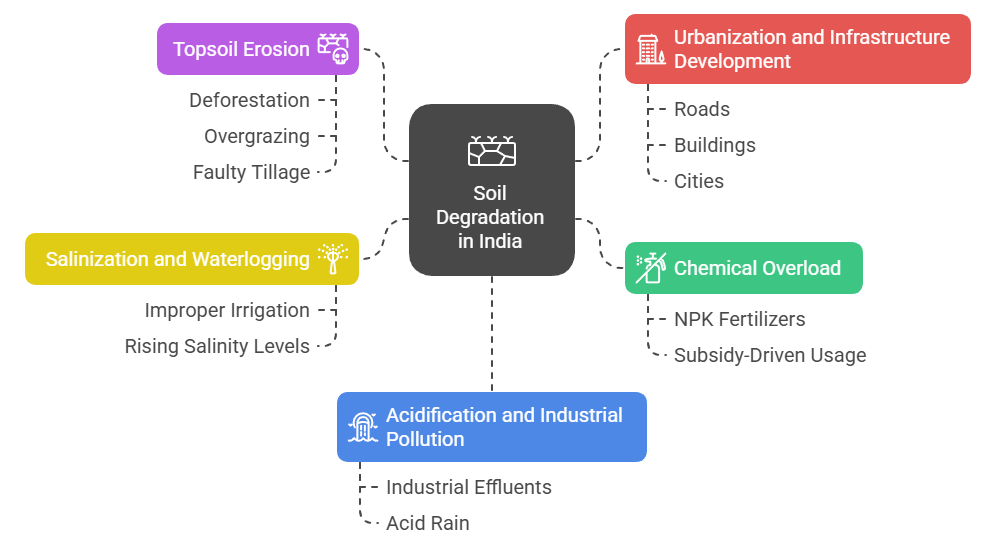
- Chemical Overload:
- Excessive use of nitrogen, phosphorus, and potassium (NPK) fertilizers, especially urea, has disrupted soil nutrient balance.
- Subsidy-driven fertilizer usage has discouraged organic inputs like compost and green manure.
- Topsoil Erosion:
- About 5 billion tonnes of topsoil are lost annually due to deforestation, overgrazing, and faulty tillage.
- Salinization and Waterlogging:
- Improper irrigation, especially in Punjab and Haryana, has led to rising salinity levels.
- Acidification and Industrial Pollution:
- Industrial effluents and acid rain (due to sulfur dioxide and nitrogen oxides) have altered soil pH in several parts of eastern India.
- Urbanization and Infrastructure Development:
- Loss of fertile land to roads, buildings, and cities is irreversible and accelerating.
Government Initiatives to Restore Soil Health
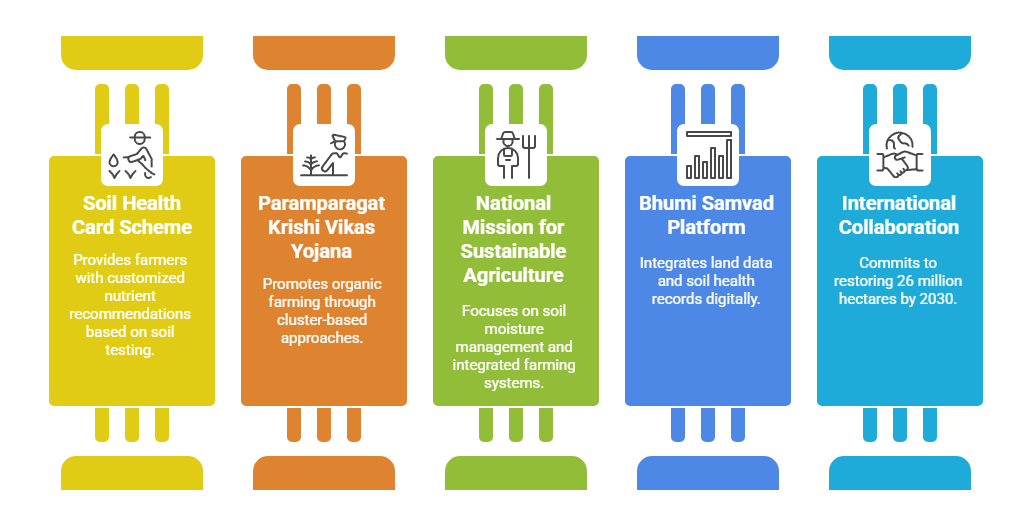
- Soil Health Card Scheme (SHC):
- Launched in 2015, over 22 crore cards have been distributed so far.
- Provides farmers with customized crop-wise nutrient recommendations based on soil testing.
- Studies by NABARD show a 16-25% increase in crop yield and a 10-15% reduction in fertilizer cost due to SHC adoption.
- Paramparagat Krishi Vikas Yojana (PKVY):
- Promotes organic farming through cluster-based approaches.
- Encourages composting, biofertilizers, and natural growth promoters.
- National Mission for Sustainable Agriculture (NMSA):
- Focuses on soil moisture management, agroforestry, and integrated farming systems.
- Bhumi Samvad Platform:
- A digital dashboard launched in 2023 to integrate land data, soil health records, and erosion-prone zones.
- International Collaboration:
- India is a signatory to the UNCCD (United Nations Convention to Combat Desertification) and committed to restoring 26 million hectares by 2030.
Emerging Solutions and Technology Integration
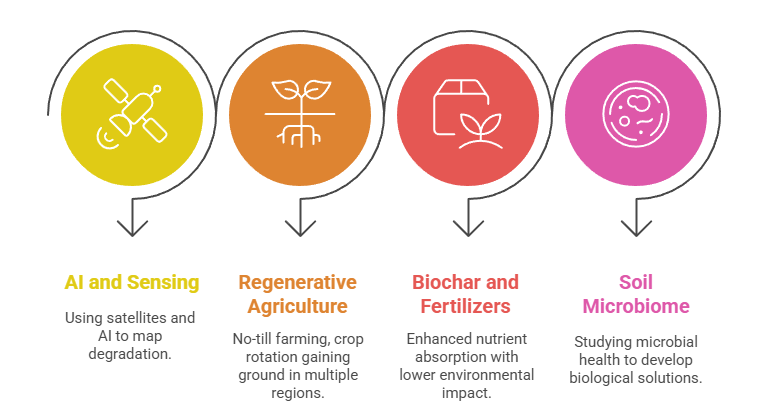
- AI and Remote Sensing:
- ISRO and ICAR are using satellites and AI to map soil degradation hotspots and recommend real-time interventions.
- Regenerative Agriculture:
- Techniques like no-till farming, crop rotation, and agroecology are gaining ground in Punjab, Sikkim, and Maharashtra.
- Biochar and Nano-fertilizers:
- These offer enhanced nutrient absorption with lower environmental impact.
- Soil Microbiome Research:
- Scientists are studying soil microbial health to develop tailor-made biological solutions for fertility restoration.
Challenges in Implementation
- Lack of awareness and training among farmers, especially smallholders.
- Fragmented landholdings reduce the scalability of sustainable practices.
- Monitoring issues: Many SHC labs lack manpower and modern testing equipment.
- Market limitations: Organic produce often lacks premium prices and certification hurdles dissuade farmers.
Way Forward: A Holistic Roadmap
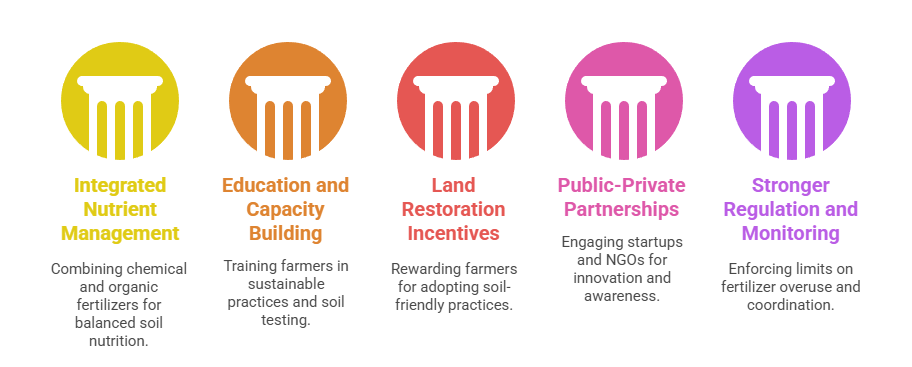
- Integrated Nutrient Management (INM):
- Combine chemical fertilizers with organic and biofertilizers for balanced soil nutrition.
- Education and Capacity Building:
- Extension services must train farmers in soil testing, composting, and sustainable irrigation.
- Land Restoration Incentives:
- Use payments for ecosystem services (PES) to reward farmers who adopt soil-friendly practices.
- Public-Private Partnerships (PPPs):
- Engage agritech startups and NGOs for low-cost innovations and awareness drives.
- Stronger Regulation and Monitoring:
- Enforce limits on fertilizer overuse and ensure better coordination among agriculture, water, and environment ministries.
Conclusion
India’s soil health crisis is both a warning and an opportunity. Ensuring fertile, healthy soil is not only vital for agricultural prosperity but also for ecological resilience, climate mitigation, and sustainable development. While government initiatives like the Soil Health Card Scheme and organic farming missions have made significant progress, they must be scaled, strengthened, and integrated with new technologies and community participation. By prioritizing soil restoration, India can secure its food systems, empower its farmers, and lead the global charge toward sustainable land management. |


The use of AI and satellite-based soil mapping is fascinating. Are there any startups currently working with the Bhumi Samvad platform to deliver real-time data to farmers via mobile apps? Would love to learn more about public-private collaborations in this space.