
Indian Village: Continuity, Change, and Development
(Relevant for Sociology Paper I: Social Change in Modern Society and Sociology Paper II: Perspectives on the study of Indian Society; Rural and Agrarian Social Structure; Rural and Agrarian Transformation in India)
IntroductionIndian villages are the soul of the nation, home to nearly 65% of the population, and the foundational unit of rural society. They are not just administrative or geographical entities, but socio-cultural systems with deeply rooted traditions, stratifications, and evolving institutions. In the study of Indian villages holds crucial importance due to their centrality in discussions on caste, economy, agrarian relations, kinship, and social change. This blog provides sociological analysis of the Indian village, its structural and cultural features, and the impact of modernization and state interventions. The Indian Village:The Indian village has often been romanticized as a self-sufficient unit of socio-economic life. Mahatma Gandhi once famously said, “The future of India lies in its villages.” This idea, while inspirational, has been challenged by empirical sociologists like M.N. Srinivas and S.C. Dube who exposed the complex interdependencies between villages and towns. Villages in India differ by region, ecology, language, and culture. However, most share key characteristics such as joint family structures, caste-based occupation, a dominant agrarian economy, and kinship-based social networks. Sociological Analysis
Village Studies in Indian Sociology
Post-Independence India saw a significant rise in village studies to understand grassroots India. Scholars moved beyond colonial administrative surveys to more immersive fieldwork approaches.
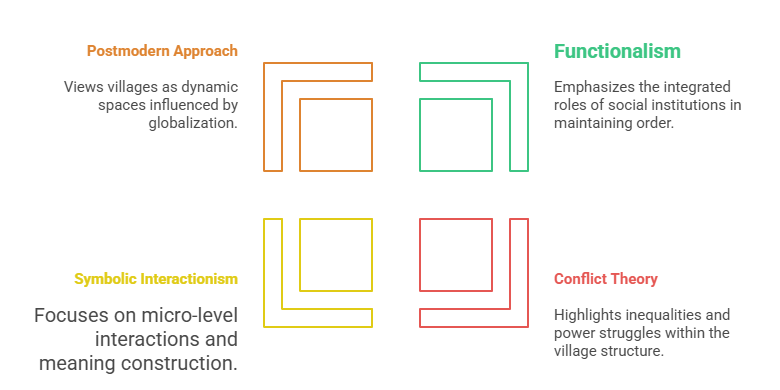
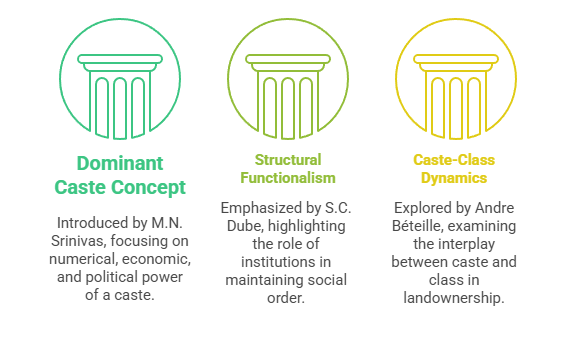
In his seminal study of Rampura village, Srinivas introduced the concept of dominant caste—a caste that holds numerical strength, economic power, and political influence. This caste often mediates between the state and the rural population.
S.C. Dube’s study of Shamirpet village emphasized structural functionalism, identifying how institutions like family, caste, and religion maintained social order.
Béteille’s fieldwork in Tanjore highlighted the interaction between caste and class in landownership patterns, documenting how caste hierarchies were being reconfigured through changes in agrarian relations. Key Sociological Institutions in Indian Villages
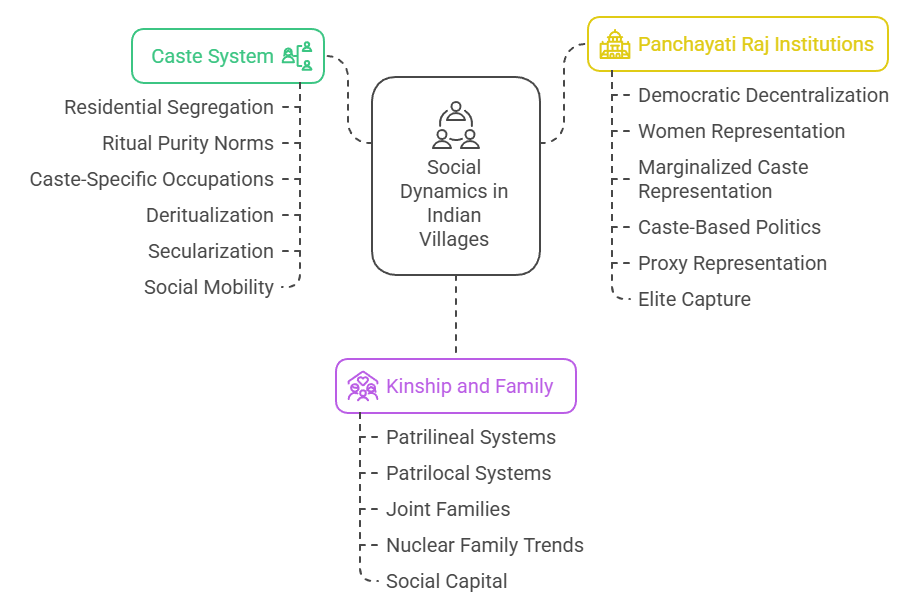
The village is often a microcosm of caste hierarchy, with residential segregation (caste-based hamlets or pallis), ritual purity norms, and caste-specific occupations. However, with the introduction of education, reservations, and migration, caste rigidity has begun to decline—leading to deritualization, secularization, and social mobility in many areas.
Villages predominantly follow patrilineal and patrilocal systems. Joint families are common, though nuclear family trends are increasing due to land fragmentation and labor migration. Kinship networks also facilitate social capital, as Pierre Bourdieu explains—creating trust, reciprocity, and access to resources.
With the 73rd Constitutional Amendment Act (1992), democratic decentralization empowered local self-governments. Women and marginalized caste representation in panchayats has reshaped village power dynamics. However, caste-based politics, proxy representation, and elite capture continue to hinder true decentralization. Agrarian Social Structure and Land RelationsLand is the primary economic asset in rural India. Historically, land ownership patterns mirrored caste hierarchy, with upper castes owning most land and lower castes being tenants or landless laborers. Key developments:
Social Change in Villages
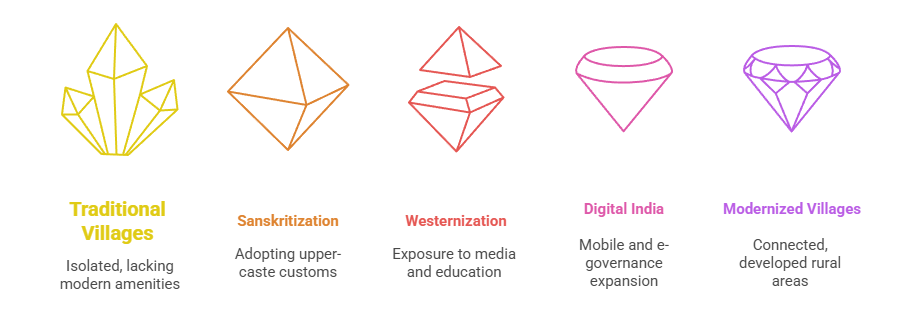
Srinivas described how lower castes adopted upper caste rituals, dress, and customs in a process called Sanskritization to climb the social ladder. Simultaneously, exposure to mass media, urban contact, and education led to Westernization.
With the rise of digital India, mobile penetration, e-governance, and rural entrepreneurship (e.g., SHGs, women-led dairy cooperatives), villages are undergoing significant transformations. Yet, development disparities persist between regions and rural backwardness continues due to inadequate infrastructure and services. Migration and Urban LinkagesVillages are no longer isolated entities. They are part of a rural-urban continuum. Seasonal and permanent migration to cities has become common. Effects:
Challenges and Contradictions in Contemporary Indian Villages
State and Non-State Interventions in Rural Development
Conclusion:Indian villages are dynamic spaces of contradiction—marked by tradition and transformation, oppression and resistance, backwardness and aspiration. Understanding them through a sociological lens not only enriches our knowledge of India’s social fabric but is also essential for framing inclusive, equitable policies. PYQsPaper I –
Paper II:
|

To Read more topics, visit: www.triumphias.com/blogs
One comment