
Reimagining Indian Cities: Transit-Oriented Development and the Sociology of Urban Sustainability
(Relevant for Paper 2: Social Change in India and Industrialization and Urbanisation in India)
|
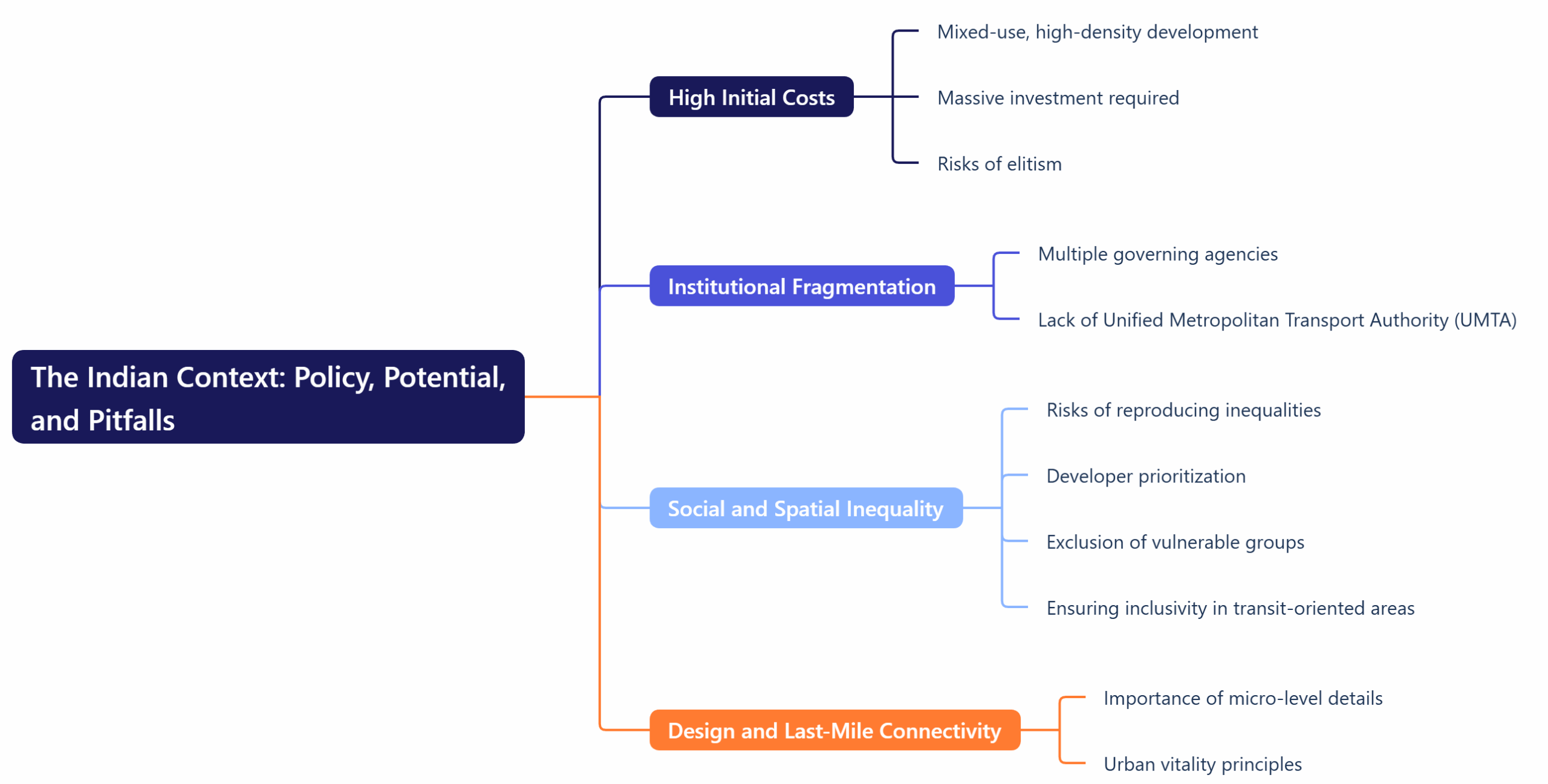
India’s urban story is at a crossroads. On one side lies the sprawling, congested, and car-dependent city — choked by pollution, fragmented by inequality, and defined by walls of gated communities. On the other stands the promise of Transit-Oriented Development (TOD): a model that seeks to integrate housing, mobility, and sustainability into a coherent urban vision. The inauguration of ‘Towering Heights’ in East Delhi — India’s first TOD project — signals more than architectural innovation; it represents a shift in how we imagine urban life itself. As the National Transit-Oriented Development Policy (2017) takes root, it’s worth exploring not just the policy and infrastructure dimensions, but also the sociological implications of TOD — for urban space, class, identity, and sustainability. What is Transit-Oriented Development (TOD)?At its core, Transit-Oriented Development is an urban planning model that promotes high-density, mixed-use development around public transport hubs such as metro or railway stations. The goal is to move away from the car-centric urban sprawl that has come to define many Indian metros, toward compact, walkable, and accessible neighbourhoods. The World Bank’s 3V Framework — Node, Place, and Market Value — highlights TOD’s multidimensional character. A station isn’t just a transport hub (node); it’s also a social and economic space (place) with development potential (market value). The integration of these three dimensions is key to creating what Henri Lefebvre called the “right to the city” — the idea that urban space should serve the people who inhabit it, not just those who profit from it. Why TOD Matters: The Urban Sociology Behind MobilityUrban sociology tells us that mobility is social power. As cities expand, access to jobs, services, and recreation increasingly depends on one’s ability to move efficiently. But India’s current pattern of growth has created mobility inequality — the wealthy commute in private cars, while the working poor spend hours navigating overcrowded buses or unsafe footpaths. TOD flips this model by putting people before vehicles. By concentrating housing, offices, schools, and markets near transit corridors, it democratizes access to urban opportunity. In doing so, it redefines mobility as a collective good rather than a private privilege. From a sustainability lens, TOD directly addresses the urban triad of sprawl, congestion, and pollution. Studies from cities like Stockholm and Singapore show that transit-linked, high-density growth can reduce emissions by over 30%, while improving productivity and social interaction. In an Indian context, where vehicular emissions account for up to 40% of urban air pollution, this shift could be transformative. Urban Sprawl and the Fragmented CityModern Indian cities have grown horizontally, not vertically. Car-centric planning, subsidized fuel, and fragmented governance have stretched cities far beyond their natural limits. As sociologist David Harvey argues, this form of urbanization serves the “circulation of capital” rather than the needs of residents. Land on the periphery becomes a site of speculative investment, while the urban poor are pushed further away from the economic core. TOD seeks to reverse this dynamic through vertical, compact growth within a 500–800 meter radius of transit stations. This not only optimizes land use but also revitalizes the social fabric of the city — fostering mixed-income, walkable communities. When successfully implemented, TOD can bridge the “urban divide” — the socio-spatial segregation that separates the formal, air-conditioned world of the metro from the informal settlements beyond its reach. The Indian Context: Policy, Potential, and Pitfalls
The National TOD Policy (2017) envisions compact, inclusive, and sustainable cities that reduce dependence on private vehicles. It aligns with policies such as the Metro Rail Policy (2017), Urban Infrastructure Development Fund (UIDF), and Multi-Modal Transport Hub (MMTH) initiative. Together, these aim to create a seamless mobility ecosystem that integrates housing, work, and transit. However, the Indian experience with TOD is layered with challenges:
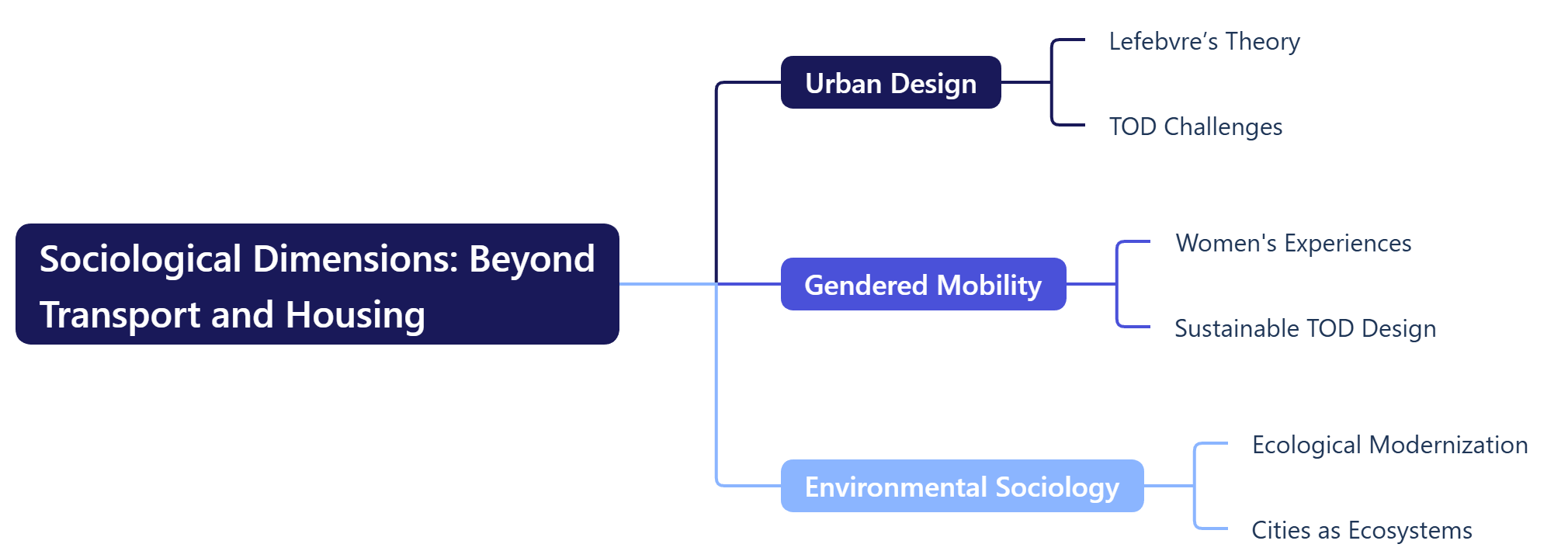
Global Lessons: Contextualizing the ModelCities like Hong Kong, Singapore, and Tokyo have demonstrated the success of TOD in dense urban environments. Their experiences show that TOD works best when land use, mobility, and housing are planned together under strong metropolitan governance. Sociological Dimensions: Beyond Transport and Housing
TOD is ultimately a social project, not merely a technical one. Its success depends on how it reshapes social relations, public spaces, and urban culture.
The Way Forward: Building the Sociological CityImplementing TOD in India requires not just engineering precision but sociological imagination. Policy reforms must ensure that compactness does not translate into congestion, and that density is matched with diversity. Key steps include:
Conclusion: The Future of Urban India Lies on the TracksTransit-Oriented Development represents a paradigm shift — from fragmented expansion to integrated urbanism, from private mobility to collective accessibility, from profit-driven construction to people-centered design. As India urbanizes — with nearly 50% of its population projected to live in cities by 2050 — the success of TOD will depend not only on technical precision but also on social vision. It must balance the economic logic of land with the human logic of community, ensuring that every metro line is also a lifeline of equality. In the words of Lefebvre, “The right to the city is not merely a right of access to what already exists, but a right to change it.” |
To Read more topics, visit: www.triumphias.com/blogs
Read more Blogs:
Birsa Munda and the Legacy of India’s Tribal Resistance: Remembering the Real “Dharti Aaba”
AI in the Classroom: A Sociological Reflection on India’s New Curriculum
One comment