
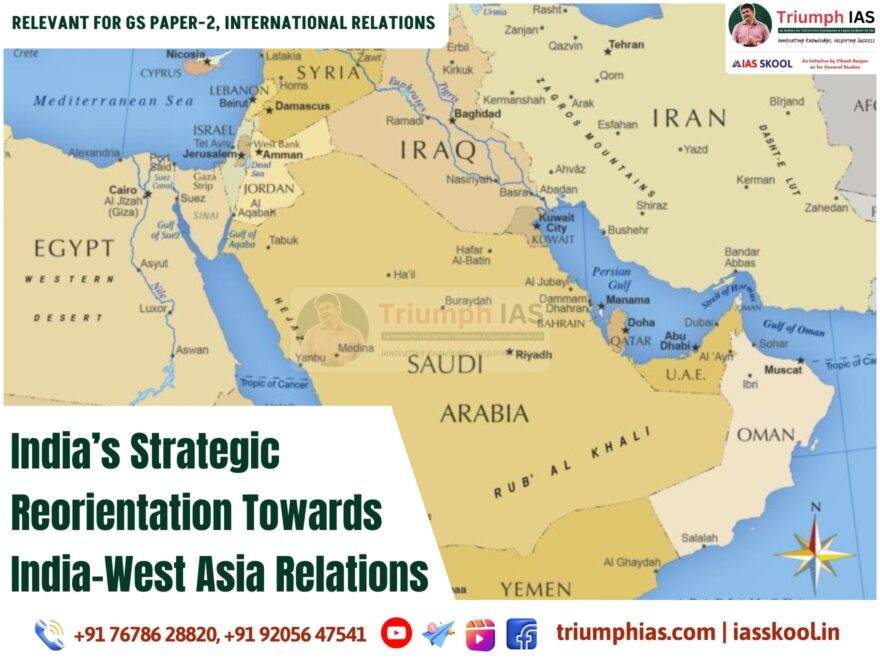
India’s Strategic Reorientation Towards
India-West Asia Relations
(Relevant for GS paper-2, International Relations)
India’s engagement with West Asia has evolved significantly, transitioning from a historically peripheral association to a strategic partnership. This transformation is driven by multifaceted interests encompassing energy security, economic collaboration, defense cooperation, and the welfare of the Indian Diaspora. The “Link West” policy epitomizes this strategic shift, aiming to bolster India’s influence and foster mutually beneficial relationships in the region.
Historical Context and Evolution
India’s ties with West Asia are deeply rooted in ancient trade routes and cultural exchanges. Post-independence, India’s foreign policy was characterized by non-alignment, maintaining neutral relations with West Asian nations while supporting causes like Palestinian statehood. The economic liberalization of the 1990s marked a turning point, leading to enhanced economic and diplomatic engagements, particularly in energy trade and labor migration.
Economic and Energy Interdependence

Trade Relations:
West Asia has emerged as a pivotal economic partner for India. In the fiscal year 2023-24, bilateral trade with the United Arab Emirates (UAE) reached $84 billion, while trade with Saudi Arabia stood at $43 billion . The India-UAE Comprehensive Economic Partnership Agreement (CEPA) aims to elevate non-oil trade to $100 billion by 2030.
Energy Security:
The region is instrumental in ensuring India’s energy security, supplying over 50% of its crude oil imports. Countries like Saudi Arabia, Iraq, and Qatar are key suppliers. Notably, a 20-year LNG agreement with Qatar, signed in February 2024, accounts for 38% of India’s LNG imports
Strategic and Defense Collaborations

Defense Partnerships:
India has strengthened defense ties with several West Asian nations. Collaborations include joint military exercises, defense manufacturing, and intelligence sharing. In 2023, India conducted trilateral naval exercises with France and the UAE, enhancing maritime security in the region .
Infrastructure and Connectivity:
Projects like the India-Middle East-Europe Economic Corridor (IMEC) and the development of Iran’s Chabahar Port under the International North-South Transport Corridor (INSTC) are strategic initiatives aimed at improving connectivity and trade routes .
Diaspora and Cultural Ties
The Indian diaspora in West Asia, numbering over 9 million, plays a crucial role in strengthening bilateral relations. Remittances from this community significantly contribute to India’s economy, and their presence fosters cultural and people-to-people connections .
Navigating Geopolitical Dynamics
India’s foreign policy in West Asia requires a delicate balance amid regional tensions. While deepening ties with countries like Israel and Saudi Arabia, India maintains its relationship with Iran, navigating complex geopolitical landscapes . Additionally, China’s expanding influence through initiatives like the Belt and Road Initiative presents both challenges and opportunities for India in the region .
Future Prospects and Policy Recommendations

To further solidify its position in West Asia, India should consider the following strategies:
- Diversify Energy Sources: While maintaining strong ties with traditional energy partners, India should explore renewable energy collaborations to align with global sustainability goals.
- Enhance Economic Engagement: Pursue comprehensive economic agreements with more West Asian countries to boost trade and investment.
- Strengthen Defense Cooperation: Expand joint military exercises and defense technology sharing to enhance regional security.
- Leverage Diaspora Networks: Engage the Indian diaspora in cultural diplomacy and economic initiatives to deepen bilateral ties.
- Engage in Multilateral Forums: Actively participate in regional organizations and dialogues to address shared challenges and promote stability.
Conclusion
India’s renewed focus on West Asia reflects a strategic recalibration aimed at fostering robust partnerships that serve mutual interests. By leveraging historical ties, economic interdependence, and strategic collaborations, India is poised to play a pivotal role in shaping the future of West Asia. Continued engagement, adaptability, and proactive diplomacy will be key to navigating the complexities of the region and achieving long-term objectives.
India-West Asia relations, India energy security, India UAE trade, India Saudi trade, India-Qatar LNG, India defense collaboration, India Middle East Europe Corridor, India Chabahar Port, India diaspora, India geopolitical strategy
PYQsPaper 1
Paper 2
|

To Read more topics like A Sociological Insight for SECC vs. Caste Census in Public Posts, visit: www.triumphias.com/blogs
Read more Blogs:
One comment