
India Needs a Green Fodder Revolution: A Sociological Reflection on Livelihoods, Ecology, and Rural Change
(Relevant for Sociology Paper 2: Rural and Agrarian transformation in India)
When the Grass Runs DryIndia’s rural economy has long been sustained by a quiet revolution — dairying. The country now produces nearly 24% of the world’s milk, engaging over 70 million farmers, and contributing to one-third of rural household incomes. Yet, beneath this success story lies a growing ecological and social crisis: a severe green fodder shortage that threatens to erode decades of progress in rural development and nutrition. At first glance, this appears to be an agricultural or economic problem. But from a sociological lens, it reveals deeper questions about ecological imbalance, social inequality, and the transformation of rural livelihoods. As India faces a deficit of up to 32% in green fodder and 40% in concentrated feed, we are not only witnessing an agricultural shortfall — we are confronting a crisis of social structure and sustainability. The Sociological Importance of FodderFodder is not merely animal feed; it is what sociologist Ruth Harrison might have called the “invisible infrastructure of rural life.” In India, livestock rearing is deeply embedded in agrarian social relations — kinship, caste, gender roles, and local ecologies. For small and marginal farmers, often owning just two or three dairy animals, milk serves as a daily income source, a safety net during crop failures, and a means of social mobility. M.N. Srinivas’s concept of “Sanskritisation” finds a modern reflection here: dairy income has allowed many lower-caste and land-poor families to climb the social ladder, educating children and gaining economic autonomy. A fodder crisis, therefore, is not simply about declining milk yields — it strikes at the heart of rural social reproduction. When fodder prices soar, smallholders sell their livestock, lose daily income, and slide back into economic precarity. The breakdown of dairy livelihoods weakens what André Béteille called the “interdependence of caste, class, and occupation” that sustains village life. Understanding the Fodder Gap: A Structural ProblemAccording to government estimates, India faces:
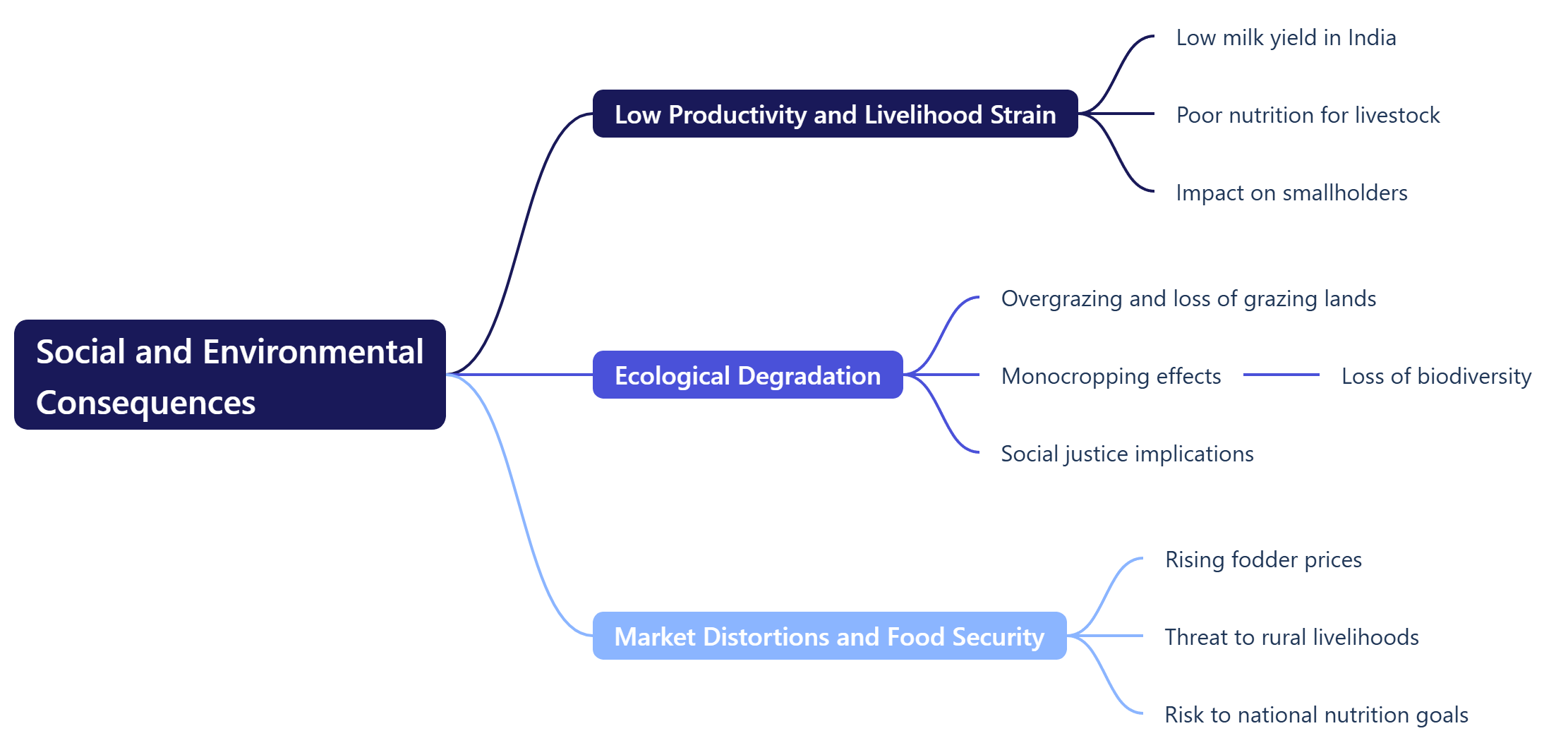
This crisis is particularly severe in Uttar Pradesh, Bihar, and Rajasthan, where livestock density is high but fodder production lags behind. From a structural-functional perspective, Émile Durkheim’s theory of social equilibrium helps explain the disruption. Just as society requires balance among its institutions, the rural ecosystem depends on harmony between crop cultivation, livestock rearing, and land use. Rapid urbanization, highway projects, and industrial zones have disrupted this equilibrium by encroaching upon grazing lands and commons that once sustained livestock. At the same time, climate change — through erratic rainfall and droughts — has further destabilized seasonal fodder crops like berseem and maize. The loss of these ecological buffers produces what Ulrich Beck termed a “risk society”: a condition where progress (industrialization, urbanization) creates new risks for the very groups it once uplifted. Economic Marginalization and the Agrarian QuestionThe Marxian perspective on the agrarian question offers insight into why the fodder crisis persists despite India’s agricultural growth. Modernization has prioritized commercial crops, export-oriented agriculture, and industrial feed production over traditional fodder cultivation. This reflects capitalist commodification of agriculture — where land and resources are diverted toward profitable uses, marginalizing subsistence practices. Crop residues like paddy straw are now used in packaging and biofuel industries, leaving little for animals. As a result, small farmers face both ecological and market vulnerability. When fodder becomes scarce, the rural poor face what Marx might call “primitive accumulation” — being dispossessed of the means of livelihood (livestock) and pushed into wage dependency. Thus, fodder scarcity reproduces agrarian inequality, widening the gap between corporate dairy players and smallholders. Social and Environmental Consequences
India’s per-animal milk yield remains among the lowest globally, largely due to poor nutrition. For a smallholder, even a one-litre drop in milk yield per day can mean losing vital household income. This economic strain extends to gendered labour relations — as women, who perform most of the fodder collection and animal care, face increased workloads.
Overgrazing, loss of grazing lands, and monocropping have reduced soil fertility and biodiversity. Ramachandra Guha’s environmental sociology reminds us that ecological crises in India are deeply intertwined with social justice — those least responsible for degradation suffer its worst effects.
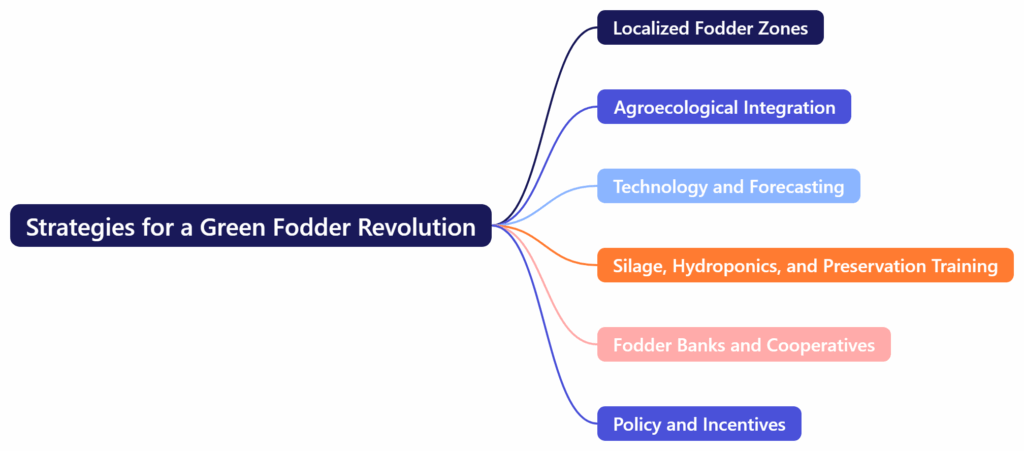
Rising fodder prices make dairy production costlier, threatening both rural livelihoods and national nutrition goals. Milk — a crucial source of protein for millions — risks becoming unaffordable, echoing Amartya Sen’s argument that famine and food crises often stem not from absolute scarcity, but from unequal access and entitlement. Why a “Green Fodder Revolution” MattersThe first Green Revolution (1960s) transformed India’s grain production but also led to regional inequalities, groundwater depletion, and input dependence. The call for a Green Fodder Revolution today is not just about increasing fodder yield — it’s about restructuring rural sustainability. Sociologically, it represents a movement from extractive modernisation to ecological modernization, where technology and policy aim to restore balance between environment, economy, and society. Strategies for a Green Fodder Revolution
From the White Revolution to the Green Fodder RevolutionJust as the White Revolution turned India from a milk-deficient nation to the world’s dairy leader, the next leap must address the foundation of that success — feed security. But unlike past revolutions driven by chemical intensification, the Green Fodder Revolution must be ecologically grounded and socially inclusive. As Talcott Parsons might argue, every social system requires adaptation to new environmental conditions to maintain equilibrium. The fodder crisis is thus not only a policy challenge but a test of India’s adaptive capacity as a society — its ability to balance growth with sustainability, and efficiency with equity. Conclusion: Reimagining Rural FuturesIndia’s fodder crisis is a reminder that agricultural progress cannot be separated from its social and ecological context. The “Green Fodder Revolution” must not only aim to increase supply but to restore harmony between humans, animals, and the environment — what sociologist Radhakamal Mukerjee described as the essence of “social ecology.” A truly sustainable rural transformation will ensure that no farmer sells their cattle for want of grass, no child goes malnourished, and no pasture lies barren. |
To Read more topics, visit: www.triumphias.com/blogs
Read more Blogs:
Children, Capital, and Control: A Sociological Lens on India’s Paediatric Drug Regulation Crisis