

Revitalizing India Investment Landscape through Reforms
(Relevant for GS Paper-3, Growth and Development)
IntroductionIndia, one of the world’s fastest-growing major economies, has been undergoing continuous economic transformation, with a renewed focus on improving its investment climate. As global investors seek stable, large-scale opportunities, India stands out with a vast market, demographic dividend, digital infrastructure, and reform-driven policies. Over the past decade, significant efforts have been made to liberalize the economy, simplify regulations, and attract both domestic and foreign investments. Current State of India Investment LandscapeFDI InflowsAs per the Department for Promotion of Industry and Internal Trade (DPIIT), India received USD 70.97 billion in Foreign Direct Investment (FDI) during FY 2022–23. Despite global economic uncertainties, India remains among the top five global FDI recipients (UNCTAD, World Investment Report 2024). Sectoral Performance
The emergence of digital services, semiconductors, renewables, and manufacturing as investment hotspots reflects India’s changing economic architecture. Government Initiatives and Reforms
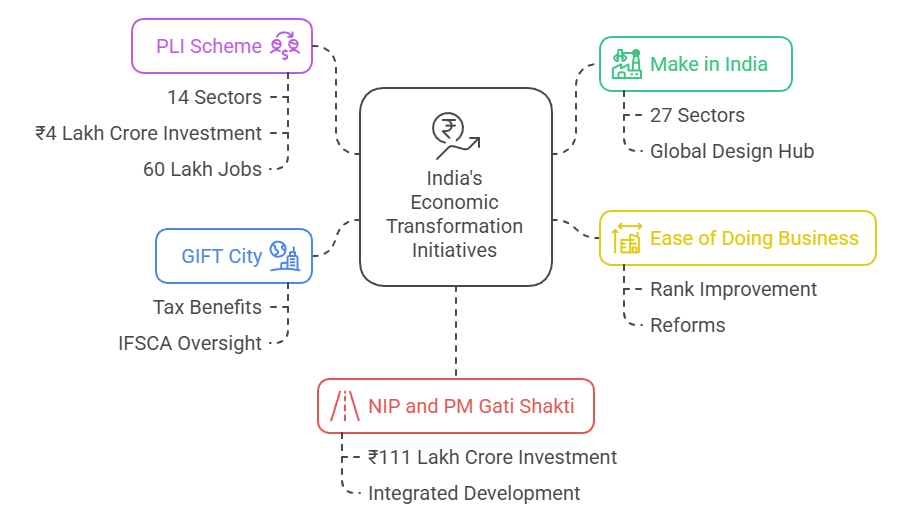
Launched in 2014, it aims to transform India into a global design and manufacturing hub. It covers 27 sectors including electronics, defense, textiles, and automobiles.
The PLI scheme for 14 sectors, including electronics, pharma, solar PV modules, and textiles, is estimated to attract ₹4 lakh crore in investments and create over 60 lakh jobs.
The Gujarat International Finance Tec-City (GIFT City) is emerging as a global financial hub offering tax benefits and a robust regulatory environment. The International Financial Services Centres Authority (IFSCA) oversees its operations, promoting fintech, insurance, and capital markets.
Recent Developments and Reforms (2023–2025)
The India Semiconductor Mission (ISM) received a boost with companies like Micron, Tata Electronics, and AMD investing over ₹76,000 crore collectively in fabrication and packaging units.
India is attracting major green finance inflows:
Unveiled during the G20 Summit 2023, IMEC is expected to enhance India’s role in global trade and boost investment in logistics, ports, and connectivity infrastructure. Challenges in the Investment Climate
Despite progress, several challenges persist:
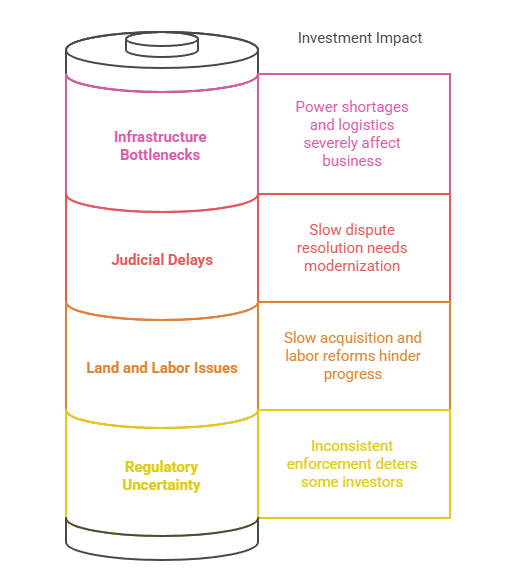
Inconsistent enforcement and overlapping jurisdictions deter some investors.
Land acquisition remains slow, and labor reforms are yet to be fully implemented across all states.
Dispute resolution mechanisms, particularly in commercial courts, need modernization and faster disposal rates.
Power shortages, logistics delays, and urban planning challenges continue to affect ease of doing business in smaller towns and rural areas. Global Positioning and Geopolitical OpportunitiesIndia’s role as a trusted supply chain partner in the post-COVID world and amid US-China trade tensions has enhanced its global investment appeal. India as a China Plus One Destination Companies seeking to diversify away from China have started investing in India, especially in electronics, pharma APIs, and textiles. Bilateral Trade Agreements
Way Forward
To maintain momentum and further improve India’s investment ecosystem, the following steps are critical:
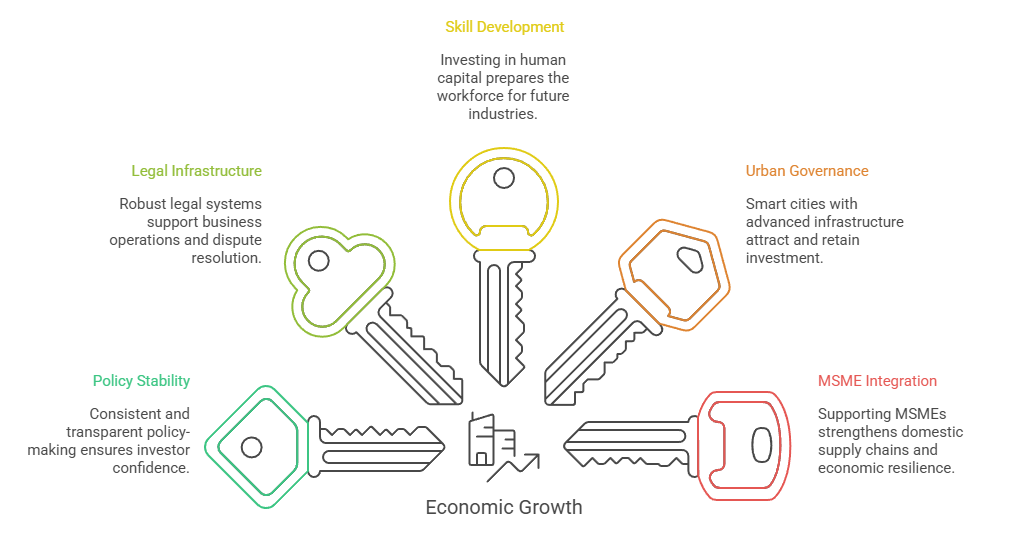
Ensure consistent and transparent policy-making, especially in taxation and trade.
Boost alternative dispute resolution (ADR), arbitration, and commercial courts.
Investment in human capital to meet the demands of emerging sectors like semiconductors, AI, and clean tech.
Develop more investor-friendly smart cities with better civic infrastructure, digital connectivity, and sustainability features.
Facilitate easier credit, digital inclusion, and tech adoption among MSMEs to build resilient domestic supply chains. ConclusionIndia’s investment climate has matured significantly, marked by robust macroeconomic fundamentals, proactive governance, and sectoral reforms. As the country aspires to become a $5 trillion economy, targeted interventions in infrastructure, innovation, and regulatory ease will be essential to attract long-term, sustainable investments. With a stable democracy, digital-first approach, and strong consumer base, India is poised to be a key investment destination in the 21st century. |
To Read more topics, visit: www.triumphias.com/blogs
One comment