Introduction: India Demographic
India, now recognized as the world’s most populous nation, has reached a historic population milestone. According to the United Nations Population Fund (UNFPA) “State of the World Population 2025” report, India’s population stands at 146.39 crore (1.4639 billion) as of April 2025. However, what’s more significant is the decline in India’s total fertility rate (TFR) to 1.9, dropping below the replacement level of 2.1. This marks a crucial turning point in India’s demographic story and brings forth multiple sociological and policy challenges.
Key Highlights:
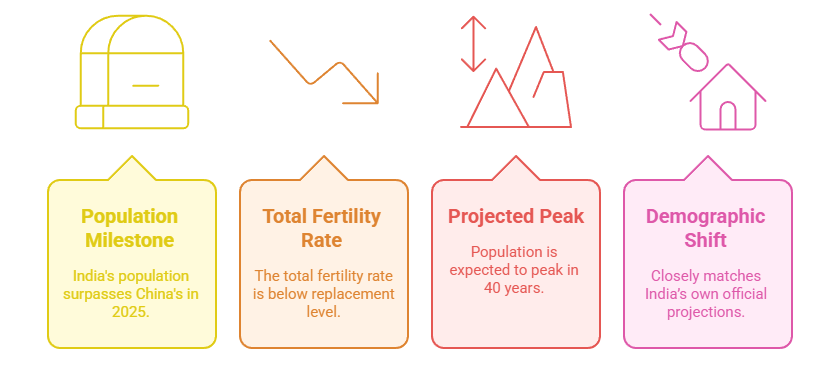
- Population Milestone: 146.39 crore (2025), surpassing China (141.61 crore)
- Total Fertility Rate (TFR): 1.9 (below replacement level of 2.1)
- Projected Peak: Expected to reach 170 crore in ~40 years before starting to decline
- Demographic Shift: Closely matches India’s own official projections
Sociological Analysis:
- Demographic Transition and the Ageing Population: Demographic Transition Theory, proposed by Warren Thompson and further developed by Frank Notestein, explains India’s move to a low stationary stage, marked by low birth and death rates. Emile Durkheim’s concept of social integration becomes relevant here—he argued that rapid demographic changes can lead to social disorganization if institutions do not adapt quickly. The rising proportion of elderly, as seen in India’s demographic shift, underscores the importance of functionalist approaches (Parsons), where family and state need to recalibrate roles to ensure social stability and care for the aged.
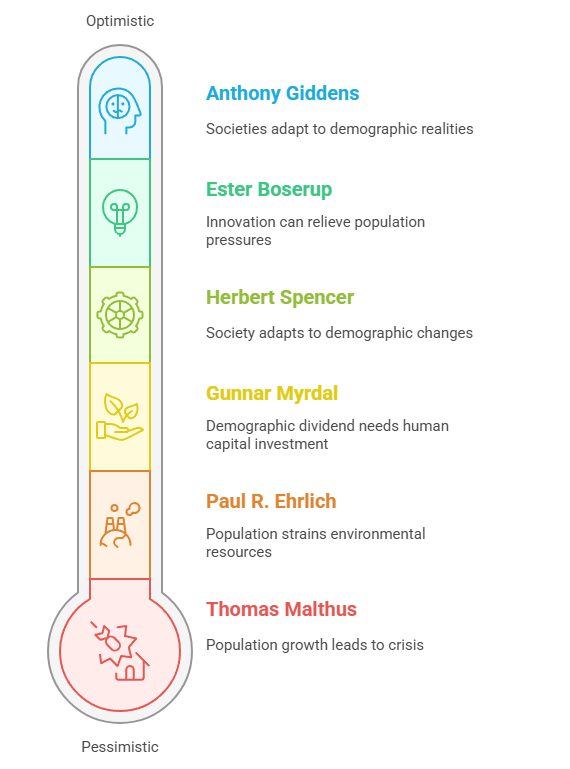
- The End of the Youth Bulge and Demographic Dividend: India’s demographic dividend echoes Herbert Spencer’s and Talcott Parsons’ ideas of social system adaptation: a large youth population contributed to economic growth, but as fertility declines, adaptation in education, healthcare, and the economy is necessary. Gunnar Myrdal, in Asian Drama, warned that without proper investment in human capital, the demographic advantage could become a “demographic burden.” The transition also reflects Kingsley Davis’ observations on population policy and its social consequences.
- Socio-Economic and Policy Implications: This demographic shift is a classic example of the structural-functional perspective (Parsons), where society’s institutions—like health and welfare systems—must evolve to maintain equilibrium. Amartya Sen’s capability approach is also relevant: as fertility falls, expanding women’s access to education, health, and employment enhances their agency, contributing to overall development. Sylvia Walby’s theory of gender regimes can help analyze how declining fertility and women’s empowerment challenge patriarchal norms within Indian society.
- Comparative Perspective: India vs. China: Paul R. Ehrlich’s Population Bomb and the “one-child policy” in China demonstrate the potential social costs of coercive population control: skewed sex ratios and rapid population ageing, as noted by Amartya Sen in his studies on “missing women.” In contrast, India’s gradual demographic transition allows for policy learning and course correction, supporting Anthony Giddens’ idea of reflexive modernity—where societies consciously adapt to demographic realities with more nuanced, gender-equitable approaches.
- Malthusian and Neo-Malthusian Perspectives: Thomas Malthus’ theory posited that unchecked population growth would outstrip resources, but India’s transition to below-replacement fertility supports Ester Boserup’s counter-view: technological advancement and social innovation can mitigate population pressures. Neo-Malthusians, like Paul Ehrlich, remain concerned about environmental limits, underscoring the need for sustainable development—a theme echoed by Ulrich Beck’s Risk Society, which stresses the interconnectedness of demographic, environmental, and technological risks.
- Changing Family and Kinship Patterns: The trend towards nuclear families is explained by William Goode’s World Revolution and Family Patterns, which associates industrialization and modernization with a shift away from joint families. Ann Oakley’s feminist perspective highlights how caregiving, especially for the elderly, continues to be gendered, often increasing the burden on women as family structures evolve. This underscores the need for new policies to address gender inequality within the care economy, as also pointed out by Nancy Folbre’s work on the economics of care.
Policy Challenges and the Road Ahead
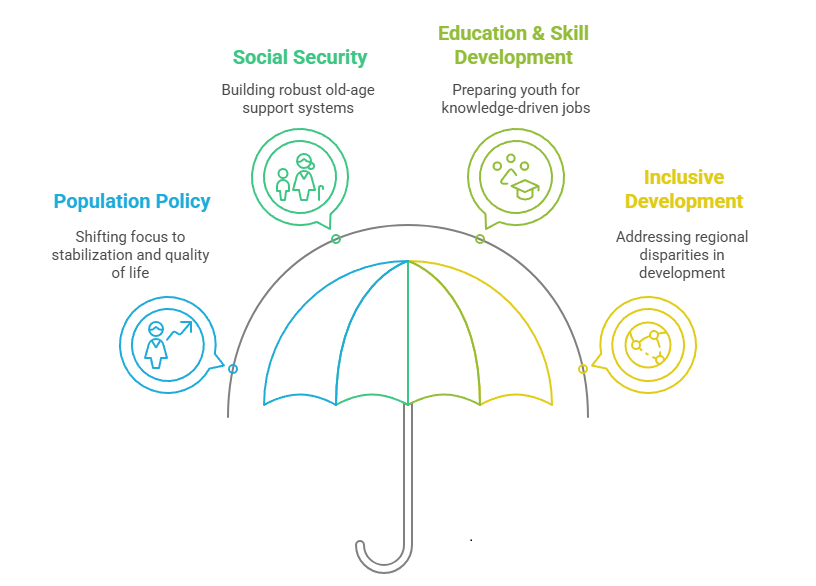
- Population Policy: Focus must shift from population control to population stabilization, quality of life, and harnessing the demographic dividend.
- Social Security: Urgent need to build robust old-age support systems.
- Education & Skill Development: Preparing youth for knowledge-driven jobs before the workforce starts shrinking.
- Inclusive Development: Address regional disparities—fertility rates and population trends still vary sharply across states.
Conclusion
India’s demographic story is at a critical inflection point. While fears of a “population explosion” are now outdated, new sociological and policy challenges are on the horizon: an ageing population, shrinking workforce, and the need for social security reforms. The focus should now be on sustainable development, gender empowerment, and inclusive growth.
PYQs
Paper I:
- Examine the demographic transition theory. Explain the stages of demographic transition with suitable examples from India. (2022)
- What is meant by demographic dividend? Discuss the opportunities and challenges associated with demographic dividend in India. (2021)
- Discuss the implications of declining fertility and increasing longevity for the institution of family in India. (2020)
- Examine the impact of falling fertility rates on gender roles and women’s empowerment in society. (2019)
- How does population ageing affect family and kinship structures in modern societies? (2019)
- How do demographic factors influence social change? Illustrate with suitable examples. (2018)
- Explain the consequences of declining fertility rate in developing societies. (2017)
- Discuss the relationship between population growth and economic development with reference to Malthusian and Neo-Malthusian perspectives. (2016)
- Write short notes on: “Changing age structure and its social implications.” (2016)
- Assess the relevance of Malthusian theory of population in the contemporary context. (2015)
Paper II:
- Critically examine the demographic profile of India. How does it affect social structure and development? (2023)
- How has the decline in fertility rate impacted the Indian family system and kinship relations? (2021)
- Describe the regional variations in demographic transition in India and its implications for policy making. (2020)
- Discuss the major demographic trends in India since Independence. How have they affected patterns of urbanization and migration? (2018)
- Evaluate the impact of demographic dividend on India’s socio-economic development. (2016)
- Discuss the social implications of the increasing proportion of elderly in the Indian population. (2019)
- How has the state responded to the challenges of population explosion and ageing in India? (2017)
- Discuss the impact of changing sex ratio and fertility patterns on gender relations in India. (2015)
|

One comment